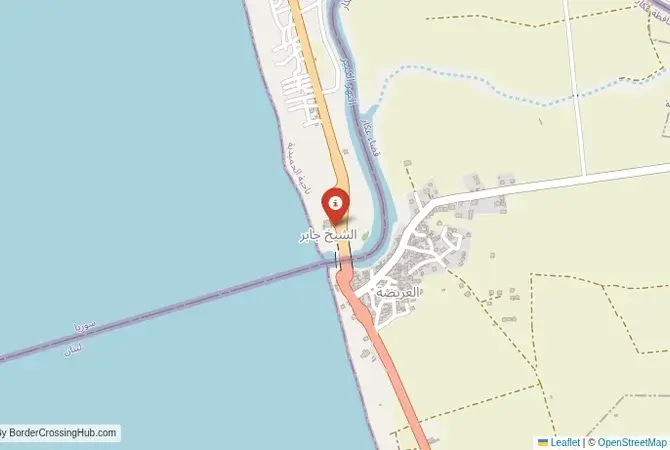
Monthly Update (November 2026):
Reconstruction at the Arida–Tartus crossing has reached its final stages, with reopening now expected in December. The November 16 update confirmed that the replacement bridge is nearing completion, alongside new passenger facilities, separate freight areas and upgraded customs equipment. Ordinary vehicle movement has not yet resumed, although limited pedestrian access for eligible Syrians has previously been permitted. The reopening of nearby Abboudieh–Dabousieh on November 9 has meanwhile restored another route between northern Lebanon and Syria.
Driving there, or sending a driver? Send them this guide.
For reports and websites
Cite this page
Border Crossing Hub (2026). Arida & Tartus Border Crossing. Updated November 2026. https://bordercrossinghub.com/arida-tartus-region-border-crossing/<a href="https://bordercrossinghub.com/arida-tartus-region-border-crossing/">Arida & Tartus Border Crossing (Border Crossing Hub)</a>Put this crossing's card on your website
Free. It updates on its own when our information changes.
<iframe data-bch-card src="https://bordercrossinghub.com/arida-tartus-region-border-crossing/?bch_view=card" width="100%" height="980" scrolling="no" style="border:0;max-width:480px;display:block" loading="lazy" title="Arida & Tartus border crossing information"></iframe>
<p style="font-size:12px;margin:4px 0 0">Crossing information: <a href="https://bordercrossinghub.com/arida-tartus-region-border-crossing/">Border Crossing Hub</a></p>
<script src="https://bordercrossinghub.com/?bch_embed_js=1" async></script>Paste it where you want the card. The last line (a script) only adjusts the height and can be left out.
About this crossing
A History as a Strategic Coastal Corridor
The coastal plain has been a primary route for armies, traders, and civilizations for thousands of years. The modern border at Arida was a relatively soft frontier for much of its history, facilitating the close economic and social links between the Sunni communities of northern Lebanon and the Alawite-dominated coastal region of Syria. The port cities of Tripoli and Tartus have long-standing connections. The Syrian civil war made this crossing's role even more critical. While the Tartus and Latakia governorates remained relatively stable government strongholds, the Arida crossing became a key gateway for goods, humanitarian aid, and individuals moving between Lebanon and these areas. Its continued operation has been a priority for both states, ensuring a degree of economic continuity even amidst the wider national collapse in Syria.
The Border Crossing Procedure: Formal and Thorough
As a primary international crossing, the procedure at Arida is more established than at smaller checkpoints, but it is still a lengthy and security-focused process. Expect it to take several hours. Leaving Lebanon (Arida): You will first approach the Lebanese General Security post. Here, you will have your passport stamped for exit. Lebanese Customs will also have a checkpoint for inspecting vehicles and goods. The Lebanese Army presence in the entire Akkar region is substantial, and you will have passed through multiple checkpoints already. Entering Syria (Al-Arida): On the Syrian side, the process is multi-layered and requires a visa, now often available on arrival at land borders from Lebanon for many nationalities (with fees applied since July 2025, varying by reciprocity, typically payable in USD; confirm current fees and eligibility).1. Initial Check: Your passport and visa will be inspected at an initial security post.2. Immigration Hall: You must go to the main immigration building to have your documents processed. This involves a potentially long wait while your details are run through various security databases. You will likely be questioned by officials.3. Customs Declaration and Inspection: You must declare any valuable items. Your vehicle and all luggage will undergo a thorough inspection. For those driving a private car, a complex temporary import procedure, known as a "trip-ticket," must be completed, which involves significant fees and paperwork.4. Final Clearance: Your documents will be checked again upon exiting the border complex before you can proceed north towards Tartus.
The Route and Regional Context
The highway on both sides of the Arida crossing is a major coastal road. On the Lebanese side, it is the main artery connecting Tripoli to the northern border. On the Syrian side, the highway continues north, passing near the city of Tartus (home to a major Russian naval base) and on to Latakia. While the Syrian coast has been more insulated from the conflict than the interior, it is still a country at war. The security presence is immense, with numerous checkpoints along the highway manned by various military and intelligence branches. Movement is tightly controlled. For any foreigner, traveling this route would feel like moving through a high-security military zone. The landscape is a mix of agricultural plains and the Mediterranean coast, but the atmosphere is heavy with the signs of conflict.
Final Contextual Analysis
The Arida crossing is a vital link in a fractured region. It is a formal gateway that has managed to maintain a high volume of commercial and civilian traffic despite the war, largely due to the strategic importance of the Syrian coastal region. However, it is not a normal border crossing. The procedures are intrusive, the security presence is overwhelming, and it leads directly into a country where a devastating conflict continues. It serves as a powerful example of how essential infrastructure can be maintained in a warzone, but it remains, without question, a frontier that independent travelers must avoid for their own safety.
Nearby Border Crossings


Heading to Arida & Tartus? Take this with you.
One page with the hours, waits, emergency numbers and coordinates. Works without signal.
Practical information
Fuel
Lebanon: <1 km - Syria: <1 km
Currency
Near Arida; LBP, SYP
Safety information
High risk; volatile security conditions
Connectivity
Wi-Fi, 4G
Have you crossed here?
Help other travelers by sharing your experience, wait times, and any updates.