Monthly Update (October 2026):
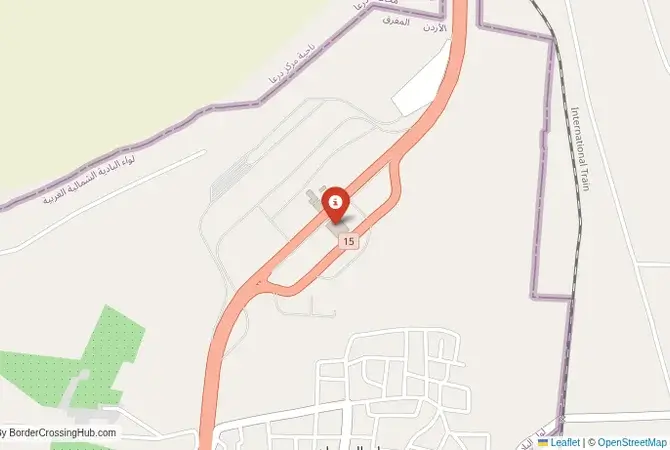
Jaber & Nassib is seeing infrastructure work on both sides of the border this October. Syria has begun a roughly 100-kilometer rehabilitation project on the Nasib–Damascus highway, while Jordan is developing a new truck area at Jaber capable of holding around 200 loaded trucks. Commercial traffic has been moving more slowly through the Syrian side during expansion work, although the crossing itself remains open.
About this crossing
Operational Details
This checkpoint connects the Daraa Governorate of Syria with the Mafraq Governorate of Jordan. It is a massive, 24/7 international facility, designed to handle a huge volume of commercial freight. The crossing is the primary route for goods moving from Lebanon and Syria to Jordan and onwards to the Gulf states. It is also a key route for Jordanian exports to Syria and Turkey. The facility is large on both sides, but it can be very congested, and the procedures can be slow and bureaucratic, a legacy of the years of conflict and the ongoing security concerns.
A History of a Conflict Frontier
The history of this region is the history of the Hauran plain, a fertile agricultural area that has been a crossroads of civilizations for millennia. The modern border was established by the French and British Mandates after World War I. The crossing grew in importance as a major trade hub. The outbreak of the Syrian Civil War in 2011, which began in the nearby city of Daraa, transformed the region. The crossing was captured by rebel forces in 2015, severing the main highway and forcing trade to be rerouted at enormous cost. The Syrian government, with Russian support, recaptured the crossing in 2018, and it was officially reopened later that year. It remains a place of high security and political sensitivity.
Nearby Border Crossings



The Border Crossing Procedure
The border crossing procedure is a complex, multi-stage, and often very slow process. You will need a valid passport and visas for both countries, which must be obtained in advance. You will first complete exit formalities at one country's checkpoint, which involves multiple stops for passport control, customs, and security checks. You will then proceed to the other country's checkpoint for their entry inspection. The checks are very thorough on both sides, reflecting the high-security nature of the location. Be prepared for a long, bureaucratic, and potentially stressful experience. The process can take many hours.
The Surrounding Region: Syria Side
On the Syrian side, the crossing is in the Daraa Governorate, the cradle of the 2011 uprising. The region has been devastated by the war, and the security situation remains volatile, with ongoing instability and unrest. The nearby city of Daraa has a rich history, with a beautiful Roman-era amphitheater in the nearby city of Bosra, a UNESCO World Heritage site. However, the entire region is a high-risk zone.
The Surrounding Region: Jordan Side
On the Jordanian side, the crossing is in the Mafraq Governorate. The area is home to the massive Zaatari refugee camp, one of the largest Syrian refugee camps in the world. The road from the border leads towards the capital city, Amman. The region is known for its "desert castles," a series of beautiful and unique early Islamic palaces and hunting lodges that are scattered throughout the eastern desert. The ancient Roman city of Jerash, one of the best-preserved Roman provincial cities in the world, is also accessible from this route.
Practical Travel Information
Travel on this route is not possible for independent tourists. The entire region is a high-risk security zone. The official currencies are the Syrian Pound (SYP) in Syria and the Jordanian Dinar (JOD) in Jordan. Any travel would have to be part of an official, heavily guarded convoy or delegation. The risks of kidnapping, terrorism, and being caught in crossfire are extremely high, particularly on the Syrian side.
Final Considerations
The Nassib–Jaber border crossing is the most vital economic artery between Syria and Jordan. It is a place of immense strategic importance that operates under the constant shadow of war and instability. Its closure and reopening have been major events in the Syrian conflict. It is a border that is a testament to the resilience of the traders and truck drivers who keep the regional economy alive. It is a journey through a beautiful and historic land, but one that is fraught with danger, a powerful symbol of the tragic and enduring conflicts of the modern Middle East.
View all border crossings between Syria and JordanPractical information
Fuel
Syria: 500 m - Jordan: 500 m
Currency
Near Jaber; SYP, JOD
Safety information
Orderly; watch for fraud
Connectivity
Wi-Fi, 4G
Have you crossed here?
Help other travelers by sharing your experience, wait times, and any updates.