Monthly Update (September 2026):
Ramtha remains a functioning Syria-Jordan border point, but it is primarily a cargo crossing rather than the normal choice for international visitors. Jordan's official tourism information currently lists Ramtha as open 24/7, with cargo accounting for most of its activity, while Jaber is the crossing normally used by visitors arriving from Syria. This makes Ramtha more relevant to freight and regional movement than independent tourism. Travelers planning a Syria-Jordan road trip should therefore check whether their specific passenger movement is accepted before heading to Ramtha.
About this crossing
Operational Details
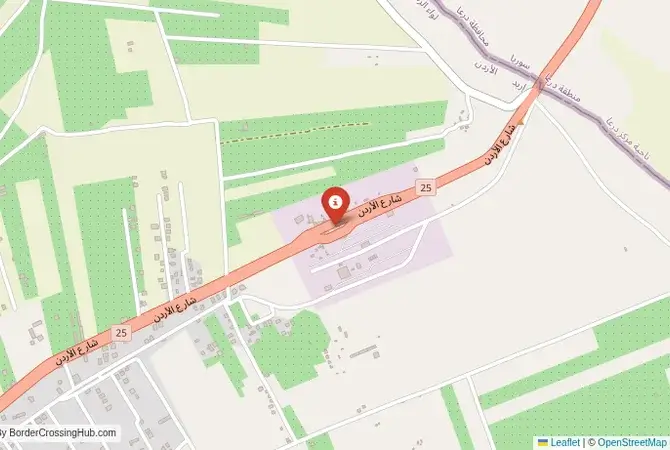
This checkpoint connects the Irbid Governorate of Jordan with the Daraa Governorate of Syria. It is a smaller international crossing, and its operational status has been highly volatile throughout the Syrian war. It has been closed for long periods and has sometimes been opened only for humanitarian cases or specific local traffic. The crossing is located directly between the two urban areas. When open, it serves the local communities, many of whom have family on both sides of the border.
A History of a Conflict Frontier
The history of this region is the history of the Hauran plain, a fertile agricultural area that has been a crossroads of civilizations for millennia. The modern border was established by the French and British Mandates after World War I. The towns of Ramtha in Jordan and Daraa in Syria grew up as closely linked market centers. The outbreak of the Syrian Civil War in 2011, which began in Daraa, transformed the region. The Ramtha crossing became a major entry point for hundreds of thousands of Syrian refugees fleeing the violence. The Jordanian city of Ramtha has been profoundly affected by the crisis, with its population swelling and its resources strained. The crossing has been a direct witness to the human cost of the war.
Nearby Border Crossings



The Border Crossing Procedure
The border crossing procedure, when the crossing is open, is a complex and highly secure process. You will need a valid passport and visas for both countries, which must be obtained in advance. You will first complete exit formalities at one country's checkpoint and then proceed to the other country's checkpoint for their entry inspection. The checks are very thorough on both sides, reflecting the high-security nature of the location. The process can be slow and unpredictable, and the crossing can be closed at a moment's notice.
The Surrounding Region: Jordan Side
On the Jordanian side, the crossing is in the city of Ramtha. Ramtha has been on the frontline of the humanitarian response to the Syrian crisis. The city is in the Irbid Governorate, the most fertile and populous region of Jordan. The nearby city of Irbid is a major university town. The magnificent Roman ruins of Umm Qais (ancient Gadara), with their stunning views over the Sea of Galilee and the Golan Heights, are also in this region.
The Surrounding Region: Syria Side
On the Syrian side, the crossing is in the Daraa Governorate, the cradle of the 2011 uprising. The region has been devastated by the war, and the security situation remains volatile, with ongoing instability and unrest. The nearby city of Daraa has a rich history, with a beautiful Roman-era amphitheater in the nearby city of Bosra, a UNESCO World Heritage site. However, the entire region is a high-risk zone, and travel is extremely dangerous.
Practical Travel Information
Travel on this route is not possible for independent tourists. The entire region is a high-risk security zone. The official currencies are the Jordanian Dinar (JOD) in Jordan and the Syrian Pound (SYP) in Syria. Any travel would have to be part of an official, heavily guarded convoy or delegation. The risks of kidnapping, terrorism, and being caught in crossfire are extremely high, particularly on the Syrian side.
Final Considerations
The Ramtha border crossing is a journey into the heart of the Syrian tragedy. It was once a simple local passage, a symbol of the deep, everyday connections between the people of the Hauran plain. Today, it is a symbol of a devastating war and a massive humanitarian crisis. It is a border that has been a witness to immense suffering and also to immense generosity. It is a powerful and poignant reminder of the human cost of conflict and the deep and enduring ties that even a brutal war cannot completely sever.
View all border crossings between Syria and JordanPractical information
Fuel
Syria: 2 km - Jordan: 2 km
Currency
Near Ramtha; SYP, JOD
Safety information
High risk; volatile border zone
Connectivity
Wi-Fi, 4G
Have you crossed here?
Help other travelers by sharing your experience, wait times, and any updates.