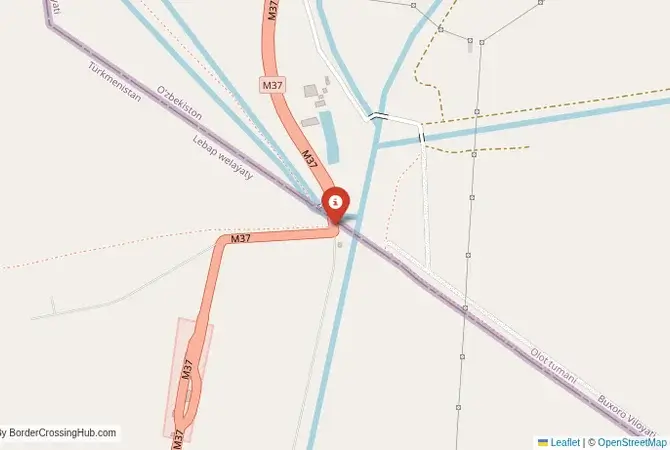
Monthly Update (September 2026):
Alat & Farap remains one of the main Uzbekistan-Turkmenistan road gateways, particularly for travelers moving between Bukhara and Turkmenabat. A September 3 report from Turkmenistan's transport authorities highlighted continued efforts to increase capacity at the Farap-Avtoyollary and Alat checkpoints after reconstruction led to higher vehicle volumes. The crossing is therefore handling more traffic than before, although there is no reported September closure. Foreign travelers should also remember that Turkmenistan requires visa arrangements in advance rather than issuing a normal walk-up tourist entry at the border.
About this crossing
Operational Details
This checkpoint connects Turkmenistan's Lebap Province with the Bukhara Region of Uzbekistan. It is a major international crossing, open to all passenger cars, buses, and commercial freight. The crossing is on a modern bridge over the Amu Darya. The facility is large, but the procedures, especially on the Turkmen side, are notoriously slow. It is the primary route for goods moving between the two countries and for the limited number of tourists who travel overland between the two Silk Road giants. The queues can be long, and the process can take many hours, with recent reports from 2025–2026 indicating average wait times of 3–5 hours for passengers and up to 12 hours for trucks during peak trade periods.
A History of a Great Oasis
The history of this region is the history of the great oasis cities of Central Asia. The nearby Uzbek city of Bukhara is one of the most perfectly preserved Islamic cities in the world, a UNESCO World Heritage site with a history of over 2,000 years. On the Turkmen side, the road leads towards the ancient city of Merv, another UNESCO site, which was one of the most important and populous cities in the world during the Islamic Golden Age. The modern border is a legacy of the Soviet administrative divisions. After independence, the border became a hard frontier, a reflection of Turkmenistan's policy of isolationism. While it is a major crossing, it is far from an open one.
Nearby Border Crossings


The Border Crossing Procedure
The border crossing procedure is a complex, multi-stage, and often extremely slow process, particularly on the Turkmen side. You will need a valid passport and valid visas for both countries, which must be obtained well in advance. A Letter of Invitation (LOI) is typically required for a Turkmen visa. Upon entering Turkmenistan, you will be required to pay numerous taxes and fees, including an entry tax, a vehicle disinfection fee, and a fuel compensation tax. The customs inspection is extremely thorough, with detailed searches of vehicles, luggage, and electronic devices. Be prepared for a long, bureaucratic, and often frustrating experience that can take half a day or more.
The Surrounding Region: Turkmenistan Side
On the Turkmen side, the crossing is near the city of Türkmenabat (formerly Chardzhou). The road from the border leads through the vast and arid Karakum Desert. The main destination for most travelers is the magnificent ruins of ancient Merv, a vast archaeological park with the remains of several ancient cities. The capital city, Ashgabat, known for its surreal, white marble architecture and its unique, authoritarian atmosphere, is a long drive across the desert.
The Surrounding Region: Uzbekistan Side
On the Uzbek side, the crossing is the gateway to the historic city of Bukhara. The old city of Bukhara is a living museum, with hundreds of mosques, madrasas, and caravanserais, all centered around the magnificent Poi Kalyan complex with its towering minaret. The city is a major center for traditional crafts, particularly carpets and suzani embroidery. The road from the border also leads to the legendary city of Samarkand, with its world-famous Registan square.
Practical Travel Information
Practical planning is absolutely essential for this route. You must have all your documents in perfect order. The official currencies are the Turkmen Manat (TMT) in Turkmenistan and the Uzbekistani Som (UZS) in Uzbekistan. Currency exchange on the black market is a complex issue in Turkmenistan. The road on the Turkmen side can be in very poor condition. Services are limited. Ensure your vehicle's Green Card insurance is valid, though you will likely need to purchase separate insurance for both countries.
Final Considerations
The Farap–Alat border crossing is a journey into the heart of the Silk Road. It is a challenging, bureaucratic, but ultimately rewarding passage for the well-prepared and patient traveler. It is a gateway to some of the most magnificent historical and architectural treasures in the world. It is a border that is a testament to the enduring legacy of the ancient trade routes and a powerful symbol of the unique and enigmatic character of modern Turkmenistan. It is a crossing that is not just a procedure, but an experience in itself.
View all border crossings between Turkmenistan and UzbekistanPractical information
Fuel
Turkmenistan: 500 m - Uzbekistan: 500 m
Currency
Near Farap; TMT, UZS
Safety information
Busy trade point; orderly
Connectivity
3G/4G mobile network
Have you crossed here?
Help other travelers by sharing your experience, wait times, and any updates.