Monthly Update (September 2026):
Giurgiu & Ruse remains a major Bulgaria-Romania Danube crossing, but travelers should be aware that bridge works are still affecting the route. Bulgarian authorities previously reported repair works on the bridge with traffic being regulated, while September traffic at Bulgaria's Romania crossings is otherwise described as normal. The bridge remains usable, but traffic control can add delays, particularly when overall road traffic is heavy. Travelers should allow extra time rather than treating this as a completely free-flowing motorway crossing.
About this crossing
Operational Details
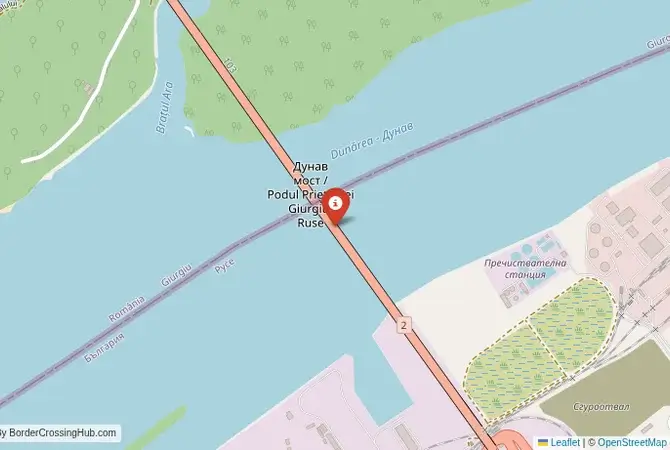
This checkpoint connects the Ruse Province of Bulgaria with Romania's Giurgiu County. It is a massive, 24/7 international corridor. The bridge has a lower deck for railway traffic and an upper deck for road traffic. It is a toll bridge, and the fee is collected at the checkpoint on the Romanian side. The facility is large, but it is often overwhelmed by the sheer volume of traffic, especially freight. It is the most direct route for goods moving from Turkey and Greece towards Central and Eastern Europe, and the queues for trucks are a permanent and legendary feature. Passenger cars can also face significant delays, especially during the summer; following full Schengen land accession on Jan 1, 2025, no systematic border controls apply, with only toll payment and occasional random checks per Romanian Border Police; recent data from politiadefrontiera.ro shows average waits 0-29 minutes typical for cars outside peaks, with freight delays variable.
A History of a Soviet-Era Symbol
The history of this crossing is the history of post-war Eastern Europe. The bridge was built as a joint project between the Soviet Union, Bulgaria, and Romania, and was opened in 1954. It was a major feat of engineering and a powerful symbol of the "friendship" between the nations of the Eastern Bloc. For decades, it was the only fixed crossing between Bulgaria and Romania, a vital strategic and economic link. During the Cold War, it was a heavily controlled frontier. After the fall of communism, it became a major commercial artery, but its aging infrastructure and limited capacity have struggled to cope with the massive increase in traffic, leading to its reputation as a major bottleneck.
Nearby Border Crossings

The Simplified EU Border Procedure
Today, the border procedure is simplified due to both countries being in the EU and full Schengen land area since Jan 2025. You will need to stop at the checkpoint to pay the bridge toll, and the border police may conduct a cursory check of your documents (passport or national ID card for EU citizens). However, there are no systematic, in-depth immigration or customs inspections for private travelers. The main challenge is not the procedure itself, but the often-severe traffic congestion on the approaches to the bridge and at the toll plaza; random checks possible anywhere in territory per official guidelines.
The Surrounding Region: Bulgaria Side
On the Bulgarian side, the crossing is in the city of Ruse, often called the "Little Vienna" of Bulgaria. Ruse has the most impressive and well-preserved collection of Neo-Baroque and Neo-Rococo architecture in the country, a legacy of its past as a prosperous and cosmopolitan river port. The city has a beautiful central square, a magnificent theater, and a long riverside promenade. The nearby Rock-hewn Churches of Ivanovo, a UNESCO World Heritage site with stunning medieval frescoes, are a must-see attraction.
The Surrounding Region: Romania Side
On the Romanian side, the crossing is in the city of Giurgiu, a major port and industrial city. The city is the main gateway to the Romanian capital, Bucharest, which is just over an hour's drive away. Bucharest, the "Paris of the East," is a vibrant metropolis with a beautiful historic old town, the massive Palace of the Parliament (the second-largest administrative building in the world), and a rich cultural life. The Comana Nature Park, a large wetland area south of Bucharest, is also accessible from this route.
Practical Travel Information
Practical planning for this route requires patience. Be prepared for potentially long wait times. The toll for the bridge must be paid at the checkpoint. The official currencies are the Bulgarian Lev (BGN) in Bulgaria and the Romanian Leu (RON) in Romania. Currency exchange facilities are available. You will need to purchase electronic vignettes for your vehicle for both countries if you plan to use the main road networks. These can be bought online in advance. Always check live traffic information before you travel to gauge the extent of the queues; politiadefrontiera.ro app provides current average waits (often 0-29 min for cars).
Final Considerations
The Ruse–Giurgiu border crossing is the grand old lady of the Danube bridges. It is a place of immense historical weight and immense logistical strain. While it can be a frustrating and time-consuming experience, it remains the most important link between Bulgaria and Romania. It is a journey over a powerful symbol of a past era, a bridge that, despite its age and congestion, continues to be the vital artery connecting two capital cities and two nations with a deep and complex history. It is a crossing that is both a monument and a bottleneck, a true icon of the Danube.
View all border crossings between Bulgaria and RomaniaPractical information
Fuel
Bulgaria: 300 m - Romania: 300 m
Currency
Exchange offices; BGN, RON, EUR
Safety information
Heavy flow; monitored
Connectivity
Wi-Fi, 4G/5G
Have you crossed here?
Help other travelers by sharing your experience, wait times, and any updates.