Monthly Update (September 2026):
Orahov Do & Slano remains a small Bosnia and Herzegovina-Croatia crossing serving the Dubrovnik hinterland, with no significant September closure identified. The route is much less important than the main coastal gateway at Karasovići, so border queues are generally not the main concern. With Croatia's September traffic forecast still warning of heavier travel toward tourist destinations, local roads around the Adriatic can remain busy even as the summer season winds down. Travelers should check the approach roads as well as the border before setting out.
About this crossing
Operational Details
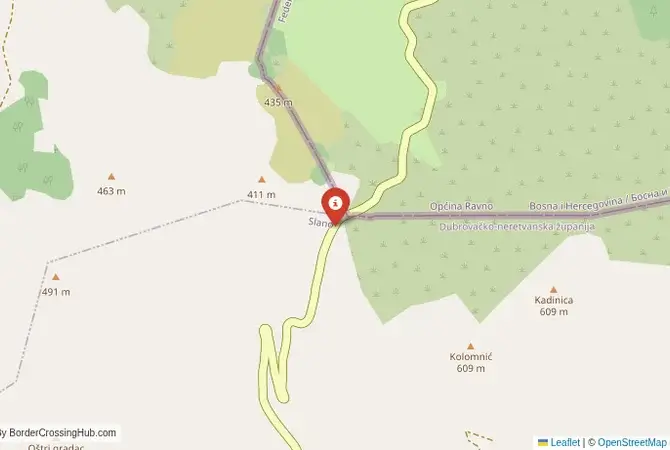
This checkpoint connects the Ravno Municipality of Bosnia and Herzegovina with Croatia's Dubrovnik-Neretva County. It is a minor, local crossing, open 24/7 (extended temporarily per Joint Commission decisions through at least Oct 2025, with status confirmed), though it is absolutely essential to verify live via official sources before attempting this route due to its remoteness. It may be subject to seasonal/weather restrictions. It is intended strictly for passenger cars. The road leading to it is very narrow, winding, and steep in places, suitable only for confident drivers in smaller vehicles. It is not a shortcut; it is an exploration of the deep hinterland, a route for those who are not on a schedule and are looking for an authentic, off-the-beaten-path experience; traffic extremely light with minimal reported waits.
A History of the Dubrovnik Republic's Frontier
The history of this region is the history of the Republic of Ragusa (Dubrovnik). For centuries, this powerful maritime republic controlled the coast, while the rugged hinterland was a border zone with the Ottoman Empire. The villages in this area were part of the republic's territory or were in its immediate sphere of influence, a buffer against the Ottoman power in Herzegovina. The modern border, established after the breakup of Yugoslavia, follows these historic administrative lines. The opening of this small crossing was a concession to the needs of the few local residents who live in this isolated region, allowing them to access services and family on both sides of the border without making extremely long detours to the main coastal crossings.
Nearby Border Crossings
The Schengen Border Procedure
The border crossing procedure is a rigorous process, reflecting its status as an entry point into the EU and the Schengen Area, despite its small size. You will first complete exit formalities at the Bosnian checkpoint. After a short drive, you will arrive at the Croatian checkpoint for a full EU/Schengen entry inspection by the Croatian Border Police and Customs. You will need a valid passport. National ID cards are only sufficient for EU citizens. Vehicle registration and international insurance (Green Card) are also necessary. As a very small crossing, the process is personal, but the checks are still thorough, as this is a sensitive area for smuggling due to its remoteness; EES from Oct 2025 requires biometrics for first non-EU entries, though minimal impact at low-traffic points.
The Surrounding Region: Bosnia and Herzegovina Side
On the Bosnian side, the crossing is in the Popovo Polje, a large and fertile karst field that is one of the most famous in the Dinaric Alps. This long, flat valley is a geological wonder, often flooded in the winter and a rich agricultural area in the summer. The region is known for the Vjetrenica cave system, the largest in Bosnia and Herzegovina, which is a UNESCO World Heritage tentative site and a place of incredible biodiversity, home to many unique underground species. The historic Serbian Orthodox monastery of Zavala is also in this region, built into the side of a cliff overlooking the polje. The nearby town of Ravno is the main administrative center.
The Surrounding Region: Croatia Side
On the Croatian side, the crossing is the gateway to the beautiful bay of Slano, a deep and sheltered inlet on the Adriatic Sea. The town of Slano is a charming and peaceful tourist resort with a new ACI marina, beautiful beaches, and a rich history. The crossing is part of the Dubrovnik coastal region. The magnificent, world-famous city of Dubrovnik, the "Pearl of the Adriatic," is about an hour's drive to the south. The beautiful Pelješac peninsula, famous for its red wines and its oysters from the town of Ston with its impressive medieval walls, is to the north.
Practical Travel Information
Practical planning is absolutely essential for this route. You must have a suitable vehicle and be comfortable with very narrow, winding roads with steep gradients. Check the operating hours of the border before you travel. The official currencies are the Bosnian Convertible Mark (BAM) in Bosnia and Herzegovina and the Euro (EUR) in Croatia. There are no services at the border itself. You must be completely self-sufficient with fuel, food, and water. Ensure your vehicle's Green Card insurance is valid for both countries. This route is not recommended for night driving or in poor weather conditions; verify status live as low-traffic may affect consistency.
Final Considerations
The Orahov Do–Slano border crossing is a route for the true explorer. It is a journey through a landscape of stark, beautiful, and empty landscapes. It is not the fastest or the easiest way to travel, but it offers a unique and authentic experience of the Dalmatian hinterland, a world away from the tourist crowds. It is a passage that connects the deep karst fields of Herzegovina with the blue of the Adriatic, a journey into a quiet and forgotten corner of the Mediterranean, rewarding the adventurous traveler with solitude and stunning scenery.
View all border crossings between Bosnia and Herzegovina and CroatiaPractical information
Fuel
Bosnia and Herzegovina: >10 km - Croatia: >10 km
Currency
None nearby
Safety information
Rural route; minimal issues
Connectivity
Mobile data
Have you crossed here?
Help other travelers by sharing your experience, wait times, and any updates.