Monthly Update (October 2026):
Gabela Polje & Metković is showing the clearest congestion in this group of southern Bosnia–Croatia crossings. On October 6, the Croatia-bound queue at Metković was estimated at about 129 minutes, far longer than Bijača–Nova Sela or Svilaj. For travelers using the Neretva valley, this makes the choice of crossing particularly important right now, especially if the journey can be shifted toward the motorway crossing at Bijača.
About this crossing
Operational Details
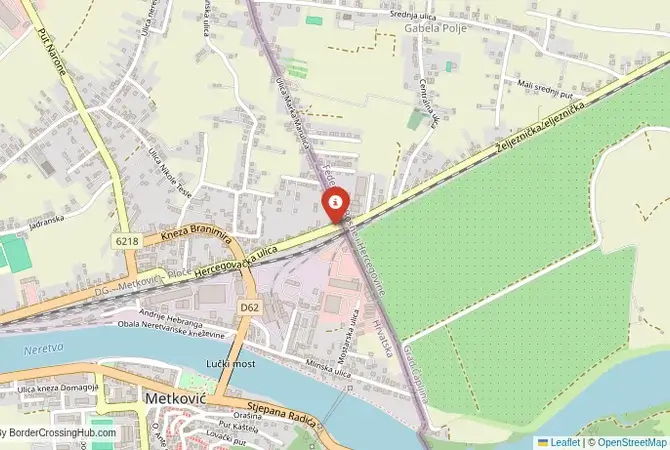
This checkpoint connects the West Herzegovina Canton of Bosnia and Herzegovina with Croatia's Dubrovnik-Neretva County. It is a major international crossing, open 24/7 to all passenger cars, buses, and commercial freight. It is one of several crossings in the Metković area, but it is one of the most important. Its location in the town center can lead to significant congestion, especially during the summer tourist season and during the harvest season for the region's famous mandarin oranges. A new, modern motorway crossing at Bijača-Nova Sela has taken some of the long-distance traffic, but this remains a vital link for local and regional trade.
A History of a Trade Route
The history of this region is the history of the Neretva River, which has been a major trade route since antiquity, connecting the Adriatic coast with the Balkan interior. The ancient Roman settlement of Narona, near the modern town of Metković, was a major trading emporium. The area has been part of the Roman Empire, the medieval Croatian and Serbian states, the Republic of Venice, and the Ottoman Empire. The modern border, established after the breakup of Yugoslavia, divided the lower Neretva valley. The crossing at Metković is a key point for the economy of the entire region, particularly for the export of agricultural products from Herzegovina to the EU.
Nearby Border Crossings
The Schengen Border Procedure
The border crossing procedure is a rigorous and meticulous process, reflecting its status as a primary entry point into the EU and the Schengen Area. You will first complete exit formalities at the Bosnian checkpoint at Gabela Polje. After a short drive, you will arrive at the Croatian checkpoint in Metković for a full EU/Schengen entry inspection by the Croatian Border Police and Customs. You will need a valid passport. National ID cards are only sufficient for EU citizens. Vehicle registration and international insurance (Green Card) are also necessary. As a Schengen entry point, the checks are very thorough, and the urban location can make the queues particularly frustrating as they often back up into the city streets.
The Surrounding Region: Bosnia and Herzegovina Side
On the Bosnian side, the crossing is near the historic village of Gabela, which is claimed to be the site of ancient Troy by some local historians. The area is a gateway to the magnificent Hutovo Blato Nature Park, one of the largest wintering grounds for birds in Europe, a vast wetland that is a paradise for birdwatchers and nature lovers. The crossing is also the main route to the famous Catholic pilgrimage site of Medjugorje and the historic city of Mostar, with its UNESCO-listed Old Bridge.
The Surrounding Region: Croatia Side
On the Croatian side, the city of Metković is the center of the Neretva delta region. The city is famous for its annual "Maraton lađa," a spectacular race of traditional, shallow-bottomed boats. The city has an excellent archaeological museum dedicated to the Roman city of Narona. The entire delta is a unique landscape of canals, lakes, and vast fields of mandarin oranges and other produce. The crossing is a gateway to the beautiful Dalmatian coast, including the Pelješac peninsula, famous for its red wines, and the city of Dubrovnik.
Practical Travel Information
Practical planning for this route requires patience, especially in summer. The official currencies are the Bosnian Convertible Mark (BAM) in Bosnia and Herzegovina and the Euro (EUR) in Croatia. Services are widely available in the towns on both sides of the border. Ensure your vehicle's Green Card insurance is valid for both countries. To avoid the worst of the queues, consider using one of the smaller, local crossings in the area if you are traveling in a passenger car, but check their operational status and vehicle restrictions in advance.
Final Considerations
The Gabela Polje–Metković border crossing is a vital economic artery in the heart of the Neretva delta. It is a busy, functional checkpoint that serves as a gateway to the rich agricultural lands, unique natural parks, and historic sites of both Herzegovina and Dalmatia. The journey through it is a passage through a shared landscape defined by the great river. It is a border that is defined by the slow-moving queues of trucks and cars, a testament to the importance of the connection between Bosnia and the EU.
View all border crossings between Bosnia and Herzegovina and CroatiaPractical information
Fuel
Bosnia and Herzegovina: <1 km - Croatia: <1 km
Currency
Limited kiosks; BAM, EUR
Safety information
Generally safe; rural roads
Connectivity
Mobile data
Have you crossed here?
Help other travelers by sharing your experience, wait times, and any updates.