Monthly Update (November 2026):
Travel through Kulata–Promachonas has been relatively straightforward during the first half of November, with no major disruption reported on the main Sofia–Thessaloniki route. The summer holiday traffic has eased, and recent monitoring has not shown the sustained congestion associated with peak travel periods. Freight movement continues along the corridor, but there has been no significant new restriction affecting passenger vehicles. For drivers heading into northern Greece, the crossing has seen little practical change from October.
Driving there, or sending a driver? Send them this guide.
For reports and websites
Cite this page
Border Crossing Hub (2026). Kulata & Promachonas Border Crossing. Updated November 2026. https://bordercrossinghub.com/kulata-promachonas-border-crossing/<a href="https://bordercrossinghub.com/kulata-promachonas-border-crossing/">Kulata & Promachonas Border Crossing (Border Crossing Hub)</a>Put this crossing's card on your website
Free. It updates on its own when our information changes.
<iframe data-bch-card src="https://bordercrossinghub.com/kulata-promachonas-border-crossing/?bch_view=card" width="100%" height="980" scrolling="no" style="border:0;max-width:480px;display:block" loading="lazy" title="Kulata & Promachonas border crossing information"></iframe>
<p style="font-size:12px;margin:4px 0 0">Crossing information: <a href="https://bordercrossinghub.com/kulata-promachonas-border-crossing/">Border Crossing Hub</a></p>
<script src="https://bordercrossinghub.com/?bch_embed_js=1" async></script>Paste it where you want the card. The last line (a script) only adjusts the height and can be left out.
About this crossing
What to expect at the crossing
Since Bulgaria joined Schengen fully on 1 January 2025, the old border formalities no longer apply to travellers here, and the European Commission's register of temporary internal border controls lists none for Bulgaria or Greece.
That does not mean the crossing is unwatched. On 22 July 2026 Greece's Minister of Citizen Protection announced a joint Bulgarian–Greek contact centre at the crossing, said it would start working at once, and described traffic there as very heavy and needing a strong police presence. So carry your passport or national ID card in case of a spot check.
Queues
Summer is the busiest period at the crossing. Waits here are unofficial estimates, and the nakordoni.eu tracker shows live queue times for Kulata. On the evening of 23 November 2026 it showed a truck wait of about 27 minutes, busier than usual for that hour. The Entry/Exit System is not active at this crossing.
Roads and rail
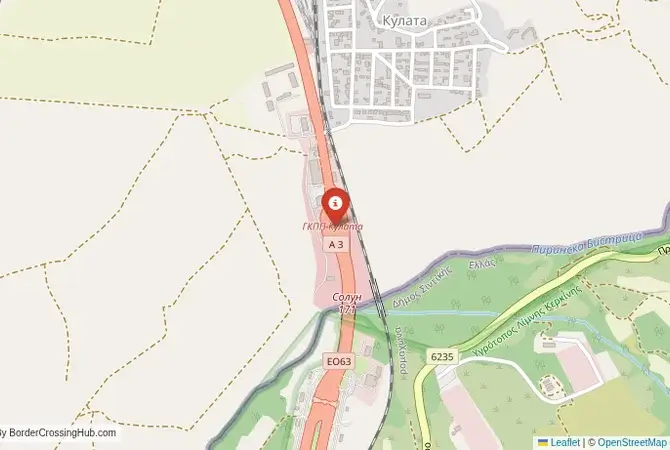
The crossing sits at the end of the Struma motorway (A3), which runs from Sofia through Pernik, Dupnitsa, Blagoevgrad and Sandanski to Kulata, and is part of the E79. On the Greek side it joins the A25 motorway towards Serres and Thessaloniki. The Sofia–Thessaloniki railway also passes through Kulata.
The motorway is not continuous. The Kresna Gorge section is still unfinished, with a bypass under construction since February 2026 and no firm completion date, so the gorge is the main gap in the route south.
Money and road charges
Bulgaria has used the euro since 1 January 2026, and the lev stopped being legal tender on 1 February 2026. You pay in euros on both sides. Passenger cars need an electronic vignette to use Bulgarian roads. Prices rose by about 30% on 1 August 2026: for a car up to 3.5 tonnes a weekly vignette is now 10 euros, a weekend one 6.60 euros, a monthly one 19.90 euros and an annual one 64.50 euros. Greece charges tolls on its motorways.
Fill up before the border, since the next fuel station can be 20 to 30 km away. If a queue builds, food and water for several hours, a phone power bank and some cash help, as not every nearby kiosk takes cards.
Once you are across
The Struma, which gives the motorway its name, rises on Vitosha near Sofia, runs 415 km to the Aegean and enters Greece close to Promachonas. Its valley has been a route between the Balkan interior and the Aegean coast since antiquity.
Kulata itself is a village in Petrich Municipality, at about 105 m elevation, with fewer than 900 residents; Petrich is the nearest town and municipal seat. On the Bulgarian side, Melnik, the smallest town in Bulgaria, lies in Blagoevgrad Province and has been known for its strong wine since at least 1346. Sandstone hills called the Melnik Earth Pyramids overlook it, and Rozhen Monastery is 6 km northeast. Further north, in Blagoevgrad Province, Pirin National Park has been a UNESCO World Heritage Site since 1983, with Bansko as its nearest town.
In Greece, Lake Kerkini, a reservoir on the Strymon River in the Serres regional unit, is a Ramsar-listed wetland described as one of Greece's premier birdwatching sites. Promachonas itself is a small village of about 180 residents. Greece annexed it in 1913 during the Second Balkan War, and it took its present name in 1927 after refugees from Asia Minor settled there. About 5 km south, at Kleidi, a monument to the Byzantine emperor Basil II commemorates the Battle of Kleidion. Beyond it the motorway runs on to Thessaloniki, the second-largest city in Greece.
Nearby Border Crossings


Heading to Kulata & Promachonas? Take this with you.
One page with the hours, waits, emergency numbers and coordinates. Works without signal.
Practical information
Fuel
Bulgaria: 500 m - Greece: 500 m
Currency
Exchange nearby; BGN, EUR
Safety information
Busy corridor; monitored
Connectivity
Wi-Fi, 4G/5G
Have you crossed here?
Help other travelers by sharing your experience, wait times, and any updates.