Monthly Update (September 2026):
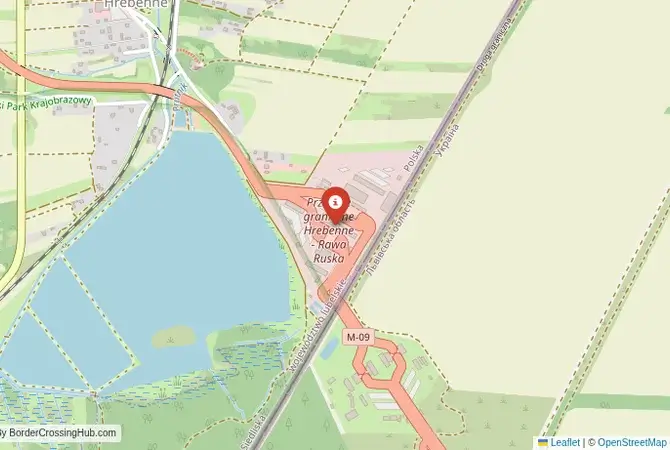
Hrebenne & Rava-Ruska remains an important Poland-Ukraine crossing, particularly for traffic using the northern approach toward Lviv. On September 4, Poland reported roughly 14 hours of truck waiting at Hrebenne, while passenger cars were moving without a reported queue in the outbound direction. The contrast between freight and passenger traffic is significant here: trucks can face substantial delays even when cars move through normally. No September closure has been identified.
About this crossing
Operational Details
This checkpoint connects Ukraine's Lviv Oblast with Poland's Lublin Voivodeship. It is a full-service international crossing, open to all passenger cars, buses, and commercial freight. The parallel railway line is also a key component of this corridor. The facility is large, but it has long struggled to cope with the high volume of traffic. Since the 2022 invasion, it has been under immense strain, serving as a critical route for Ukrainian exports and humanitarian aid. This has led to extremely long queues for trucks, which can often spill over and cause significant delays for passenger cars as well.
A History of a Galician Crossroads
The history of this region is the history of Galicia, a crown land of the Austrian Empire that was a melting pot of Poles, Ukrainians, Jews, and Germans. Rava-Ruska was a significant railway junction and a bustling market town with a large Jewish population before the Holocaust. The border, established after World War II, divided this historically integrated region. After Ukraine's independence, the Rava-Ruska-Hrebenne crossing became a key symbol of the renewed connection with Poland. It has also been a focal point for political expression, including recent blockades by Polish farmers protesting Ukrainian grain imports, which have highlighted the economic sensitivities of the cross-border relationship.
Nearby Border Crossings
Border Crossing Procedure
The border crossing procedure is a rigorous and often very slow process, reflecting its status as a major entry point into the EU and the Schengen Area. You will first complete exit formalities at the Ukrainian checkpoint at Rava-Ruska. After this, you will proceed to the Polish checkpoint at Hrebenne for a full EU entry inspection by the Polish Border Guard (Straż Graniczna) and Customs Service. You will need a valid passport, vehicle registration, and international insurance (Green Card). Customs inspections can be very thorough. The combination of high traffic volume, meticulous checks, and potential political disruptions makes this one of the most unpredictable crossings in terms of wait times.
The Surrounding Region
The surrounding area is rich in history. On the Ukrainian side, Rava-Ruska is a historic town. The crossing is the main northern gateway to the magnificent city of Lviv, a UNESCO World Heritage site renowned for its stunning architecture, its countless cafes, and its vibrant, Central European atmosphere. On the Polish side, Hrebenne is a small border village. The crossing leads into the beautiful Roztocze region of Poland, known for the Roztocze National Park. The route is the most direct path to the historic Renaissance town of Zamość, another UNESCO site, and further on to Lublin and Warsaw.
Essential Practical Planning
Practical planning is absolutely critical for this route. You must be prepared for extreme wait times. Have a full tank of fuel, and ample food, water, and any necessary medications. The official currencies are the Ukrainian Hryvnia (UAH) and the Polish Złoty (PLN). Services are available near the border, but it is wise to be self-sufficient. You will need the Polish `e-TOLL` system if you are driving a vehicle over 3.5 tonnes. Always check the latest official information on queue lengths, potential blockades, and any new travel restrictions before heading to the border. Having a flexible schedule is essential.
Final Considerations
The Rava-Ruska–Hrebenne border crossing is a vital economic and social artery, but it is also a place of significant logistical and political challenges. It is a critical lifeline for Ukraine and a primary gateway to Europe, operating under immense pressure. The journey through it can be a test of endurance, a direct encounter with the complexities of a major EU border in a time of crisis. It is a crossing that encapsulates the deep historical ties, the current economic interdependencies, and the political frictions that define the modern relationship between Poland and Ukraine.
View all border crossings between Ukraine and PolandPractical information
Fuel
Ukraine: 500 m - Poland: 500 m
Currency
Banks nearby; UAH, PLN
Safety information
Busy route; controlled
Connectivity
Wi-Fi, 4G/5G
Have you crossed here?
Help other travelers by sharing your experience, wait times, and any updates.