Monthly Update (November 2026):
Benyakoni–Šalčininkai continues to handle significant cross-border movement this November, particularly commercial traffic. Figures released in mid-November showed that Šalčininkai handled roughly a third of the trucks entering Lithuania from Belarus during the reporting period. Passenger travel has not been affected by a new closure, but the pressure on the remaining international road routes continues to make queues unpredictable. There is no confirmed new passenger procedure at Benyakoni this month.
Driving there, or sending a driver? Send them this guide.
For reports and websites
Cite this page
Border Crossing Hub (2026). Benyakoni & Šalčininkai Border Crossing. Updated November 2026. https://bordercrossinghub.com/benyakoni-salcininkai-border-crossing/<a href="https://bordercrossinghub.com/benyakoni-salcininkai-border-crossing/">Benyakoni & Šalčininkai Border Crossing (Border Crossing Hub)</a>Put this crossing's card on your website
Free. It updates on its own when our information changes.
<iframe data-bch-card src="https://bordercrossinghub.com/benyakoni-salcininkai-border-crossing/?bch_view=card" width="100%" height="980" scrolling="no" style="border:0;max-width:480px;display:block" loading="lazy" title="Benyakoni & Šalčininkai border crossing information"></iframe>
<p style="font-size:12px;margin:4px 0 0">Crossing information: <a href="https://bordercrossinghub.com/benyakoni-salcininkai-border-crossing/">Border Crossing Hub</a></p>
<script src="https://bordercrossinghub.com/?bch_embed_js=1" async></script>Paste it where you want the card. The last line (a script) only adjusts the height and can be left out.
About this crossing
Operational Details
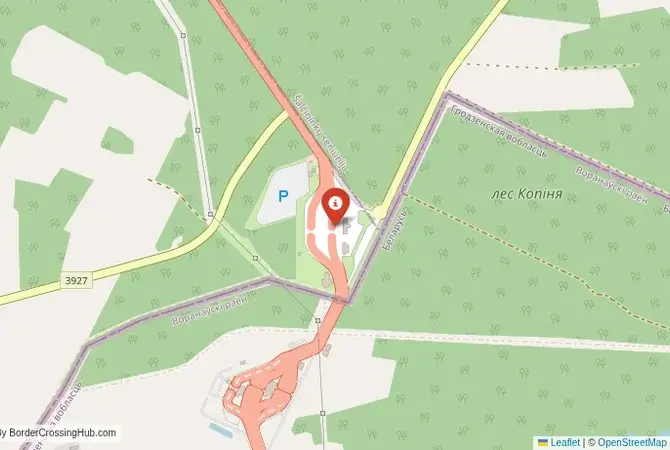
This checkpoint connects the Hrodna Region of Belarus with Lithuania's Vilnius County. It is located in a region that is historically part of the Vilnius Region, an area with a significant Polish minority on both sides of the border. This gives the crossing a unique cultural context. With the closure of other smaller crossings, traffic at Šalčininkai has increased significantly, leading to long and unpredictable wait times for both cars and trucks. It is one of the few remaining gateways on a border that is becoming increasingly difficult to cross, with electronic queue systems recommended on the Belarus side.
A History of the Vilnius Region
The history of this region is a story of the Polish-Lithuanian Commonwealth and its multicultural legacy. The area around Vilnius (Wilno in Polish) was for centuries a vibrant center of Polish, Lithuanian, Belarusian, and Jewish culture. The current borders, established after World War II, divided this historically integrated region, leaving a large Polish-speaking population in Lithuania and a smaller one in Belarus. The Šalčininkai district in Lithuania is one of the main centers of the country's Polish minority, where Polish is widely spoken and cultural traditions are maintained. This shared heritage means that for many local residents, the border is a line that cuts through a familiar cultural landscape.
Border Crossing Procedure
The border crossing procedure is a thorough and often lengthy process. As an entry point into the EU and the Schengen Area, it involves rigorous checks. You will first complete exit formalities at the Belarusian checkpoint at Benyakoni. This involves inspection by border guards and customs officials. You will then proceed to the Lithuanian checkpoint at Šalčininkai for a full EU entry inspection by the State Border Guard Service (VSAT) and Lithuanian Customs. You will need a valid passport, a Schengen visa (if required), vehicle registration, and international insurance (Green Card). Given the current political climate, expect detailed questioning and potential searches of your vehicle. The high volume of traffic, combined with the heightened security protocols, makes long delays a common experience.
The Surrounding Region
The surrounding area is rich in history. On the Lithuanian side, the town of Šalčininkai is the administrative center of the district. The region is dotted with historic manor houses and churches that reflect its Polish aristocratic past. The city of Vilnius, with its magnificent UNESCO-listed Old Town, is less than an hour's drive away. On the Belarusian side, the crossing is near the town of Voranava (Woronów in Polish). The area is close to the historic town of Lida, which is famous for its well-preserved 14th-century castle built by Grand Duke Gediminas, a major landmark in Belarus. The region offers a glimpse into the rural life of western Belarus.
Essential Practical Planning
Practical planning is absolutely critical for this route. You must continuously monitor official sources for the crossing's operational status. Be prepared for very long wait times by having a full tank of fuel, and ample food, water, and any necessary medications. The official currencies are the Euro (EUR) in Lithuania and the Belarusian Ruble (BYN). Services are available in the towns of Šalčininkai and Voranava. Ensure all your travel documents are in perfect order and that you meet all current, and potentially strict, entry requirements. Using online queue-tracking websites is highly recommended before approaching the border.
Final Considerations
The Benyakoni and Šalčininkai border crossing is a vital and heavily burdened link between Belarus and Lithuania. It is a gateway that serves not only as a major trade route but also as a connection point for the historic Polish-minority communities of the region. The journey through it is a direct encounter with the realities of a high-security EU border in a time of acute political tension. Any travel here requires immense patience and careful preparation. It stands as one of the last open doors on a frontier that is increasingly being sealed, a testament to the complex and layered history of this multicultural borderland.
Nearby Border Crossings

Heading to Benyakoni & Šalčininkai? Take this with you.
One page with the hours, waits, emergency numbers and coordinates. Works without signal.
Practical information
Fuel
Belarus: <1 km - Lithuania: <1 km
Currency
Near Benyakoni (BYN, EUR)
Safety information
Rural, low crime
Connectivity
Basic 3G coverage
Have you crossed here?
Help other travelers by sharing your experience, wait times, and any updates.