Monthly Update (September 2026):
Kotlovka & Lavorishkes remains closed and is not a usable alternative to the two Belarus-Lithuania crossings currently handling international road traffic. Current border-status information continues to list Kotlovka-Lavoriškės as closed, with the closure dating back to March 2024. Live monitoring likewise shows the checkpoint as temporarily closed rather than reporting a passenger queue. There is no September reopening or relaxation to report.
About this crossing
Operational Details
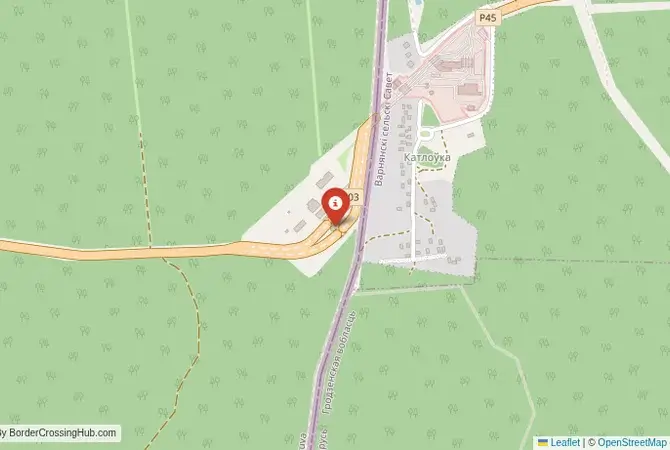
This checkpoint connected the Hrodna Region of Belarus with Lithuania's Vilnius County. It was located on the road that connects the Belarusian town of Astravyets (Ostrovets) with Vilnius. Its importance grew in recent years due to the construction of the Belarusian Nuclear Power Plant near Astravyets, which increased traffic and strategic focus on the area. The crossing was a full-service international post, equipped to handle a steady flow of traffic, and was often recommended as a less congested alternative to the main highway.
A History of a Multicultural Borderland
The history of this region is that of the eastern edge of the historic Vilnius Region. The area has been a multicultural borderland for centuries, with Lithuanian, Belarusian, and Polish communities living side-by-side. The landscape is dotted with small villages, traditional wooden houses, and historic churches. The border, established in the 20th century, cut through this landscape, but local connections remained. The crossing at Lavoriškės was a key point for maintaining these ties, as well as for facilitating trade and tourism. The name Lavoriškės is associated with a historic royal manor of the Grand Duchy of Lithuania, highlighting the area's deep historical roots.
Nearby Border Crossings


Former Border Procedure
The border crossing procedure, when it was operational, was a standard two-part process for entering the EU and the Schengen Area. Travelers would first complete exit formalities at the Belarusian checkpoint at Kotlovka. This involved checks by border guards and customs officials. After this, they would proceed to the Lithuanian checkpoint at Lavoriškės for a full EU entry inspection by the State Border Guard Service (VSAT) and Lithuanian Customs. A valid passport, a Schengen visa (if required), vehicle registration, and international insurance (Green Card) were required. While it was generally considered less congested than the main Medininkai crossing, wait times could still be significant, especially for freight.
The Surrounding Region
The surrounding area is known for its natural beauty. On the Lithuanian side, the road from Lavoriškės to Vilnius passes through scenic forests and near several lakes. The area is popular for recreation and country living. The capital city, Vilnius, with its UNESCO-listed Old Town, is the main destination. On the Belarusian side, the crossing is near the town of Astravyets. The region is part of the Narachansky National Park, a beautiful area known as the "Blue Lakes" region of Belarus, famous for its pristine lakes and dense forests. This made the crossing a potential gateway for eco-tourism between the two countries.
Closure Due to National Security
The closure of the Lavoriškės-Kotlovka crossing in early 2024 was part of a broader move by Lithuania to increase pressure on the Belarusian government and enhance its own national security. Citing concerns over national security, smuggling of sanctioned goods, and the actions of the Belarusian regime, Lithuania has progressively sealed its border, leaving only the two main crossings at Medininkai and Šalčininkai operational. This decision was a direct response to the ongoing political tensions and the perceived threats emanating from Belarus since 2020.
Final Considerations
The Kotlovka and Lavorishkes border crossing was once a vital and scenic northern gateway between Belarus and Lithuania. It served as a crucial artery for trade and travel, connecting the beautiful lake districts of both countries. Its closure is a stark symbol of the deteriorating relationship between the two neighbors and the new "Iron Curtain" descending on Europe's eastern flank. The silent checkpoint now stands as a testament to how quickly political conflict can sever long-standing connections, turning a busy road into a dead end and a bridge between cultures into a fortified barrier.
View all border crossings between Belarus and LithuaniaPractical information
Fuel
Belarus: <1 km - Lithuania: <1 km
Currency
Near Kotlovka (BYN, EUR)
Safety information
Remote, rural area
Connectivity
Basic 3G coverage
Have you crossed here?
Help other travelers by sharing your experience, wait times, and any updates.