Monthly Update (October 2026):
The Fălciu & Stoianovca Border Crossing remains a very different proposition from the busy road crossings farther south. This is primarily a railway crossing, so its usefulness depends on the train service rather than normal road traffic, and there is no comparable October road-queue buildup to report. For travelers planning to use it, the important point is to confirm the current rail service before relying on the crossing, as the timetable and train availability determine whether the route is actually usable.
About this crossing
Operational Details
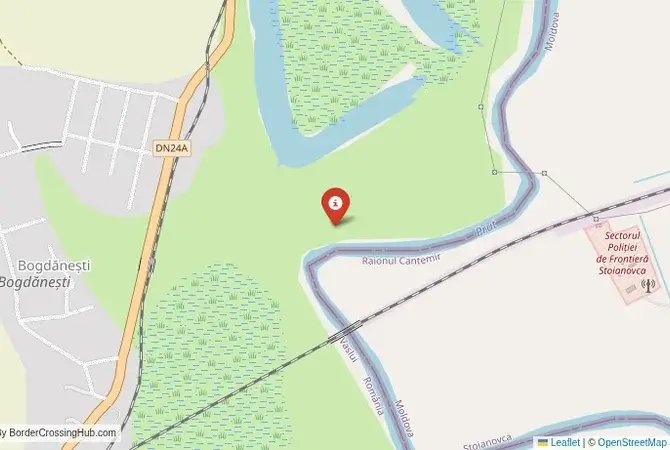
This checkpoint connects Moldova's Cantemir District with Romania's Vaslui County. Its operation is entirely dependent on the international rail schedule. There are no 24/7 operations here; the crossing is active only when a passenger or freight train is scheduled to pass. For many years, passenger service on this line has been sporadic or suspended entirely. Therefore, it is absolutely critical for any potential traveler to understand that this is not a general-purpose crossing. You cannot simply show up here and expect to cross. Travel is possible only if there is a scheduled international train running, for example, between Chișinău and Bucharest, that is routed this way. Verifying the existence and schedule of such a train is the first and most important step.
A History of Different Gauges
The history of this railway line is tied to the Russian Empire's expansion into the Bessarabia region in the 19th century. The Russian-built railways used a broader gauge (1520 mm) than the standard gauge (1435 mm) used in Romania and most of the rest of Europe. This difference was partly for logistical reasons but also served as a strategic barrier, making it more difficult for foreign armies to use the rail network. After the collapse of the Soviet Union, this legacy of different gauges remained. The Stoianovca–Fălciu crossing, along with others like Ungheni-Iași, became a crucial point where this technical challenge had to be overcome. The complex process of lifting each train car and swapping its wheelsets is a time-consuming but essential procedure for direct rail travel.
Nearby Border Crossings



The Border Procedure by Train
The border crossing procedure for a train passenger is integrated into the journey and can be a lengthy affair. The train will stop at the Moldovan border station, likely Prut II, near Stoianovca. Moldovan border police and customs officials will board the train and move from carriage to carriage, checking passports and making any necessary inspections. This process can take a significant amount of time. After the Moldovan checks are complete, the train will slowly proceed across the Prut River railway bridge to the Romanian station at Fălciu. Here, the process is repeated with the Romanian Poliția de Frontieră and customs officials boarding the train for a full EU entry check. Following the immigration formalities, the train will then move to a special facility where the bogie-changing operation takes place. This can add several hours to the total stop time at the border, making it an exercise in patience.
The Surrounding Region
The surrounding region is one of rolling hills and agricultural land, characteristic of southern Moldova and eastern Romania. There are no major tourist attractions at the immediate border. The Moldovan side is part of the Cantemir district, a rural area known for its wine production. The Romanian side is in Vaslui County, one of the more rural and less-visited parts of the country. The nearest major towns are Cantemir in Moldova and Bârlad in Romania. For the train traveler, however, the journey is the destination. The experience is about observing the landscape from the train window and witnessing the unique technical ballet of the border procedure, a piece of living industrial history that is invisible to those traveling by road.
Practical Travel Information
Practical planning for this route is entirely about rail tickets and schedules. You must confirm that an international passenger train is operating on this route and book your ticket in advance through the official railway operators of Moldova (CFM) or Romania (CFR Călători). The official currencies are the Moldovan Leu (MDL) and the Romanian Leu (RON). As a train passenger, you will not need to worry about vignettes or road conditions. It is advisable to have some snacks and water with you, as the border stop can be very long, and services at the small border stations are minimal to non-existent. Be prepared for a journey where time is measured differently.
Final Considerations
The Stoianovca–Fălciu railway crossing is a route for the dedicated rail enthusiast and the patient traveler. It is not a practical choice for anyone in a hurry. However, for those interested in the technical and historical aspects of European railways, it offers a fascinating and unique experience. It is a journey that highlights the physical and logistical barriers that borders can create and the ingenious engineering solutions developed to overcome them. It is a slow, deliberate passage that tells a powerful story about the legacy of empires and the complex mechanics of connecting a continent, one wheelset at a time.
View all border crossings between Moldova and RomaniaPractical information
Fuel
Moldova: 2 km - Romania: 2 km
Currency
Near Stoianovca (MDL, RON)
Safety information
Rural, low crime
Connectivity
Basic 3G coverage
Have you crossed here?
Help other travelers by sharing your experience, wait times, and any updates.