Monthly Update (September 2026):
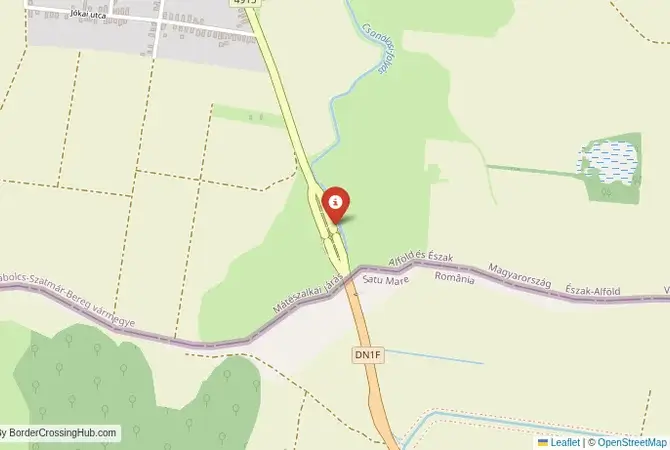
PARAGRAPH: Urziceni & Vállaj remains a quiet rural Hungary-Romania crossing, with only a few cars showing in September 4 monitoring. The removal of routine internal border checks means travelers normally pass through without the old passport-control stop. The route is therefore best suited to local or regional travel rather than as a high-speed alternative to the motorway crossings. There is no significant September closure or disruption identified.
About this crossing
Historical and Geopolitical Context
The story of this crossing is the story of Szatmár County, a historic administrative region of the Kingdom of Hungary. For a millennium, the area around Vállaj and Urziceni (known in Hungarian as Csanálos) was an integrated whole, its fate tied to the powerful Hungarian noble families of the region, like the Károlyi dynasty. A unique cultural element was added in the 18th century when Swabian German settlers were invited to populate the area, leaving a lasting architectural and cultural mark, particularly evident in Vállaj. The Treaty of Trianon in 1920 shattered this unity, bisecting the county and placing a stark new border between villages. Urziceni became part of Romania, while Vállaj remained in Hungary. The border became a heavily fortified barrier during the Cold War, an "Iron Curtain" that severed family ties and local economies. The opening of this crossing point after the fall of communism was a momentous event for locals, symbolizing a reconnection with their own past. Today, with both nations in the EU, the relationship is cooperative, but the physical border checks remain for land travel, a persistent reminder of a political boundary that remains significant despite decades of integration. Romania's partial Schengen status as of March 2024 does not apply to land borders, so you will still encounter full passport control here.
Crossing Procedures and Wait Times
Unlike major international crossings, the Vállaj-Urziceni border point does not operate 24/7. Its hours are typically from 8:00 AM to 8:00 PM (local time), though it's always wise to check for any recent changes before planning your trip, especially if arriving late. The procedure itself is simple and conducted from your vehicle. You will first be checked by Hungarian police for your exit from the Schengen Area, followed by a short drive to the Romanian Border Police checkpoint for entry inspection. For EU/EEA/Swiss citizens, showing a national ID card is usually sufficient. For other nationalities, a passport is required and will be stamped. The officials on both sides are professional, and the process is usually conducted from your vehicle. Wait times are almost always negligible, often taking less than 10-15 minutes. This is one of the crossing's main advantages. Traffic might see a slight increase on weekends or local market days when residents cross for shopping or family visits, but significant delays are extremely rare. This crossing is intended for passenger vehicles and pedestrians; it is not equipped for heavy commercial freight.
Nearby Border Crossings


Scams & Warnings
The quiet, local nature of the Vállaj-Urziceni crossing means you are highly unlikely to encounter the aggressive scams found at busier borders. Your awareness should be focused on practical matters. The primary one is the road vignette. Both Hungary and Romania require you to purchase a digital vignette to use their national road networks outside of local areas. Do not buy these from individuals flagging you down. Purchase them only at official points: major petrol stations are the most reliable option. In Hungary, look for signs for 'e-vinjeta,' and in Romania, for 'rovinietă.' Secondly, be cautious with currency exchange. You won't find official exchange booths here. If you need local currency (Forint in Hungary, Leu in Romania), it is best to use an ATM in a larger nearby town like Mátészalka (HU) or Carei (RO) for the most favorable rates. Informal, roadside money changers should be avoided.
Transportation Options
This border is fundamentally a destination for those traveling by car. In Hungary, Vállaj is reached via secondary roads branching off Route 49, which connects to the larger city of Mátészalka. On the Romanian side, Urziceni connects via road DJ108M to the city of Carei, which is only about 15 kilometers away. The roads are paved but are rural in character: expect to share them with agricultural vehicles and cyclists. There is no cross-border public bus service. While both Vállaj and Urziceni are served by their respective domestic bus networks, these services terminate in the villages. Crossing on foot is possible during operating hours, but you would need to pre-arrange taxis on both sides for onward travel, which requires careful coordination and may not be reliable without local contacts. The journey by car between Mátészalka and Carei through this crossing is scenic and direct, offering a peaceful alternative to the larger, more truck-heavy crossing at Csengersima further north.
Nearby Attractions and Tips
The area around the crossing is rich in low-key, authentic attractions. The village of Vállaj is notable for its well-preserved Swabian heritage, visible in its orderly street plan and traditional houses. A few kilometers away, the town of Mátészalka is home to the Szatmár Museum, which provides excellent insight into the region's history. On the Romanian side, the city of Carei is a must-visit. Its centerpiece is the magnificent Károlyi Castle, a beautifully restored palace with surrounding gardens that now houses a museum. The city center of Carei also has a pleasant atmosphere with numerous cafes and restaurants. For nature lovers, the region is part of the historical Ecsed Marsh (Lápos-láp), and while much of it has been drained, protected remnants offer opportunities for birdwatching. A practical tip: while credit cards are widely accepted in larger towns, carry a small amount of local currency (Hungarian Forint and Romanian Leu) for purchases in smaller villages, cafes, or markets.
Seasonal and Weather Considerations
The Szatmár Plain experiences a continental climate with distinct seasons. Summers are warm to hot, with temperatures often reaching 28-32°C (82-90°F), and can be accompanied by thunderstorms. Winters are cold, with frequent frosts and temperatures that regularly fall below freezing. Snowfall is common but usually not extreme enough to close the crossing, though rural roads may be slippery. The most challenging conditions can occur in late autumn and early spring, when morning fog can be dense across the flat landscape, severely limiting visibility. It is advisable to drive with caution during these periods. The landscape is arguably at its most beautiful in late spring when the fields are lush and green, and in early autumn during the harvest.
Planning Your Crossing
Before setting out, double-check the crossing's operating hours, as they are not 24/7. Ensure your passport or ID card is valid and that you have your vehicle's documents, including registration and insurance (Green Card), are in order. Remember the mandatory vignette purchase for both countries if you plan to travel beyond the immediate border area. This crossing is an excellent choice if your itinerary involves exploring the cultural heritage of the historic Szatmár region, for those traveling between Mátészalka and Carei, or for anyone looking to experience a border that feels less like a formal checkpoint and more like a simple bridge between neighboring communities. Its tranquility is its greatest asset.
View all border crossings between Hungary and RomaniaPractical information
Fuel
Hungary: <1 km - Romania: <1 km
Currency
Near Vállaj (HUF, RON)
Safety information
Remote, rural risks
Connectivity
Basic 3G signal
Have you crossed here?
Help other travelers by sharing your experience, wait times, and any updates.