
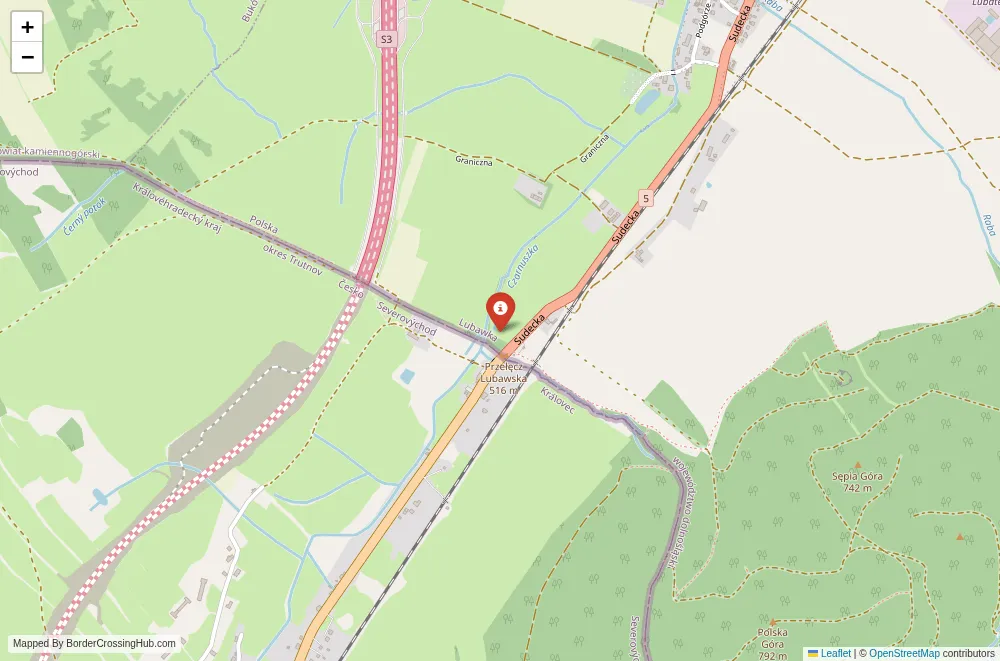
Approximate Border Location
Border Countries
- 🇵🇱Poland
- 🇨🇿Czech Republic
Border Cities
- 🇵🇱Lubawka
- 🇨🇿Královec
Wait Times
Cars 0-15m; peaks 20-90m weekends
Just crossed? Tap to report:
Operating Hours
Open 24 hrs (12:00 AM-11:59 PM)
Crossing Types
Cars,buses; trucks limited; pass road
Border Type
Land crossing via road (E65)
Peak Times
10:00 AM-04:00 PM; winter/summer peaks
Daily Crossings
4,000-18,000/day
Currency Exchange
PLN; CZK in Trutnov; ATMs
Safety Information
Weather on pass; fog/ice possible
Languages Spoken
Polish/Czech
Accessibility Features
Paved areas; limited accessible toilets
About Zawidów & Frýdlant v Čechách
Monthly Update (March 2026):
As of 03/2026, the Zawidów & Frýdlant v Čechách Border Crossing remains calm and mostly stable. Vehicles pass freely between the towns with little sign of queues. Midday tends to be the quietest moment to cross. Weekend visits and local shopping trips sometimes bring a few extra cars.
No Cell Service at the Border? No Problem.
Don’t get caught scrambling for paperwork when you lose signal. Download the complete Europe Transit Guide directly to your device and access every critical detail, fast-track strategy, and border rule – 100% offline.
Zawidów connects Poland to the Czech Republic in the western Sudetes foothills of Lower Silesia, where the border runs along a main road bridge over the Kwisa River dividing the Polish border town of Zawidów from the Czech town of Frýdlant v Čechách in a scenic valley setting with historic trade and cultural significance.
Location and Basic Connections
You reach this crossing where Zawidów in Poland’s Lower Silesian Voivodeship (Zgorzelec County) meets Frýdlant v Čechách (historically Friedland in Böhmen) in the Liberec Region (Liberec District). It lies along the primary road bridge (Polish road 30 / Czech road 13) over the Kwisa River, in a valley with surrounding hills, forests, and small settlements. Foreign visitors cross here when traveling from Zgorzelec, Jelenia Góra, or the Polish side of Lower Silesia toward Liberec, Jablonec nad Nisou, or the Czech Jizera Mountains, or the reverse for Polish medieval towns and the Karkonosze foothills. Alternative names include the Zawidów Frýdlant border or Kwisa River crossing at Zawidów. As a Schengen internal point, it normally allows free movement with no fixed booths, but temporary controls remain active on the Polish side as of February 11 2026.
Historical Background and Geopolitical Role
The border traces the post-World War II Polish-Czechoslovak frontier formalized by the 1945 Potsdam Agreement and the 1958 Czech-Polish border treaty. Zawidów (German Seidenberg) and Frýdlant v Čechách (Friedland) were historically part of the Bohemian region under the Lords of Ronov and later the Habsburgs, with the Kwisa serving as a natural divider for centuries. Zawidów grew as a medieval trading town with a Gothic church and town walls, while Frýdlant developed around its 13th-century castle (one of the oldest in Bohemia) and became a textile and glassmaking center. The frontier split the shared Bohemian-Silesian cultural area after 1945, with population shifts due to expulsions of German residents and resettlement by Poles and Czechs. During the Cold War, the crossing was restricted, but reopened after 1989. Full Schengen integration in 2007 made it seamless, supporting cross-border tourism to Frýdlant Castle, the Jizera Mountains, and Polish Lower Silesian heritage sites.
Current Status and Safety Considerations
Poland maintains temporary internal border controls with Czechia until at least April 30 2026, citing irregular migration pressures along eastern routes, smuggling networks, asylum system strains, and security concerns from global conflicts. Czechia does not impose routine reciprocal controls here. At this moderately used valley crossing, controls consist of random police stops on the Polish side, often on the bridge or approach from Zawidów, rather than permanent booths. Travelers report these as infrequent and brief here compared to busier points like Kudowa-Słone or Gorzyczki-Věřňovice, with no long queues. The area has low crime typical of small-town mountain border zones, with no reported scams, aggressive touts, or specific issues for visitors. Carry your passport or national ID at all times to handle any verification smoothly.
Operating Hours and Wait Times
The road bridge operates 24 hours with no routine barriers or gates under Schengen conditions. Temporary controls introduce occasional variability: most crossings pass without intervention, while a random stop adds 5 to 20 minutes for document review or questions. This crossing sees moderate tourist and local traffic, with potential minor delays during summer hiking season, winter weekends, or holidays. Off-peak times move quickly. Weather in the Sudetes foothills affects access: heavy snow in winter can slow the road, while heavy rain or spring floods may temporarily restrict the bridge.
Visa Requirements for Foreign Visitors
Schengen rules govern entry: EU/EEA/Swiss citizens proceed freely with valid ID or passport. Non-EU nationals qualify for visa exemptions up to 90 days in any 180-day period if eligible, or require a Schengen visa. The Entry/Exit System registers non-EU travelers at external borders but not routinely here; spot checks may verify your status. Present your passport during any control, along with proof of purpose, funds, accommodation, or onward travel if requested. No entry or exit fees apply here.
Crossing Procedures Step by Step
You approach on road 30 from Poland or road 13 from Czechia, reaching the bridge over the Kwisa where the border follows the river channel and signs switch languages. Normally, drive, cycle, or walk across as the valley scenery continues seamlessly. If Polish police conduct a control, expect a roadside or bridge stop for ID presentation and basic travel questions. Provide documents promptly; the process ends quickly amid local flow. Pedestrians use sidewalks on the bridge without separate facilities. The transition feels understated, with immediate access to town streets or mountain roads on both sides.
Transportation Options and Road Details
Local buses connect Zawidów to Jelenia Góra or Zgorzelec on the Polish side, with some services reaching Náchod or Trutnov on the Czech side. Driving uses paved secondary roads winding through the Kłodzko Valley and Sudetes foothills, passing forests, meadows, small villages, and river views. Scenery includes mountain ridges, sandstone formations, and distant Sudetes panoramas. Traffic stays moderate outside peak seasons. Cycling suits the moderate terrain with marked cross-border paths nearby.
Nearby Attractions and Practical Tips
Lubawka offers a historic old town, spa facilities, and proximity to the Karkonosze National Park trails. Královec provides access to Czech hiking paths and nearby Náchod with its castle and old town. Carry ID due to controls. Euros work on both sides, Polish złoty useful in Lubawka; cards accepted widely. Pack layers for changeable mountain weather. Shop or refuel on either side for convenience. Cross in daylight for safer valley roads.
Cultural and Economic Significance
The crossing sustains cross-border tourism in this Sudetes foothills region, where visitors enjoy seamless access to Polish and Czech hiking, spas, and historic sites. Shared Bohemian-Silesian heritage appears in architecture, cuisine, and mountain traditions. It supports local economies through nature tourism and regional ties, exemplifying Schengen’s valley integration amid temporary security measures.
Final Planning Notes
Check official EU or national sources for updates on temporary controls before travel, keep ID ready, and allow flexibility for any random check. This scenic valley bridge route offers a convenient and beautiful local passage between Poland and Czechia when you stay prepared.
No reviews yet.