Monthly Update (October 2026):
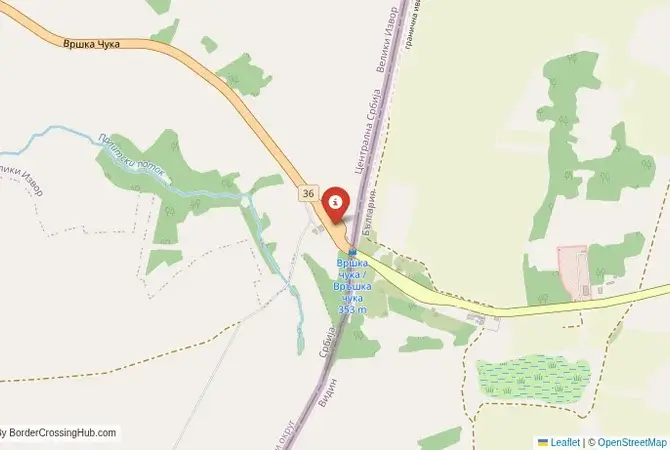
Vrashka Chuka & Vrska Cuka remains a relatively quiet alternative to Kalotina–Gradina. Bulgarian authorities reported normal traffic at the Serbia border in their latest bulletin, and there is no new October restriction affecting this crossing. The difference is most noticeable when Kalotina becomes busy, making the smaller western route worth considering if the itinerary allows it.
About this crossing
Operational Details
This checkpoint connects the Vidin Province of Bulgaria with the Zaječar District of Serbia. It is a smaller international crossing, open 24/7 to passenger cars and local traffic, though it is crucial to check live status via sources like BorderAlarm or Nakordoni before travel for any rare temporary issues. The exclusion of heavy freight preserves the tranquility of this rural area. The road leading to the crossing is a scenic, winding route through the hills. The traffic is generally light, with typical wait times around 5-10 minutes in recent 2025-2026 data, making it a relatively quick and uncomplicated crossing for those exploring the region.
A History of a Roman Frontier
The history of this region is the history of the Roman province of Moesia Superior. The Balkan Mountains have long been a strategic barrier and a cultural dividing line. The nearby Serbian city of Zaječar is home to the magnificent Gamzigrad-Romuliana, the palace of the Roman emperor Galerius, which is a UNESCO World Heritage site. The modern border, established in the late 19th century, divided a region with a shared history and a mixed population of Serbs and Bulgarians. During the Cold War, this was a controlled border. Its opening has been important for the development of regional tourism and cross-border cooperation.
Nearby Border Crossings

The EU Border Procedure
The border crossing procedure is a rigorous process, reflecting its status as an entry point into the EU. You will first complete exit formalities at one country's checkpoint and then proceed to the other country's checkpoint for entry inspection. As an EU entry point, the checks by the Bulgarian Border Police and customs authorities are thorough. You will need a valid passport, vehicle registration, and international insurance (Green Card). As a smaller crossing, the process is generally faster and more personal than at the main highways, but the checks are still meticulous. You should be prepared for a full inspection; 2025-2026 reports show consistently short queues and quick processing.
The Surrounding Region: Bulgaria Side
On the Bulgarian side, the crossing is in the Vidin Province, one of the most sparsely populated and poorest regions of the EU, but also one of the most beautiful and untouched. The nearby city of Vidin, on the Danube River, is home to the magnificent, perfectly preserved medieval Baba Vida Fortress. The Belogradchik Rocks, a stunning and unique landscape of bizarrely shaped sandstone and conglomerate rock formations, are also in this region and are a major natural wonder of Bulgaria. The Magura Cave, with its prehistoric paintings, is another highlight.
The Surrounding Region: Serbia Side
On the Serbian side, the crossing is the gateway to the Zaječar District, the heart of the Serbian Timok Valley. The main attraction is the UNESCO World Heritage site of Gamzigrad-Romuliana, a vast and impressive complex of palaces, temples, and fortifications built by the Emperor Galerius in the late 3rd and early 4th centuries. The nearby city of Zaječar has a national museum with a rich collection of artifacts from the site. The region is also known for its wine production.
Practical Travel Information
Practical planning is essential for this route. Check live operating status and queues via BorderAlarm or Nakordoni before travel. The roads leading to the crossing are regional and can be narrow and winding. The official currencies are the Bulgarian Lev (BGN) in Bulgaria and the Serbian Dinar (RSD) in Serbia. There are no services at the border itself. You must be self-sufficient with fuel, food, and water. You will need to purchase an electronic vignette for your vehicle for Bulgaria. Ensure your vehicle's Green Card insurance is valid for both countries.
Final Considerations
The Vrashka Chuka–Vrška Čuka border crossing is a scenic and historically rich route. It is a peaceful and beautiful alternative to the main highway. It is a crossing that connects two UNESCO World Heritage sites and two of the most spectacular natural wonders of the region. For the traveler looking to explore the Roman heritage and the pristine nature of northwestern Bulgaria and eastern Serbia, it is an excellent and highly recommended choice, a passage through a land of emperors, fortresses, and incredible rocks.
View all border crossings between Bulgaria and SerbiaPractical information
Fuel
Bulgaria: <1 km - Serbia: <1 km
Currency
Limited exchange; BGN, RSD
Safety information
Low crime; rural traffic
Connectivity
Mobile data
Have you crossed here?
Help other travelers by sharing your experience, wait times, and any updates.