
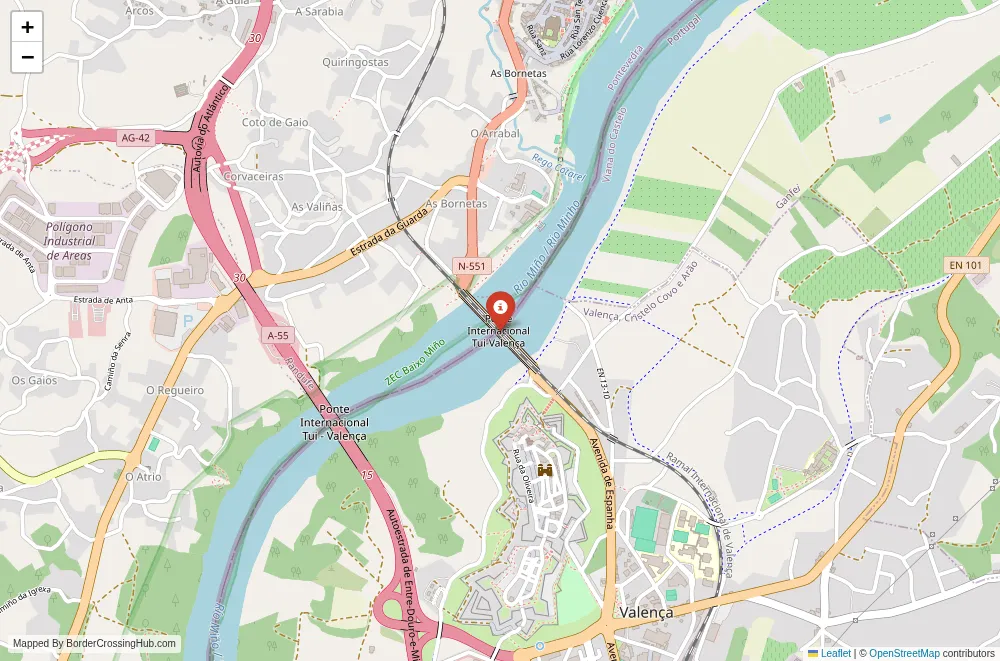
Approximate Border Location
Wait Times
Cars 0-15m; peaks 20-90m weekends
Just crossed? Tap to report:
Operating Hours
Open 24 hrs (12:00 AM-11:59 PM)
Crossing Types
Ped,cars,bikes,buses; bridge crossings
Border Type
Land crossing via road bridge (Minho)
Peak Times
Sat-Sun 10:00 AM-06:00 PM; summer
Daily Crossings
25,000-90,000/day
Currency Exchange
EUR only; ATMs in both towns
Safety Information
Bridge congestion; watch pedestrians/cyclists
Languages Spoken
Spanish/Portuguese
Accessibility Features
Good sidewalks; curb cuts common
About Vilar Formoso & Fuentes de Oñoro
Monthly Update (March 2026):
As of 03/2026, the Vilar Formoso & Fuentes de Oñoro Border Crossing remains active with a steady mix of cars and freight trucks. Traffic moves along the motorway crossing fairly smoothly, though trucks sometimes stack up briefly on the Portuguese side during busy freight periods. Midday crossings usually pass quickly. Long-distance travel and logistics traffic shape the flow.
No Cell Service at the Border? No Problem.
Don’t get caught scrambling for paperwork when you lose signal. Download the complete Europe Transit Guide directly to your device and access every critical detail, fast-track strategy, and border rule – 100% offline.
The Vilar Formoso-Fuentes de Oñoro border stands as a major inland crossing between Portugal and Spain, linking the Portuguese village of Vilar Formoso directly to the Spanish town of Fuentes de Oñoro along the historic Beira Alta railway corridor and the IP2 / N-620 road.
Alternative Names
You will see this referred to as the Vilar Formoso border, Fuentes de Oñoro crossing, Vilar Formoso-Fuentes de Oñoro international frontier, or simply the Beira Alta / Salamanca border point.
Current Status
Portugal and Spain share full Schengen membership, so this land border remains open with no permanent passport checks or vehicle controls for routine travel. You drive or walk across without stopping under normal conditions. Random spot checks by Portuguese GNR or Spanish Guardia Civil can occur (often focused on freight, commercial vehicles, or specific security alerts), but they are infrequent for private cars and tourists. The crossing handles steady regional traffic and freight, with no major long-term closures reported in 2026.
Historical Background
This frontier follows the natural divide between Portugal and Spain established in the 13th century and confirmed by later treaties. During World War II, Vilar Formoso became known as the “Frontier of Peace”: thousands of refugees fleeing Nazi-occupied Europe entered Portugal here, welcomed with food and shelter before moving onward. The railway station played a central role in those journeys. The area also saw fighting during the Peninsular War (notably the Battle of Fuentes de Oñoro in 1811, part of Wellington’s campaign against Masséna). The modern road and rail links grew after the mid-20th century as trade expanded between central Portugal and western Spain.
Geopolitical and Economic Role
This crossing serves as one of the main inland routes between central Portugal and Castilla y León, handling passenger cars, buses, and significant freight (including rail cargo on the Beira Alta line). It supports cross-border shopping (Portuguese often cross for cheaper Spanish fuel and groceries; Spaniards seek Portuguese goods), family visits, and tourism. The railway carries important freight and occasional international passenger services, though direct passenger trains remain limited.
Visa Requirements for Foreign Visitors
Schengen rules apply equally to Portugal and Spain. If your nationality qualifies for visa-free entry, you cross with only a valid passport or national ID. Most non-EU visitors receive 90 days in any 180-day period across the area. Carry your travel document at all times, though checks are extremely rare for private travelers on this route.
Crossing Procedures Step by Step
By car or motorbike, follow the IP2 (Portugal) from Guarda or Celorico da Beira toward Vilar Formoso. You pass through the village, reach the border area (with empty customs buildings on both sides), and continue straight onto the N-620 (Spain) toward Fuentes de Oñoro and Salamanca. No booths or queues exist for routine crossings. Pedestrians and cyclists use the same road (sidewalks are limited); the transition is unmarked beyond small signs. Rail passengers (if using rare cross-border services) experience no formalities on board. The reverse direction follows the same pattern. No forms or officials are present routinely.
Typical Wait Times and Peak Periods
Road crossings take seconds with no wait in normal conditions. Delays only arise during major Portuguese or Spanish holidays (summer vacations, Easter, Christmas) when shopping traffic increases, or during occasional police operations. Even then, queues rarely exceed 10–20 minutes. Rail wait times depend on train schedules rather than border processing.
Operating Hours
The road and rail crossing operate 24 hours a day, every day of the year, as a continuous public link.
Transportation Options to and From the Border
Drive the IP2 from Coimbra, Guarda, or Viseu to Vilar Formoso (then cross). On the Spanish side, the N-620 connects to Salamanca (about 1 hour) or Ciudad Rodrigo. Regional buses serve Vilar Formoso and Fuentes de Oñoro, but direct cross-border services are limited; you often walk or take a short taxi between the towns. Trains use the Beira Alta line (Pampilhosa–Vilar Formoso) on the Portuguese side and connect onward from Fuentes de Oñoro to Salamanca. No frequent direct passenger rail crosses here, though freight is heavy and occasional international services run.
Road Conditions and Scenery
The IP2 and N-620 are good two-lane highways with decent surfaces, though the final approach to the border passes through villages with some narrow sections. The landscape features rolling hills, granite outcrops, pine woods, and open fields typical of the Beira Interior and western Castilla y León. The crossing itself sits in a flat valley with views of distant hills.
Seasonal Variations and Weather Impacts
Summer sees the most traffic from tourists and shoppers. Winter rain, fog, or occasional snow/ice can slow rural roads, but the main routes stay open and maintained. No seasonal closures occur.
Nearby Attractions
Vilar Formoso has the small but moving “Frontier of Peace” museum near the railway station, documenting World War II refugees and the role of Aristides de Sousa Mendes. Fuentes de Oñoro offers a quiet historic center tied to the 1811 battle. Nearby, the fortified village of Almeida (Portugal) with its star-shaped walls and castle is a short drive, while Ciudad Rodrigo (Spain) provides a well-preserved medieval town with cathedral, walls, and castle. The area suits history lovers and those exploring the Portuguese-Spanish frontier.
Common Scams and Warnings
Serious scams are very rare at this quiet inland crossing. Occasional aggressive shop owners or vendors in Vilar Formoso may push overpriced souvenirs or “special deals” on border goods. Some travelers report minor overcharging at fuel stations or small eateries near the frontier. Keep valuables secure when parking or walking, and avoid leaving items visible in cars.
Travel Tips and Preparation
Carry euros (both countries use them), passport/ID, and vehicle papers. Fuel up on the cheaper side (often Spain). Use navigation apps to follow IP2/N-620, as signage changes language at the line. If walking between the towns, note the short distance (about 1–2 km). Combine the crossing with visits to Almeida or Ciudad Rodrigo for a fuller frontier experience.
Cultural and Economic Significance
This point illustrates the enduring connection between Beira Interior and Castilla y León, with shared rural traditions, history, and cross-border commerce. Daily shopping and family ties keep the frontier alive despite the political line.
Final Planning Advice
Check holiday dates for quieter travel. Bring your documents, drive or walk the short distance, and explore the World War II history and nearby fortified villages. This peaceful inland crossing offers a low-key way to move between Portugal and Spain while touching on centuries of shared frontier life. Safe travels.
No reviews yet.