
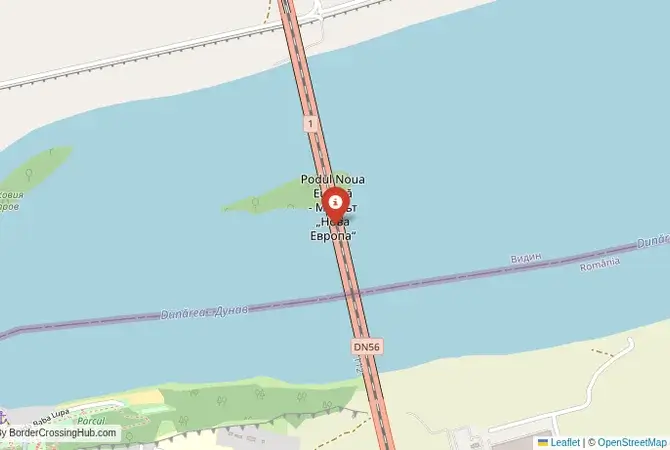
Approximate Border Location
Wait Times
30–90 min
Just crossed? Tap to report:
Operating Hours
Open 12:00 AM–11:59 PM
Crossing Types
Pedestrians, vehicles, rail, freight
Border Type
Land crossing via bridge
Peak Times
Morning peak, weekends
Daily Crossings
5,000–7,000 daily
Currency Exchange
Banks nearby; BGN, RON, EUR
Safety Information
Busy hub; controlled traffic
Languages Spoken
Bulgarian/Romanian
Accessibility Features
Elevators, ramps
About Calafat (Danube Bridge, road/rail) & Vidin
Monthly Update (March 2026):
In 03/2026, the Calafat & Vidin Border Crossing across the Danube Bridge sees steady movement of cars and freight trucks. Customs checks for trucks can slow the line, especially midday. Passenger vehicles often clear faster. Freight schedules and regional trade keep the crossing busy.
No Cell Service at the Border? No Problem.
Don’t get caught scrambling for paperwork when you lose signal. Download the complete Europe Transit Guide directly to your device and access every critical detail, fast-track strategy, and border rule – 100% offline.
A New Bridge of Hope on the Danube
The border crossing connecting the Bulgarian city of Vidin with Calafat in Romania is a journey across the “Danube Bridge 2,” a magnificent, modern structure that has become a powerful symbol of regional cooperation and European integration. Officially named the “New Europe Bridge,” it is a combined road and rail bridge that provides a vital link on a major Pan-European transport corridor. Since both Bulgaria and Romania are members of the European Union, this is an internal EU border with simplified procedures. To cross here is to travel over a state-of-the-art piece of infrastructure, a seamless passage that has brought new hope and economic opportunity to one of the most underdeveloped regions of the EU.
Operational Details
This checkpoint connects the Vidin Province of Bulgaria with Romania’s Dolj County. It is a major international crossing, open 24/7 to all passenger cars, buses, and commercial freight, as well as railway traffic. The bridge, opened in 2013, has dramatically improved connectivity between northwestern Bulgaria and southwestern Romania. It is a toll bridge, and the fee is collected at the checkpoint on the Romanian side. The facility is modern and designed to handle a significant volume of traffic, though queues can form, especially for freight; post-Schengen land accession Jan 1, 2025, no systematic border controls, only toll payment and occasional random checks per Romanian Border Police; recent online traffic app data shows average waits 0-29 minutes typical, with occasional maintenance interruptions.
A History of a Long Wait
The history of this crossing is a story of a long-held dream. For decades, the only way to cross the Danube in this region was by a slow and unreliable ferry. The construction of a bridge was discussed for many years but was delayed by political and financial challenges. The project was finally realized with major funding from the European Union. Its construction was a major engineering feat, and its opening was a huge celebration, a symbol of a new era of connection and a promise of economic revitalization for the Vidin and Dolj regions, which have historically been among the poorest in their respective countries.
The Simplified EU Border Procedure
Today, the border procedure is simplified due to both countries being in the EU and Schengen land area since Jan 2025. You will need to stop at the checkpoint to pay the bridge toll, and the border police may conduct a cursory check of your documents (passport or national ID card for EU citizens). However, there are no systematic, in-depth immigration or customs inspections for private travelers. The process is generally quick and efficient; random checks possible anywhere in territory.
The Surrounding Region: Bulgaria Side
On the Bulgarian side, the crossing is in the historic city of Vidin. Vidin is home to the magnificent, perfectly preserved medieval Baba Vida Fortress, the best-preserved medieval castle in Bulgaria. The city also has a beautiful riverside park, a historic synagogue, and other Ottoman-era architectural monuments. The crossing is a gateway to the stunning Belogradchik Rocks, a unique landscape of bizarrely shaped sandstone and conglomerate rock formations, and the Magura Cave, with its prehistoric paintings.
The Surrounding Region: Romania Side
On the Romanian side, the crossing is in the town of Calafat. Calafat has a history as an important river port and was the site of a major battle during the Russo-Turkish War. The town has a beautiful central park and a pleasant riverside promenade. The crossing provides a direct route to the major city of Craiova, the capital of the Oltenia region, which has a beautiful art museum and a large botanical garden. The region is known for its rich agricultural plains.
Practical Travel Information
Practical planning for this route is straightforward. The main roads leading to the bridge are modern and well-maintained. The toll for the bridge must be paid at the checkpoint. The official currencies are the Bulgarian Lev (BGN) in Bulgaria and the Romanian Leu (RON) in Romania. Currency exchange facilities are available. You will need to purchase electronic vignettes for your vehicle for both countries if you plan to use the main road networks. These can be bought online in advance. Ensure your vehicle’s Green Card insurance is valid for both countries; check politiadefrontiera.ro traffic app for current waits (often 0-29 min).
Final Considerations
The Vidin–Calafat border crossing is a powerful symbol of the transformative power of modern infrastructure. The “New Europe Bridge” is more than just a way to cross a river; it is a lifeline for a region, a catalyst for economic growth, and a testament to the benefits of European cooperation. It offers a fast, efficient, and scenic passage over the Danube, connecting two historic and beautiful regions. For the modern traveler, it is a journey that is both functional and inspiring, a passage over a bridge that truly lives up to its name.
No reviews yet.