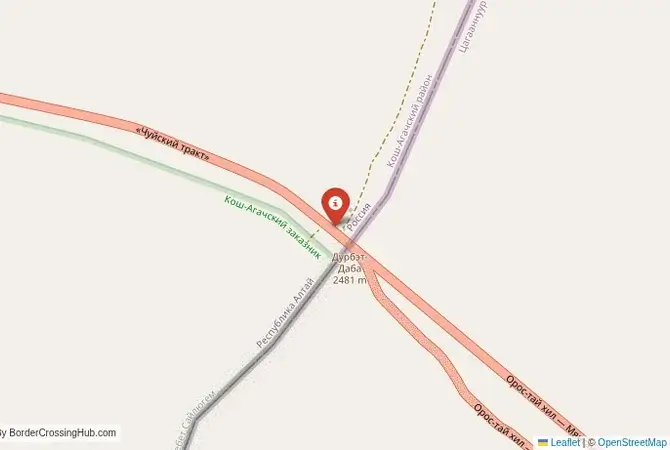
Monthly Update (October 2026):
Tashanta & Tsagaannuur enters October at the end of the main summer overland season, with no major new restriction reported. The Altai route becomes increasingly sensitive to colder weather as autumn progresses, particularly on the long approaches to the crossing. Travelers planning Tashanta & Tsagaannuur should therefore check road and weather conditions rather than assuming that summer travel conditions will continue through the month.
About this crossing
A History of an Ancient Crossroads
The Altai Mountains have been a crossroads of civilizations for millennia. This is the region where the Turkic, Mongolic, and Siberian worlds meet. It is famous for its incredible archaeological treasures, including the Scythian "ice maiden" burial mounds and thousands of ancient petroglyphs that adorn the rocks throughout the region. The modern border is a legacy of the Russian and Qing Empires, a line drawn through a region inhabited by nomadic peoples who had roamed freely for centuries, following their herds and the seasons. The Tsagaannuur-Tashanta crossing follows a traditional trade and migration route. During the Soviet era, it was a tightly controlled internal border, a sensitive frontier between the USSR and its satellite, the Mongolian People's Republic. After the collapse of the USSR, it became an international frontier. In recent years, it has gained fame as a key point on the "Mongol Rally" and other overland adventures, a legendary crossing for those driving across Eurasia. It is a border that feels ancient, a passage through a landscape that is saturated with history and shamanic tradition, where every mountain and valley seems to hold a story.
The Border Crossing Procedure: A Remote and Meticulous Affair
The border is open on weekdays during daylight hours only. It is closed on weekends and on all Mongolian and Russian public holidays. The process is formal and can be very slow and meticulous, especially on the Russian side. You must have a valid Russian visa obtained in advance. Exiting Mongolia (Tsagaannuur): The Mongolian border post is located in the small village of Tsagaannuur, about 25 kilometers before the actual border line. It is a simple, functional facility. You will present your passport to the immigration officer and get your exit stamp. The customs check is the more time-consuming part. If you are in a vehicle, the officials will conduct a thorough inspection. They will check your vehicle import papers and may ask to see your luggage. The process is generally friendly but can be slow, operating on a relaxed, rural pace. The No-Man's-Land: After clearing the Mongolian post, you will drive for 25 kilometers on a rough, unpaved road through a stunning, high-altitude valley. This is the no-man's-land, a beautiful and desolate stretch of true wilderness. Entering Russia (Tashanta): You will arrive at the Russian border post at Tashanta. The facility is modern but the process is notoriously slow and bureaucratic. You will first go through immigration. The officer will carefully scrutinize your passport and your pre-arranged Russian visa. You will fill out a migration card. The next step is customs, which can take several hours. The officials will conduct an exhaustive search of your car, often asking you to remove all of your luggage. They are professional but extremely thorough. Patience is absolutely essential. There is no room for haste at this border.
Nearby Border Crossings



Route, Onward Travel, and the Altai Republic
This crossing is for the self-sufficient traveler with their own vehicle. There is no public transport. On the Mongolian side, the border is about a 2-hour drive from the city of Ulgii, the capital of the Bayan-Ulgii province. The road is mostly paved but has some rough sections. Ulgii is the main center of the Kazakh eagle hunters of Mongolia, and a fascinating cultural hub. On the Russian side, from the Tashanta border, you are on the legendary Chuya Highway (R256), often cited as one of the most beautiful roads in the world. The highway is perfectly paved and winds its way through the spectacular scenery of the Altai Republic, a region of stunning mountains, turquoise rivers, and alpine lakes. The nearest major Russian town is Kosh-Agach. From there, the Chuya Highway continues north for several hundred kilometers to the cities of Gorno-Altaysk and Novosibirsk. This border is the perfect gateway to an unforgettable road trip through the Russian Altai, a region that is a UNESCO World Heritage site and a paradise for nature lovers and adventurers.
Final Planning Advice for the Altai Gateway
The Tsagaannuur-Tashanta crossing is a spectacular and rewarding adventure, but it requires careful planning. The key to success is to have your Russian visa sorted out months in advance and to have all your vehicle documents (registration, international driving permit, and insurance) in perfect order. Be prepared for a very long and slow customs process on the Russian side. Plan your crossing for a weekday and be aware of the numerous public holidays in both countries, as the border will be closed. Have plenty of fuel, food, and water, as the region is very remote. This crossing is a true adventure, a passage through a landscape of incredible beauty and deep history. For the patient and well-prepared overland traveler, it is one of the greatest border crossings in the world, a gateway to a land of epic landscapes and ancient secrets.
View all border crossings between Mongolia and RussiaPractical information
Fuel
Mongolia: <1 km - Russia: <1 km
Currency
Limited near Tsagaannuur (MNT, RUB)
Safety information
Restricted, remote risks
Connectivity
Basic 3G mobile coverage; no public Wi-Fi
Have you crossed here?
Help other travelers by sharing your experience, wait times, and any updates.