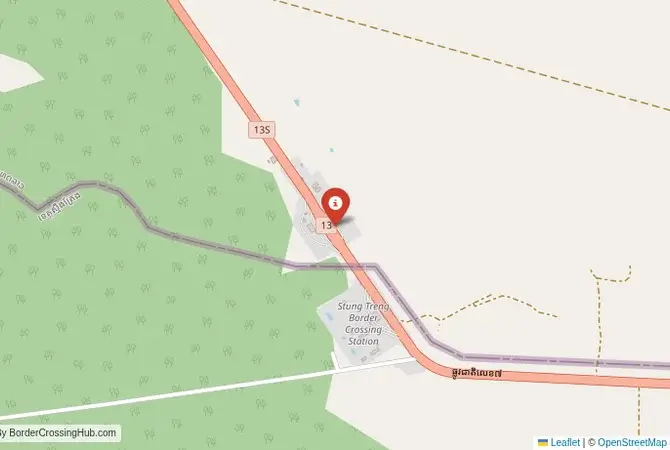
Monthly Update (September 2026):
Stung Treng & Veun Kham remains the Laos-Cambodia land gateway near the 4,000 Islands region. Current September border information identifies Dong Kralor-Veun Kham, also known as Trapeang Kriel, as the sole legal Laos-Cambodia land crossing, with passenger processing operating during daytime hours. There is no significant September closure reported, so travelers can continue to use the route, although the relatively short operating window makes an early arrival sensible.
About this crossing
A History of a New Connection
For most of history, there was no formal border crossing here. The region was a remote and sparsely populated area, and movement between what is now southern Laos and northern Cambodia was largely unrestricted for the local population. The modern border crossing is a relatively recent creation, developed to formalize the growing overland tourist route. The construction of a bridge over a Mekong tributary and the paving of the road (National Highway 7 in Cambodia and National Highway 13 in Laos) as part of the Asian Highway network (AH11) was a major development. It turned a difficult, muddy track into a viable, all-weather route. The crossing is a testament to the rise of independent, overland travel in the region and the efforts of both governments to facilitate this movement. It remains, however, a remote outpost, a single point of connection on a long and often wild frontier.
The Border Crossing Procedure: A Remote and Sometimes Tricky Process
The border is open from 07:00 to 17:00 daily. The process is straightforward in theory, but this crossing has a notorious reputation for scams and unofficial "fees" demanded by officials on both sides. A patient, polite, but firm approach is necessary. Reports from 2025–2026 continue to note persistent minor corruption attempts, particularly on the Cambodian side. Exiting Laos (Veun Kham): The Lao immigration post is a simple building in the village of Veun Kham. You will present your passport to the officer. They will stamp you out of the country. It is common for the Lao officials to ask for a small "stamping fee" of a dollar or two, especially if it is lunchtime or late in the day. While this is not official, it is often easier to pay it than to argue. The No-Man's-Land: After the Lao post, you will travel a few kilometers through a dusty no-man's-land to the Cambodian side. If you are on a direct tourist bus, the bus will drive you. If traveling independently, you may need to walk or hire a motorbike taxi. Entering Cambodia (Dong Kralor): The Cambodian post at Dong Kralor is a larger facility. Here, you will need to get your Cambodian visa on arrival (available for most nationalities). This is where you need to be most vigilant. You will need to fill out an application form, provide a passport photo, and pay the visa fee in US dollars. Officials here are known for trying to overcharge for the visa, demanding extra for a "health check" form, or insisting on payment in a different currency at a terrible rate. Know the official visa fee in advance, have the exact amount in clean US dollar bills, and politely refuse to pay any extra charges. After getting your visa, you will get your entry stamp. Again, a small, unofficial stamping fee may be requested.
Nearby Border Crossings


Route, Transportation, and Onward Travel
The most common and recommended way to navigate this crossing is by taking a direct tourist bus or minivan. Numerous companies in the 4000 Islands (Don Det) in Laos and in Stung Treng or Kratie in Cambodia sell through-tickets. This is the most hassle-free option, as the bus company will guide you through the border process and handle the transport in the no-man's-land. If you travel independently, you will need to take a local bus or boat to the Lao border town, then find transport across the no-man's-land, and then find another bus or shared taxi on the Cambodian side to the city of Stung Treng. This is more adventurous but requires more time and effort. From Stung Treng, you can get buses to Kratie (the best place to see the rare Irrawaddy dolphins in Cambodia), Siem Reap, or the capital, Phnom Penh. The road in northeastern Cambodia is paved but can be rough in places.
Final Planning Advice for the Southern Laos Gateway
The Veun Kham-Dong Kralor crossing is an essential link for the Southeast Asia overland trail. It is a remote and rustic border with a reputation for minor corruption. The key to a smooth crossing is to be well-informed and prepared. Know the official visa fee and have the exact amount in US dollars. Be prepared for the requests for small, unofficial stamping fees and decide in advance how you want to handle them. Taking a direct tourist bus is the easiest way to manage the logistics. By being prepared for the small hassles, you can enjoy the journey through a beautiful and remote part of the Mekong region, a passage that takes you from the tranquil islands of Laos to the wild and adventurous heart of northeastern Cambodia.
View all border crossings between Laos and CambodiaPractical information
Fuel
Laos: <1 km - Cambodia: <1 km
Currency
Limited exchange (LAK, KHR)
Safety information
Safe, remote area
Connectivity
Limited Wi-Fi, 3G
Have you crossed here?
Help other travelers by sharing your experience, wait times, and any updates.