Monthly Update (September 2026):
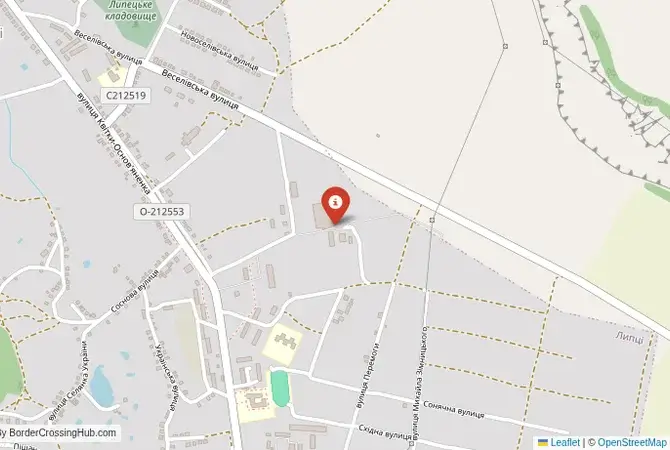
Strilecha & Zhuravlyovka remains unavailable for normal international travel. The crossing lies directly in the conflict-affected Kharkiv border zone, where civilian movement remains heavily restricted. There is no September reopening to report. For international travelers, this remains a non-operational frontier rather than a usable road crossing.
About this crossing
Operational Details
This checkpoint connected Ukraine's Kharkiv Oblast with Russia's Belgorod Oblast. It was a smaller crossing, likely with limited hours, intended for passenger cars and local traffic. Its purpose was to facilitate the everyday life of a region where the international border cut through a continuous landscape of settlement. It allowed people to access their dachas, visit relatives, or travel between villages without making the longer journey to the main highway crossing at Hoptivka-Nekhoteyevka. It was a crossing born of local necessity.
A History of an Integrated Region
The history of this region is one of almost complete integration with the city of Kharkiv. The villages on both sides of the border were effectively suburbs or exurbs of the great city. During the Soviet era, the administrative line between the Ukrainian SSR and the Russian SFSR was of little consequence. After 1991, the new international border created a major complication for the local residents. The Strilecha-Zhuravlyovka crossing was a pragmatic solution that allowed a semblance of normal life to continue. It was a place where the border was a formality to be navigated in the course of a daily routine.
Nearby Border Crossings
Former Border Procedure
The border crossing procedure, when it was operational, was a standard two-part process. Travelers would first complete exit formalities at the Ukrainian checkpoint at Strilecha. They would then proceed to the Russian entry checkpoint at Zhuravlyovka for a full inspection by the Russian Border Guard Service and Federal Customs Service. A valid passport and, if required, a Russian visa were necessary. As a smaller, local crossing, the process was generally less formal and faster than at the main highways, serving a community that was familiar to the guards on both sides.
The Surrounding Region
The surrounding area is a densely populated, agricultural and recreational region on the immediate northern outskirts of Kharkiv. On the Ukrainian side, Strilecha is a significant village that has been on the frontline of the war since 2022. On the Russian side, the crossing leads into the Belgorod Oblast. The entire region is characterized by its close proximity to the two major cities of Kharkiv and Belgorod. It is a landscape that, until recently, was defined by its peaceful, suburban character.
Transformation into a Conflict Zone
The closure of this crossing was an immediate consequence of the full-scale Russian invasion of Ukraine in February 2022. This area was on the direct line of advance for Russian forces attacking Kharkiv from the north. The village of Strilecha was occupied. After the liberation of the area in the September 2022 Ukrainian counteroffensive, the border became an intense frontline. The village and the surrounding area have been subjected to constant and devastating shelling, and in May 2024, it became one of the focal points of a new Russian offensive into the Kharkiv region, with the situation unchanged as of early 2026.
Final Considerations
The Strilecha–Zhuravlyovka border crossing was once a symbol of the deep, everyday integration of the Kharkiv-Belgorod cross-border metropolitan region. It was a place of routine, local travel. Today, it is a name synonymous with intense combat and destruction. It is a stark example of how the war has turned the most peaceful and integrated of places into the most dangerous. The quiet country road that once connected suburban villages is now a fortified and deadly no-man's-land, a tragic symbol of a community and a relationship that has been utterly shattered by the invasion.
View all border crossings between Ukraine and RussiaPractical information
Currency
Local exchange UAH, RUB
Safety information
Security screening
Connectivity
Checkpoint Wi-Fi, 4G/5G
Have you crossed here?
Help other travelers by sharing your experience, wait times, and any updates.