
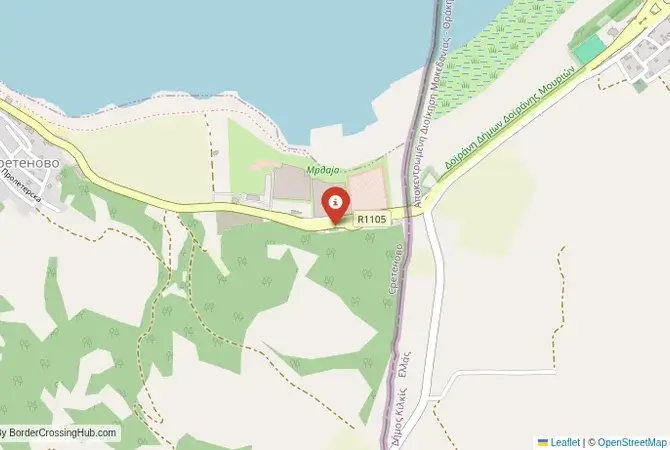
Approximate Border Location
Border Countries
Border Cities
- 🇬🇷Dojran region
- 🇲🇰Star Dojran
Wait Times
15–60 min average
Just crossed? Tap to report:
Operating Hours
06:00 AM–10:00 PM
Crossing Types
Pedestrians, private vehicles
Border Type
Land crossing via road
Peak Times
07–10 AM mornings
Daily Crossings
2,000–4,000 crossings
Currency Exchange
Limited locally (MKD, EUR)
Safety Information
Tourist flows, calm
Languages Spoken
Macedonian/Greek
Accessibility Features
Ramps, assistance offered
About Dojran region & Star Dojran
Monthly Update (March 2026):
As of 03/2026, the Dojran & Star Dojran Border Crossing ticks along quietly near the lake. Cars pass through routine passport checks with short waits most of the time. Late morning often brings the most vehicles. Tourism around Lake Dojran can add small bursts of traffic.
No Cell Service at the Border? No Problem.
Don’t get caught scrambling for paperwork when you lose signal. Download the complete Europe Transit Guide directly to your device and access every critical detail, fast-track strategy, and border rule – 100% offline.
A Crossing on a Historic Lake
The border crossing connecting the town of Star Dojran in North Macedonia with the area near the village of Dojran in Greece is a journey through a landscape of poignant history and remarkable ecological resilience. This is a secondary checkpoint, a quiet road that runs along the shore of the beautiful and historic Dojran Lake. To cross here is to travel through a region that was a major battlefield during World War I and whose lake suffered a catastrophic ecological disaster in the late 20th century. Today, it is a peaceful passage, a symbol of the recovery of both the natural environment and the cross-border relationship.
Operational Details
This checkpoint connects the Southeastern Statistical Region of North Macedonia with the Kilkis regional unit of Greece. It is a smaller international crossing, open 24/7, and intended for passenger cars and local traffic. The exclusion of heavy freight preserves the tranquility of this tourist and recreational area. The crossing is particularly popular with tourists and local residents, especially during the summer months when the lake resorts are busy. The road offers beautiful views of the lake and the surrounding hills. Recent reports show occasional wait times up to 30-40 minutes during peaks, though generally shorter outside high season.
A History of a Battlefield and an Ecological Recovery
The history of this region is dominated by two major events. During World War I, the area around Dojran Lake was the site of a series of brutal battles on the Macedonian Front between the Allied forces (led by the British and Greeks) and the Bulgarian army. The original town of Dojran was completely destroyed in the fighting, and the area is dotted with military cemeteries and memorials. In the late 20th century, the lake suffered a near-total ecological collapse due to the over-extraction of its water for agriculture. A major, internationally-funded restoration project in the early 2000s, which involved diverting water from a nearby river, has brought the lake back to life. The open border has been a key part of the joint effort to manage and protect the trans-boundary lake ecosystem.
Border Crossing Procedure
The border crossing procedure is a rigorous process, reflecting its status as an entry point into the EU and the Schengen Area. You will first complete exit formalities at the Macedonian checkpoint at Star Dojran. After a short drive, you will arrive at the Greek checkpoint at Dojran for a full EU/Schengen entry inspection by the Hellenic Police and customs authorities. You will need a valid passport, a Schengen visa (if required for your nationality), vehicle registration, and international insurance (Green Card). As a smaller crossing, the process is usually quicker than at the main highway at Evzoni, but queues can form during the summer.
The Surrounding Region: North Macedonia Side
On the North Macedonian side, the main attraction is the resort town of Star Dojran. The town is famous for its unique, traditional fishing method using cormorants to drive fish into nets, which is practiced in the shallow waters near the shore. The town has a pleasant promenade, numerous fish restaurants, and beaches that are popular with summer visitors. The area is also known for its therapeutic mud. The town is a peaceful and relaxing destination, a world away from the bustle of the larger resorts.
The Surrounding Region: Greece Side
On the Greek side, the village of Dojran is smaller and quieter. The main attraction is the large and moving British military cemetery from World War I, a poignant reminder of the region’s history. The area is a gateway to the Kilkis region, a land of rolling hills and agriculture. The crossing also provides access to the city of Thessaloniki, the second-largest city in Greece, which is about an hour’s drive away.
Practical Travel Information
Practical planning for this route is straightforward. The coastal road on both sides of the border is well-maintained and scenic. The official currencies are the Macedonian Denar (MKD) in North Macedonia and the Euro (EUR) in Greece. Currency exchange facilities are available at the border. You will need to purchase an electronic vignette for your vehicle for North Macedonia if you plan to use the main road networks. Greece uses a toll system on its main motorways. Ensure your vehicle’s Green Card insurance is valid for both countries.
Final Considerations
The Star Dojran–Dojran border crossing is a journey through a landscape of profound history and inspiring natural recovery. It offers a peaceful and scenic alternative to the main highway. It is a crossing that connects two parts of a shared lake, a place where the memory of past conflicts is honored and a new future of environmental cooperation is being built. For the traveler interested in history, nature, and a more relaxed pace of life, it is a beautiful and highly recommended route.
No reviews yet.