
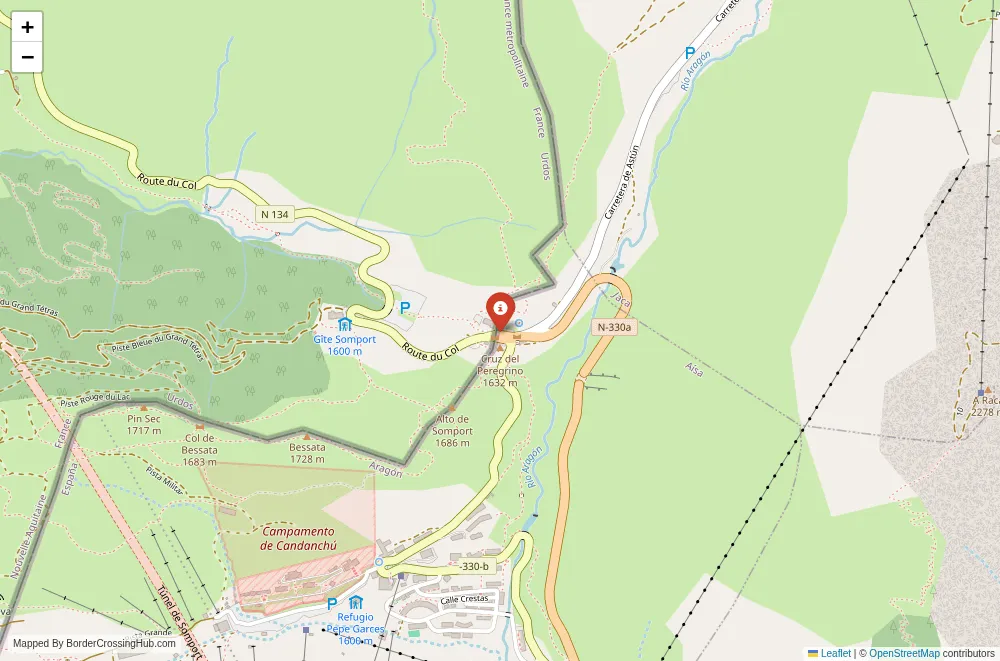
Approximate Border Location
Wait Times
Cars 5-25m; peaks 30-120m incidents
Just crossed? Tap to report:
Operating Hours
Open 24 hrs; tunnel controls as needed
Crossing Types
Cars,buses,trucks; tunnel rules apply
Border Type
Land crossing via road tunnel (Somport)
Peak Times
08:00-11:00 AM; 04:00-07:00 PM; winter
Daily Crossings
3,000-12,000/day
Currency Exchange
EUR only; services/ATMs in Canfranc/Oloron
Safety Information
Tunnel hazards; weather and closures possible
Languages Spoken
French/Spanish
Accessibility Features
Paved areas; some accessible facilities
About Somport & Aragon
The Col du Somport border crossing rises to 1,632 meters in the central Pyrenees, linking the Spanish province of Huesca (Aragón) near Canfranc with the French Pyrénées-Atlantiques department near Urdos, serving as a key trans-Pyrenean route via a modern road tunnel and the historic high pass.
Location and Basic Connections
You approach this crossing along the N-134 (France) from Oloron-Sainte-Marie or the A-136/N-330 (Spain) from Jaca and Canfranc. The Somport road tunnel (8,465 meters long) bypasses the high col summit, carrying most traffic year-round. The old pass road (D-934/N-134 over the col) remains open for scenic use when weather allows. The tunnel connects directly between Urdos (France) and Canfranc (Spain), shortening travel between Pau and Zaragoza. Buses from Pau or Jaca reach valley bases, then private vehicles or taxis cover the climb. The route suits drivers, cyclists, and skiers linking southern France to Aragón, with the tunnel handling freight and tourists.
Alternative Names
This point is called Col du Somport, Puerto de Somport, Paso de Somport, Túnel de Somport, or the Canfranc-Urdos crossing.
Historical Background
The Somport pass has served as a trade and shepherd route for centuries, formalized in the 1659 Treaty of the Pyrenees. The road tunnel opened in 1970, replacing the exposed col road for winter reliability. The parallel Somport railway tunnel (7,875 meters, built 1915) once carried trains but closed for rail service in 1970 after an accident; it now functions as an emergency gallery for the road tunnel. Rehabilitation plans for the rail line (Zaragoza-Canfranc-Pau) advanced in 2025, with ADIF managing the €93 million project to reopen the tunnel, aiming for full international service by late 2020s. The pass ties into the Camino de Santiago and historical pilgrim routes.
Geopolitical Significance
Within Schengen, no permanent controls apply at Somport. France’s temporary internal border checks (extended to April 30, 2026, due to terrorism threats, antisemitic incidents, migration smuggling, and public order) affect all internal Schengen frontiers including Spain, potentially involving random ID or vehicle inspections. These rarely disrupt Somport heavily compared to major highways. The tunnel supports tourism, winter sports access, and freight between Aragón and southern France. Recent years saw temporary road closures from landslides (e.g., September 2024 event), but the tunnel reopened December 20, 2024, after repairs, with normal operations in early 2026 aside from weather incidents and occasional night maintenance for heavy vehicles.
Practical Crossing Procedures
You drive through the tunnel or over the col without stopping under normal Schengen rules. No fixed booths exist; random patrols may request ID, check documents, or inspect goods. Most nationalities cross freely (90 days visa-free short stay in Schengen). Carry your passport or ID for any verification. Vehicles need registration, insurance, and chains in winter. The tunnel prohibits pedestrians, bicycles, and certain hazardous loads; heavy vehicles face night restrictions (e.g., 2200-0600 when enforced). Customs limits apply for alcohol, tobacco, or other items; declare excesses. The old col road adds scenic but slower travel.
Typical Wait Times and Operating Hours
The tunnel operates 24/7 when open, with no queues in clear flow. Random checks take minutes. The col road closes seasonally from snow/ice. Recent 2026 incidents (e.g., brief truck bans or avalanche risks) added short delays, but the tunnel reopened reliably post-2024 repairs.
Transportation Options
Private cars or motorcycles handle the route best. Regional buses reach Jaca (Spain) or Oloron-Sainte-Marie (France), then taxis or rideshares continue. No direct public buses cross routinely. Cycling is popular for the col road’s challenge. The tunnel suits most vehicles; the high pass appeals to adventurous drivers or bikers.
Road Conditions and Scenery
The tunnel stays well-maintained, wide, and lit. The old col road features steep switchbacks, narrow lanes, and exposure to weather. Scenery shifts from deep valleys and forests to open alpine meadows, peaks, and reservoirs. Winter demands chains; summer offers clear views but possible rockfall.
Scams and Warnings
Remote Pyrenean passes see few scams. Weather risks dominate: avalanche closures or ice strand drivers; carry supplies and check status. Random checks may occur; cooperate. The area has low crime but high mountain driving risks. Monitor official sites or apps for closures, especially winter.
Nearby Attractions
Canfranc (Spain) features the grand international station ruins and access to Ordesa y Monte Perdido National Park. Urdos (France) offers quiet valley life and trails. The pass links to skiing (Candanchú, Astún) or hiking in the Pyrenees. The rail tunnel rehabilitation promises future tourism boosts.
Seasonal Variations and Delays
Winter brings frequent snow, ice, and avalanche risks with chain needs or short closures. Summer provides reliable access and peak traffic. Recent repairs stabilized the route post-2024 landslide.
Cultural and Economic Role
The crossing sustains ties between Val d’Aran and upper Garonne areas, boosting tourism and local trade. It blends Aragonese, Catalan, and Occitan influences in mountain culture.
Final Planning Notes
Carry ID, chains in winter, and check status via official sites or phone lines. This suits drivers ready for mountain conditions and potential weather waits.
Crossing This Central Pyrenean Tunnel
Col du Somport provides a reliable, tunnel-based border hop in the Pyrenees, linking Aragón and southern France with minimal formalities when open. Stay updated on weather and occasional checks for a safe passage across this historic mountain route.
No reviews yet.