
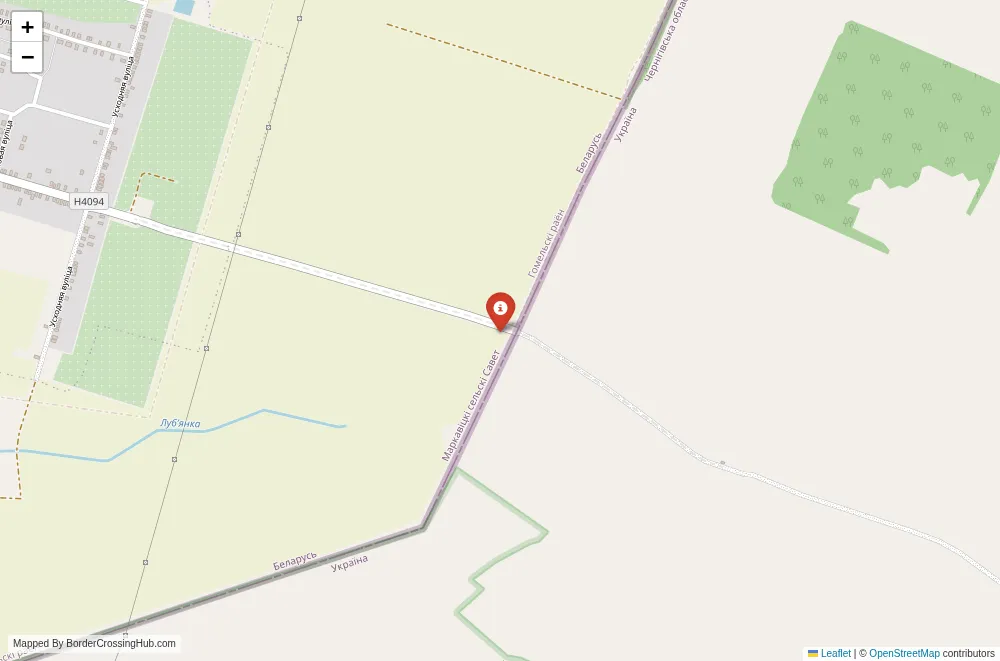
Approximate Border Location
Wait Times
Closed/very limited; delays 240-720m if open
Just crossed? Tap to report:
Operating Hours
Hours variable; confirm before travel
Crossing Types
Ped,cars if permitted; full controls
Border Type
Land crossing via rural road
Peak Times
N/A; access limits
Daily Crossings
0-150/day
Currency Exchange
BYN; UAH; some USD; ATMs scarce
Safety Information
High security; restrictions likely
Languages Spoken
Belarusian/Ukrainian
Accessibility Features
Minimal accessibility
About Slavečna & Vystupovychi
Monthly Update (March 2026):
As of 03/2026, the Slavečna & Vystupovychi Border Crossing remains largely inactive for regular travel. The checkpoint area stays quiet most days, with little visible vehicle movement. Border patrol presence is more noticeable than traffic itself. Activity can shift depending on regional security developments.
No Cell Service at the Border? No Problem.
Don’t get caught scrambling for paperwork when you lose signal. Download the complete Europe Transit Guide directly to your device and access every critical detail, fast-track strategy, and border rule – 100% offline.
The Slavečna-Vystupovychi border crossing (also known as Slavechna-Vystupovychi, Словечна-Виступовичі, or Teryukha/Slavechna to Vystupovychi in some transliterations) exists as a railway-only point on the Belarus-Ukraine border, situated within the broader Chernobyl exclusion zone context and serving primarily as a rail link between Gomel oblast in Belarus and Zhytomyr oblast in Ukraine.
Location and Basic Connections
This crossing ties the Belarusian railway station at Slavečna (Slovechno or Slovечна, near the village of the same name) to Vystupovychi station on the Ukrainian side, close to the settlement of Vystupovychi in Ovruch district, Zhytomyr oblast. The rail segment forms part of the historical lines connecting areas around Ovruch and Korosten in Ukraine to Mozyr or Gomel directions in Belarus. No road infrastructure supports this point; it remains strictly for trains, with the border area overlapping the Chernobyl-affected Polesia region of marshes, forests, and sparse population. Pre-closure, it handled occasional freight or limited passenger services on the regional network.
Historical Background
The rail infrastructure here dates to pre-Soviet and Soviet periods, when Polesia’s transport lines crossed what later became international borders without much disruption. Slavečna station and the line to Vystupovychi integrated into the broader network linking Ukrainian Volhynia and Zhytomyr regions to Belarusian Gomel oblast. In the Chernobyl zone vicinity (though not directly in the reactor exclusion area), the crossing reflected post-1986 adjustments for radiation monitoring alongside standard rail controls. Before 2022, it supported minor cross-border rail traffic in a region of shared ethnic Belarusian and Ukrainian communities, where family ties and local economies blurred lines. The 2022 invasion halted operations entirely, as Belarus’s involvement in northern Ukraine offensives militarized the frontier, suspending rail links and turning infrastructure into a security concern.
Current Status and Safety Warnings
All Belarus-Ukraine border crossings, railway points like Slavečna-Vystupovychi included, stay closed to civilian and regular traffic as of early 2026. No trains carry passengers or routine freight across; the frontier maintains heavy military presence with patrols, barriers, and monitoring. The area poses significant dangers. Proximity to former conflict zones and the Chernobyl legacy increases risks from potential unexploded ordnance, residual contamination concerns, or active security enforcement. Unauthorized approaches to rail border segments lead to detention, fines, deportation, or escalation by guards on either side. Foreigners encounter particular restrictions and suspicion. Claims online about rail reopenings or bypasses lack verification and carry high risk. Consult your government’s travel advisory, Ukraine’s State Border Guard Service updates, and Belarusian border committee statements. Avoid the zone entirely.
Operating Hours and Wait Times
When the railway point operated, activity followed train schedules rather than set hours, with border processing aligned to arrivals and departures. Inspections for cleared trains remained relatively quick, depending on cargo or passenger volume. No such operations exist now; the crossing has no public activity.
Visa Requirements for Foreign Visitors
Pre-closure, Belarus permitted visa-free entry for many nationalities at rail borders, and Ukraine offered visa-on-arrival or e-visa facilities. Rail crossings needed valid tickets and documents, often limiting use to regional travelers. Indefinite closure makes visa rules inapplicable. Illegal crossing attempts result in serious legal action irrespective of passport.
Crossing Procedures Step by Step
Procedures centered on rail protocols in active times. Trains halted at Slavečna for Belarusian exit and customs checks, crossed the short border rail segment, then underwent Ukrainian entry and inspection at Vystupovychi station. Focus included document verification, cargo manifests, and security scans in basic station setups. No pedestrian crossing applied; all movement stayed on rails. Civilian procedures no longer occur; the segment falls under restricted military oversight.
Transportation Options
Rail provided the only access. Pre-closure required tickets on relevant lines, with coordination through operators for any passenger or freight service. No road, bus, or taxi options existed directly to the point. Closures eliminate rail passenger crossings, and approach paths face severe restrictions.
Road Conditions and Scenery
While no roads cross, nearby access involves rural tracks of gravel or dirt, prone to deterioration from weather. The Polesia environment features extensive pine and birch forests, wetlands, small rivers, and open fields with minimal development. The rail line traverses this flat, wooded terrain, offering isolated views of marshes and sparse villages in operational days.
Nearby Attractions
The crossing area holds no tourist interest. Vystupovychi remains a small settlement near the Chernobyl zone edge, with basic rural life. Zhytomyr oblast farther south includes historical sites like ancient towns or natural areas, but border proximity and restrictions limit access. Belarusian Gomel oblast side presents comparable quiet Polesia countryside, though the fortified border prevents visits.
Seasonal Variations and Weather Impacts
Rail in Polesia contends with winter snow delays, spring flooding on low lines, and summer storms or heat affecting tracks. Insects and humidity complicate warmer periods. Security and political decisions dominate over seasonal issues; any change depends on state-level resolutions.
Practical Travel Tips
Do not attempt travel here. For rail or border history research, use maps, official archives, and verified reports rather than site visits. In border regions of Ukraine or Belarus, comply with all security measures, keep distance from restricted areas, secure documents, and avoid rail or military photography.
Cultural and Economic Role
In functional times, it facilitated freight movement and limited passenger links, aiding regional exchanges of goods like timber or agricultural items. It reflected Polesia’s interconnected past, where rail supported communities across the border through shared economic and family patterns. Its overall impact stayed modest compared to larger corridors.
Final Note on This Rail Border Point
Slavečna-Vystupovychi lingers as an inactive railway trace on maps, closed and guarded amid persistent tensions. Omit it from travel plans and follow official sources for possible future developments. Stay safe on your next border pursuits.
No reviews yet.