Monthly Update (August 2026):
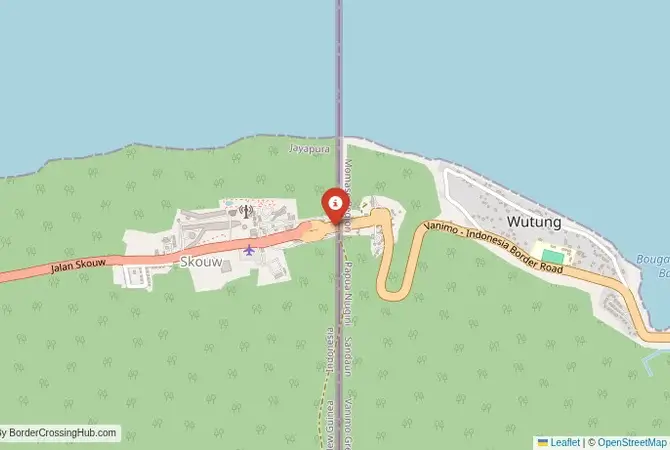
Skouw–Wutung remains the main road gateway between Indonesia and Papua New Guinea, with local cross-border movement continuing around the market area. There has been no major change to ordinary traveler access in August, although activity can rise around market days and local events. The crossing remains more important for people living around the border than for long-distance international travelers.
About this crossing
A History of a Colonial Line in a Pre-State World
The history of this border is the history of European colonialism imposing itself on a world that had no concept of modern nation-states. The island of New Guinea was divided in the 19th century, with the western half claimed by the Dutch (now Indonesia) and the eastern half eventually divided between Germany and Britain (the latter's portion later administered by Australia, and now the independent nation of Papua New Guinea). The border is a straight line drawn on a map, cutting through the traditional lands of hundreds of different indigenous tribes, many of whom were uncontacted at the time. For most of its history, the border was a theoretical line in a dense, impenetrable jungle. The Skouw-Wutung crossing was developed as the only official point of contact. The Indonesian government has recently invested heavily in building a massive, modern border post (PLBN) at Skouw, a project designed to boost economic development and to serve as a powerful symbol of Indonesian national pride and its presence in its easternmost province.
The Border Crossing Procedure: A Remote and Meticulous Process
This is a very quiet border with very little traffic. The border is open during daylight hours only, typically 8:00 AM to 4:00 PM Indonesian time (accounting for time difference with PNG). The process is formal, and you must have all your documents in perfect order. Visas are not available at the border for either country.Preparation: This is the most critical part. You must have a valid visa for the country you are entering, obtained well in advance from an embassy. For Papua New Guinea, this is a notoriously slow and difficult visa to obtain (apply for eVisa or physical in advance; no visa on arrival at land border). You will also need special permits (surat jalan) to travel in the Papua province of Indonesia, which you must arrange in advance in a city like Jayapura.Exiting Indonesia (Skouw): You will arrive at the very large and impressive Indonesian PLBN at Skouw. The facility is modern and clean. You will present your passport, your Indonesian visa, and your surat jalan to the immigration officer and receive your exit stamp. The customs check is usually a brief formality.The No-Man's-Land: After clearing the Indonesian post, you will walk a short distance through a well-maintained no-man's-land to the PNG side. The area is right on the coast, with beautiful views of the Pacific Ocean.Entering Papua New Guinea (Wutung): The PNG border post is a much more modest, rustic facility. You will present your passport and your pre-arranged PNG visa to the immigration officer. The officials are generally friendly but will check your documents carefully. They will stamp you into the country. The customs check is usually very informal. Once you are cleared, you are officially in Papua New Guinea.
Nearby Border Crossings


Route, Onward Travel, and Extreme Remoteness
This crossing is for the dedicated, self-reliant traveler. There is very limited public transport. On the Indonesian side, the border is about a 1.5 to 2-hour drive from the city of Jayapura, the capital of Papua province. You will need to hire a private car or take a shared taxi to get there. On the PNG side, the situation is even more challenging. The nearest major town is Vanimo, the capital of Sandaun Province, which is several hours away on a road that can be in very poor condition. There are usually some local PMVs (Public Motor Vehicles, the PNG equivalent of minibuses) waiting at the border, but their service can be infrequent. You must be prepared for a long and potentially difficult journey to Vanimo. Vanimo itself is a remote outpost with an airport that has flights to other parts of PNG, but these can be expensive and infrequent. There are no roads connecting Vanimo to the rest of the country; all onward travel is by air or sea.
Final Planning Advice for a True Frontier
The Skouw-Wutung crossing is one of the world's great overland adventures, a journey to a truly remote and fascinating frontier. It is not a trip to be undertaken lightly. The key to success is meticulous and lengthy pre-planning. The absolute first step is to secure your visa for Papua New Guinea, a process that can take months. You must also arrange your Indonesian travel permits. Be prepared for very limited infrastructure and challenging transport on the PNG side. This is a border for the experienced, patient, and resourceful traveler. The reward is the incredible experience of crossing the island of New Guinea on land, a journey that takes you through a world of immense cultural diversity and wild, natural beauty. It is a passage between two halves of a single, extraordinary island, a true adventure at the edge of the modern world.
View all border crossings between Indonesia and Papua New GuineaPractical information
Fuel
Indonesia: <1 km - Papua New Guinea: ~45 km
Currency
Limited exchange (IDR, PGK)
Safety information
Restricted, tribal area
Connectivity
Limited Wi-Fi, 3G
Have you crossed here?
Help other travelers by sharing your experience, wait times, and any updates.