Monthly Update (September 2026):
Sitnica & Zupci remains a useful Montenegro-Bosnia and Herzegovina crossing on the Herceg Novi-Trebinje route, with no significant September closure identified. Traffic across the Montenegro-Bosnia frontier has been variable in early September, with the larger crossings sometimes developing substantial waits while smaller routes remain easier. The crossing is particularly useful for travelers approaching Trebinje from the Bay of Kotor area. Checking current traffic before departure is worthwhile, as conditions can change considerably during the day.
About this crossing
Operational Details
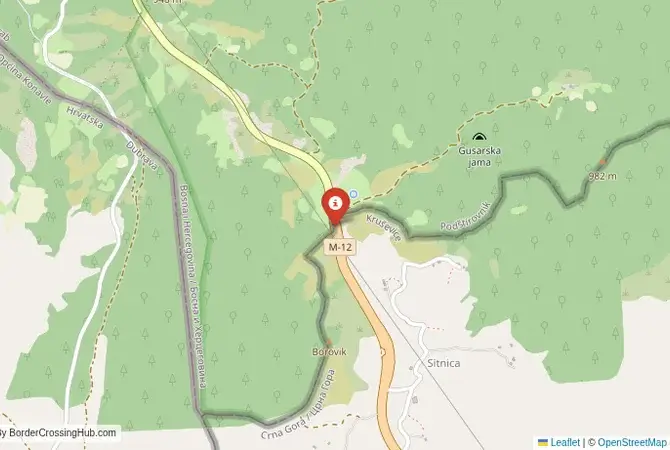
This checkpoint connects the Herceg Novi Municipality of Montenegro with the Trebinje Municipality of Bosnia and Herzegovina. It is a secondary international crossing, open 24/7, and intended for passenger cars and local traffic. The exclusion of the heaviest freight traffic, which uses the main crossing at Ilino Brdo-Klobuk, helps to preserve the character of this route. The road is a winding, two-lane mountain road. The crossing can be a good alternative to the main coastal crossing into Croatia at Debeli Brijeg for those traveling from the Bay of Kotor to Trebinje and beyond, often allowing you to bypass the long summer queues.
A History of a Military Frontier
The history of this region is the history of a heavily fortified military frontier. During the rule of the Austro-Hungarian Empire, the mountains above the Bay of Kotor were turned into a massive fortress, with a network of roads, forts, and gun emplacements built to defend the empire's main naval base. The road that this crossing is on was part of this strategic network. The modern border, established after the breakup of Yugoslavia, follows the historic administrative lines. The opening of this border has turned a former military road into a scenic tourist route, allowing travelers to explore this fascinating and once-secretive landscape.
Nearby Border Crossings

Border Crossing Procedure
The border crossing procedure is a standard two-part process. You will first complete exit formalities at one country's checkpoint and then proceed to the other country's checkpoint for entry inspection. You will need a valid passport or, for citizens of many European countries, a national ID card. Vehicle registration and international insurance (Green Card) are also necessary. As a smaller crossing, the process is generally quick and personal, with none of the queues that can form at the main crossings. The checkpoints are simple, functional facilities in a remote mountain setting.
The Surrounding Region: Montenegro Side
On the Montenegrin side, the crossing is in the hinterland of the beautiful city of Herceg Novi, which guards the entrance to the magnificent Bay of Kotor. The road to the border climbs steeply from the coast, offering spectacular views. The area is dotted with the ruins of Austro-Hungarian forts, which are fascinating to explore. The crossing is a gateway to the Orjen mountains, a wild and beautiful limestone massif that is popular with hikers and mountaineers.
The Surrounding Region: Bosnia and Herzegovina Side
On the Bosnian side, the crossing is the gateway to the beautiful city of Trebinje, the southernmost city in Bosnia and Herzegovina. Trebinje is a charming city with a beautifully preserved Ottoman-era old town, a famous stone bridge, and numerous Serbian Orthodox monasteries, including the magnificent Hercegovačka Gračanica, which offers stunning panoramic views. The city is the center of a wine-producing region and is known for its relaxed, Mediterranean atmosphere. The crossing is also a gateway to the famous city of Mostar, with its UNESCO-listed Old Bridge.
Practical Travel Information
Practical planning is essential for this route. You must have a suitable vehicle and be comfortable with narrow, winding mountain roads. The official currencies are the Euro (EUR) in Montenegro and the Bosnian Convertible Mark (BAM) in Bosnia and Herzegovina. There are no services at the border itself. You must be self-sufficient with fuel, food, and water. Ensure your vehicle's Green Card insurance is valid for both countries. The road is paved and well-maintained but requires careful driving.
Final Considerations
The Sitnica–Zupci border crossing is a scenic and valuable alternative for travel between the Montenegrin coast and Herzegovina. It offers a journey through a region of stunning natural beauty and fascinating military history. For travelers looking to avoid the coastal crowds and explore the beautiful hinterland, it is an excellent choice. It is a passage that connects the blue of the Adriatic with the green of the Herzegovinian hills, a journey into the beautiful and complex heart of the Dinaric Alps.
View all border crossings between Montenegro and Bosnia and HerzegovinaPractical information
Fuel
Montenegro: ~20 km - Bosnia and Herzegovina: ~15 km
Currency
Euro, BAM nearby
Safety information
Narrow roads, caution
Connectivity
Mobile data available
Have you crossed here?
Help other travelers by sharing your experience, wait times, and any updates.