
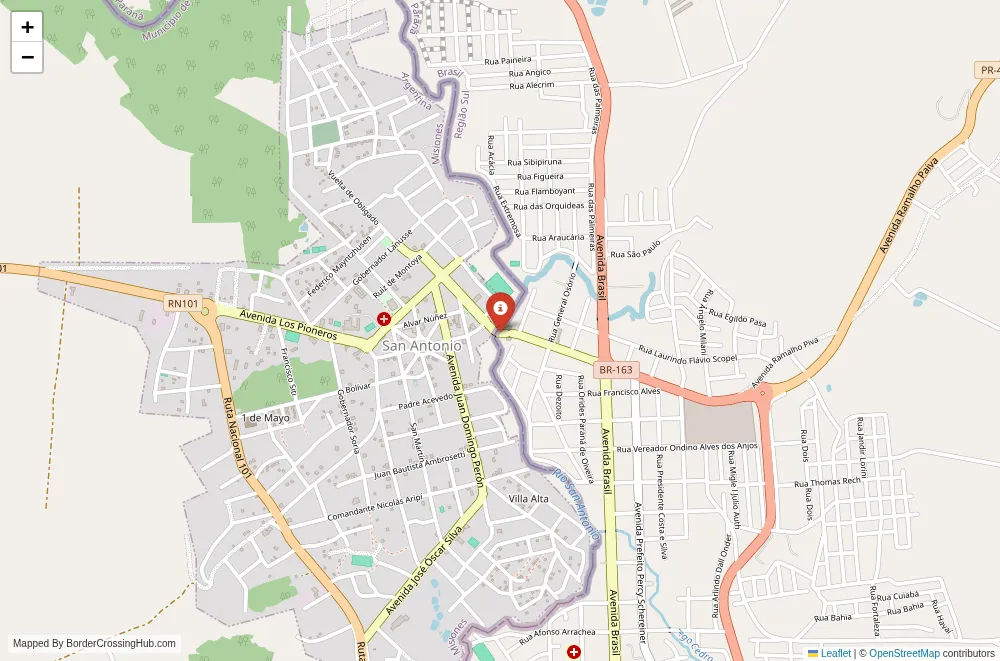
Approximate Border Location
Wait Times
Cars 5-20m; peaks 30-75m
Just crossed? Tap to report:
Operating Hours
Open 24 hrs (12:00 AM-11:59 PM)
Crossing Types
Ped,cars,buses; light freight
Border Type
Land crossing via road checkpoint
Peak Times
07:00-09:00 AM; 05:00-08:00 PM; weekends
Daily Crossings
800-3,000/day
Currency Exchange
AR$; R$ near center; ATMs available
Safety Information
Urban crossing; watch theft in busy times
Languages Spoken
Portuguese, Spanish, English
Accessibility Features
Sidewalk cuts; some step-free counters
About San Antonio & Santo Antônio do Sudoeste
The San Antonio-Santo Antônio do Sudoeste border crossing bridges the narrow San Antonio River in northern Misiones province, Argentina, directly connecting the small town of San Antonio to its twin city in Paraná state, Brazil.
Location and Connections
You find this crossing in the northeastern tip of Misiones, where the San Antonio River forms the natural divide. San Antonio sits on the Argentine bank, linked by a short bridge to Santo Antônio do Sudoeste on the Brazilian side. The bridge handles both vehicles and pedestrians, with the towns practically merging across the water—immigration posts lie just 150 meters apart in an urban setting. From Argentina, Ruta Nacional 101 approaches from the west, connecting to larger routes toward Posadas or Oberá. In Brazil, local roads tie into the regional network around western Paraná, offering access toward Pato Branco or Francisco Beltrão.
Historical Background
The San Antonio River has served as the boundary since late 19th-century treaties resolved colonial-era disputes between Argentina and Brazil, with the thalweg line formalized after an 1895 arbitral award. This crossing emerged later, with the bridge built in 1987 to replace informal fords or small ferries used by locals. It became the last major segment of the Argentina-Brazil frontier to gain a fixed link. The area has always centered on agriculture, including yerba mate and soy, with cross-border family ties and trade defining daily life in these twin towns.
Current Status and Operating Hours
The paso remains open year-round, with Argentine sources listing 24-hour availability in some records, though practical operations align more closely with 7:00 AM to 11:00 PM or similar windows based on recent patterns. Brazilian controls, managed by the Federal Police and customs, have expanded since early 2023 to include full tourist processing, often running 7:00 AM to 7:00 PM daily, with possible extensions during summer peaks. Seasonal adjustments occur, especially for tourism flows. River levels rarely affect this bridge, but always check argentina.gob.ar or Brazilian federal police updates right before crossing, as hours can shift with administrative decisions.
Visa Requirements for Foreign Visitors
Most nationalities enter Argentina and Brazil visa-free for tourism, typically up to 90 days each. Your passport should remain valid for at least six months past entry. No on-site visas apply here; handle any required Brazilian visa at a consulate beforehand if your nationality demands it. Both sides stamp passports at their posts. Carry onward travel proof and sufficient funds, though checks usually stay light for tourists passing through.
Crossing Procedures and Wait Times
The process keeps it basic in this low-traffic spot. From Argentina, complete exit immigration and customs near the bridge approach, then cross the short span. Brazilian entry follows immediately on the other end, with immigration, customs declarations, and occasional vehicle inspections. The reverse mirrors this. Queues seldom top 20 to 40 minutes, even on busier days, thanks to modest volumes of locals, shoppers, and occasional tourists. Pedestrians walk across easily; vehicles roll straight over.
Transportation Options and Road Conditions
Buses from nearby Argentine towns like San Pedro or Oberá reach San Antonio, with short taxis covering the final bit to the bridge. Private cars work well on paved RN 101. On the Brazilian side, local transport connects to regional highways. Roads stay mostly paved through rolling hills dotted with farms and forest patches. Some secondary links include gravel, so rain can make them slick. The scenery includes open fields, small plantations, and the quiet river valley.
Scams and Warnings
This twin-city crossing attracts few targeted tourist scams due to its local focus, but shoppers sometimes face inflated prices from informal vendors on either side. Avoid unofficial money changers offering bad rates or “helpers” pushing unnecessary services. Customs rules limit duty-free goods—Brazil allows up to US$500 in purchases from Argentina without tax—leading to occasional overzealous checks or fines for undeclared items like wine or electronics. Reports note wine smuggling as a regional issue, so stick to personal-use quantities. Petty theft stays low, but secure belongings in busier market areas.
Nearby Attractions and Practical Tips
San Antonio offers little beyond border-town basics, but serves as a launch point for Misiones countryside exploration, including yerba mate routes. Santo Antônio do Sudoeste provides access to Paraná’s rural interior. Carry Argentine pesos, Brazilian reais, and small USD for fees or buys. Insect repellent helps in the humid subtropical climate. Summer months bring heat, crowds for shopping, and possible heavier rain; winter offers milder temperatures and quieter days. Stock water and snacks, as amenities remain simple.
Cultural and Economic Role
Daily crossings sustain strong ties between the twin towns, with Argentines shopping in Brazil or vice versa for cheaper goods, while workers commute across for jobs. Agriculture and small trade drive the economy, with the bridge easing family visits and local commerce in this remote frontier pocket.
Final Crossing Advice
Confirm current hours and any seasonal notes via official migration sites before heading out. Arrive prepared with documents, cash, and realistic time buffers for checks. This straightforward bridge delivers an authentic, low-key experience of binational life in Misiones-Paraná, great for those exploring quieter corners of the Argentina-Brazil border. (Word count: 948)
No reviews yet.