
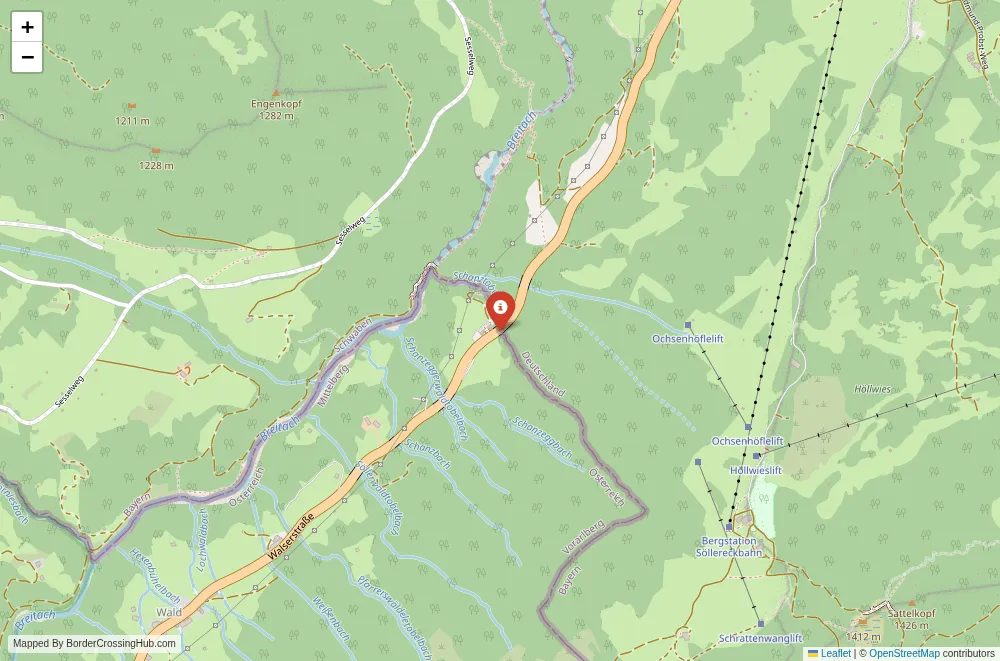
Approximate Border Location
Wait Times
Cars 0-20m; peaks 30-150m ski days
Just crossed? Tap to report:
Operating Hours
Open 24 hrs (12:00 AM-11:59 PM)
Crossing Types
Ped,cars,buses; valley road
Border Type
Land crossing via valley road (Kleinwalsertal)
Peak Times
09:00 AM-12:00 PM; Dec-Mar; weekends
Daily Crossings
6,000-25,000/day
Currency Exchange
EUR only; ATMs in Oberstdorf/Hirschegg
Safety Information
Avalanche/snow controls possible
Languages Spoken
German
Accessibility Features
Accessible buses; sidewalks mostly step-free
About Salzburg & Berchtesgaden
Monthly Update (March 2026):
As of 03/2026, the Salzburg & Berchtesgaden Border Crossing sees steady daily traffic and feels mostly stable. Cars move easily along the regional road, though afternoon commuting can slow the German side slightly. Midday crossings tend to pass quickly. Tourist visits to the national park area sometimes add more movement.
No Cell Service at the Border? No Problem.
Don’t get caught scrambling for paperwork when you lose signal. Download the complete Europe Transit Guide directly to your device and access every critical detail, fast-track strategy, and border rule – 100% offline.
The Salzburg-Berchtesgaden crossing carries you south from the lively streets of Salzburg into the dramatic Bavarian Alps of Germany, along a valley road that winds through forested hills toward Berchtesgaden and its national park heartland.
Location and Connections
You reach this crossing on the B150/B160 (often signed as B305 after the border) from Salzburg, passing through Grödig before the line near Marktschellenberg or Schellenberg. Salzburg city center sits about 10 to 15 minutes north. On the German side, the road continues as the B305 through Marktschellenberg to Berchtesgaden town, roughly 20 to 30 minutes further. From there, it links to Königssee lake, Obersalzberg, and the Berchtesgaden National Park. Cars, regional buses (RVO lines), motorcycles, cyclists, and occasional pedestrians use it. The route serves as a direct alternative to the A8/A1 motorway corridor west via Freilassing-Walserberg, favored by those heading to Berchtesgaden attractions or avoiding highway tolls and traffic.
Alternative Names
It appears as the Salzburg-Berchtesgaden border crossing, Grödig-Marktschellenberg crossing, or B150/B305 crossing near Schellenberg/Marktschellenberg.
Historical Background
The border traces older Austrian-Bavarian divisions shaped by salt trade rivalries and territorial swaps. Berchtesgaden secured Bavarian control in 1809 after earlier disputes. The valley road developed in the 19th century for access to alpine sites. Customs posts operated until Schengen eased things in the late 1990s. The crossing ties into regional history, from salt mining at nearby Dürrnberg to royal echoes in Berchtesgaden and Salzburg. Old guardhouses near Marktschellenberg remain as quiet nods to pre-Schengen days.
Geopolitical Context
Schengen since the late 1990s normally removes routine passport and customs checks for EU citizens and visa-exempt travelers. Germany and Austria keep no active temporary controls on this Bavaria-Salzburg border segment as of February 10, 2026 (unlike Germany’s checks on eastern borders or Austria’s on eastern neighbors like Czechia, Slovakia, Hungary, and Slovenia extended to June 2026 for migration and security). Random spot checks by police can happen on roads, though this valley route sees them less often than motorways. The border follows streams and ridges, marked simply without permanent infrastructure.
Practical Crossing Procedures
You drive across the road with a border sign or marker. No booths or systematic queues exist under normal Schengen flow. If a random check occurs, police may request ID and ask about travel purpose. EU citizens present passport or national ID. Non-EU nationals carry valid passports, visas/residence permits if needed, and basics like hotel bookings or return tickets. Vehicles require insurance; no vignette applies to this non-motorway path. Pedestrians and cyclists cross without special setup.
Typical Wait Times
You usually cross in seconds with no delay. Random checks might add 5 to 20 minutes depending on questions. Traffic builds moderately during tourist seasons, but the valley road handles it better than highways, with rare long backups.
Operating Hours
The road runs 24 hours daily, year-round. Schengen eliminated fixed hours. Winter snow or ice can slow the valley temporarily, but plowing maintains access.
Transportation Options and Road Conditions
Drive your car for flexibility; regional buses connect Salzburg to Berchtesgaden via this route or nearby. The B150/B305 offers good pavement through a green valley with gentle climbs, curves, and elevation staying modest. Views feature meadows, rivers, forests, and alpine peaks. Watch for buses, cyclists, or wildlife on rural parts. The drive feels relaxed compared to high passes.
Scams and Warnings
Scams stay rare at this tourist-friendly crossing. No common touts or fake services reported. Roadside stops near attractions sometimes charge more, but problems remain minor. The valley feels safe; drive carefully on curves or in wet/icy weather.
Nearby Attractions
Salzburg offers the old town, Hohensalzburg Fortress, Mozart sites, and Mirabell Gardens. Grödig adds the Untersberg cable car. Marktschellenberg features an old guardhouse and valley views. Berchtesgaden includes the town center, salt mines, and Obersalzberg historical sites. Königssee lake and Watzmann mountain provide stunning nature. Berchtesgaden National Park offers trails and wildlife. The route suits blending Salzburg culture with Bavarian alpine exploration.
Seasonal Variations and Weather Impacts
Winter snow December to March needs winter tires; roads ice in shaded areas. Summer brings tourists with clear conditions. Autumn foliage colors the valley with fewer crowds. Rain slicks surfaces occasionally, but closures stay uncommon.
Travel Tips and Preparation
Carry passport or ID for possible spot checks. Refuel in Salzburg or Berchtesgaden. Offline maps help in hilly spots. Pack layers for weather shifts. Check road and weather apps before departure. Follow marked paths if hiking.
Cultural and Economic Significance
The crossing fuels tourism from Salzburg to Berchtesgaden, linking Austrian city life with Bavarian nature and history. Shared alpine and salt heritage drives cross-border visits, supporting local economies through day trips, skiing, and hiking.
Before You Cross
Verify road and weather details from official sources near your travel date. With prep for alpine driving and rare checks, you handle this valley crossing and move between Salzburg’s vibrancy and Berchtesgaden’s mountains. Safe travels.
No reviews yet.