Monthly Update (October 2026):
Ruwaished & Turaibil remains an important but remote Iraq–Jordan crossing, linking western Iraq with Jordan's desert highway network. October travel remains shaped more by the long approach and regional security environment than by passenger queues at the checkpoint itself. There is no major new October closure to report, but travelers using this isolated route should confirm the crossing status before making the long journey to the border.
About this crossing
Operational Details
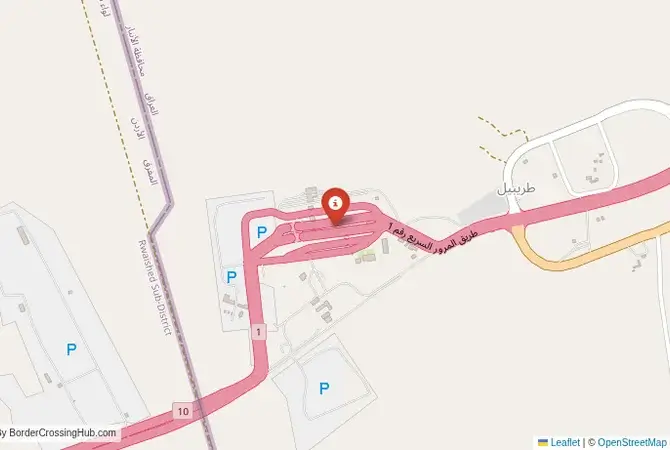
This checkpoint connects the Al-Anbar Province of Iraq with the Mafraq Governorate of Jordan. It is a major international crossing, and under stable conditions, it operates 24/7 for commercial freight and with specific hours for passenger traffic. The facility is large, designed to handle a significant volume of trucks and buses. It is the main route for Iraqi goods heading to the Jordanian port of Aqaba and for Jordanian goods entering Iraq. The crossing is located in an extremely remote part of the desert, with the nearest major cities, Amman in Jordan and Ramadi in Iraq, being hundreds of kilometers away.
A History of a Strategic Corridor
The history of this route is the history of the desert highway. For centuries, this was a path for camel caravans and Bedouin tribes. The modern border was established after World War I with the creation of the states of Iraq and Transjordan under British mandate. The highway was built as a strategic link. During the years of sanctions against Saddam Hussein's regime, this crossing became a vital lifeline for Iraq, with convoys of oil tankers and trucks forming the backbone of the "oil-for-food" program. After the 2003 US-led invasion, the highway became a notorious and dangerous route, a frequent target for insurgent attacks. In 2014, the crossing was captured by the Islamic State (ISIS), who held it for several years, severing this vital artery. Its recapture and reopening was a major strategic victory for Iraqi and Jordanian forces.
Nearby Border Crossings


Border Crossing Procedure
The border crossing procedure is a complex, multi-stage, and extremely thorough process, reflecting the high-security nature of the location. You will first complete exit formalities at one country's checkpoint, which involves multiple stops for passport control, customs, and security checks. You will then drive through a long neutral zone to the other country's checkpoint for their entry inspection. You will need a valid passport and visas for both countries, which must be obtained in advance. Vehicle registration and international insurance are also necessary. Expect detailed inspections of your vehicle and luggage, and be prepared for a very slow and meticulous process. The security presence on both sides is extremely high.
The Surrounding Region: Iraq Side
On the Iraqi side, the crossing is in the vast Al-Anbar Province, the largest in Iraq. The area is a harsh desert landscape. The road from the border leads towards the city of Ramadi and the infamous city of Fallujah, both of which were major centers of the insurgency and the war against ISIS and have been heavily damaged. The journey through Anbar is extremely dangerous, with the risk of IEDs, ambushes, and a volatile security situation.
The Surrounding Region: Jordan Side
On the Jordanian side, the crossing is in the Mafraq Governorate, part of the eastern Jordanian desert, known as the Badiya. The nearby town of Ruwaished is a small service center for the highway. The road from the border leads towards the capital city, Amman. The region is known for its "desert castles," a series of beautiful and unique early Islamic palaces and hunting lodges that are scattered throughout the eastern desert, such as Qasr Kharana and Qasr Amra, a UNESCO World Heritage site.
Practical Travel Information
Travel on this route is strongly discouraged for independent tourists. The security situation is extremely precarious. The official currencies are the Iraqi Dinar (IQD) in Iraq and the Jordanian Dinar (JOD) in Jordan. Services are extremely limited on the long desert highway. You must be completely self-sufficient with fuel, food, and water. Travel in a convoy is often a necessity. The climate is one of extreme heat in the summer and cold in the winter.
Final Considerations
The Turaibil–Karameh border crossing is a journey through one of the most challenging and dangerous regions in the Middle East. It is a vital economic artery that operates under the constant shadow of conflict. It is a testament to the resilience of the truck drivers and traders who brave the desert highway to keep their economies alive. For the traveler, it is a route that is best observed from afar, a powerful symbol of the deep-seated instability that continues to plague this historic and beautiful, but deeply troubled, part of the world.
View all border crossings between Iraq and JordanPractical information
Currency
Exchange nearby; IQD, JOD
Safety information
Security screenings
Connectivity
Wi-Fi, 4G/5G
Have you crossed here?
Help other travelers by sharing your experience, wait times, and any updates.