
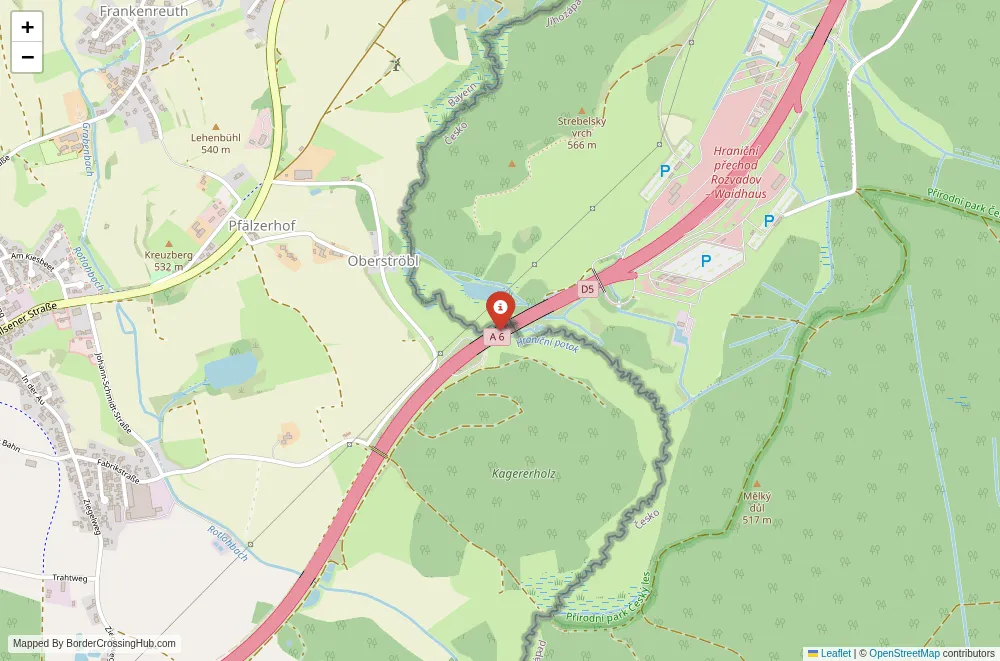
Approximate Border Location
Border Countries
Border Cities
- 🇨🇿Rozvadov
- 🇩🇪Waidhaus
Wait Times
Cars 0-20m; peaks 30-180m at controls
Just crossed? Tap to report:
Operating Hours
Open 24 hrs (12:00 AM-11:59 PM)
Crossing Types
Cars,buses,trucks; motorway crossing
Border Type
Land crossing via motorway (D5/A6)
Peak Times
Mon-Fri 02:00-07:00 PM; holiday returns
Daily Crossings
20,000-70,000/day
Currency Exchange
EUR; CZK at service areas; ATMs
Safety Information
High-speed corridor; queues during checks
Languages Spoken
German/Czech
Accessibility Features
Accessible rest stops; step-free toilets
About Rožany & Sohland an der Spree
Monthly Update (March 2026):
As of 03/2026, the Rožany & Sohland an der Spree Border Crossing stays quiet and mostly stable. Vehicles move freely along the small road linking the two towns, with only a handful of cars at a time. Afternoons sometimes see a few more commuters returning home. Local shopping trips and weekend travel can add a slight bump in activity.
No Cell Service at the Border? No Problem.
Don’t get caught scrambling for paperwork when you lose signal. Download the complete Europe Transit Guide directly to your device and access every critical detail, fast-track strategy, and border rule – 100% offline.
The Rožany-Sohland an der Spree crossing bridges a quiet corner of the Šluknov Hook in northern Bohemia with the Upper Lusatia region of Saxony, offering a local road link through gentle hills and forested valleys that sees mostly regional traffic.
Location and Connections
You reach this point in the part of Šluknov municipality called Rožany on the Czech side, directly opposite Sohland an der Spree in Germany. The crossing follows a local road from the Czech side (often signed toward Šluknov-Rožany) into Hohberg or central Sohland. From Šluknov, it’s a short 10 to 15 minute drive north. On the German side, Sohland lies about 20 minutes from Bautzen or 45 minutes to an hour from Görlitz. Cars, local buses, cyclists, and pedestrians use it primarily; no major motorway or heavy truck route runs here. The area connects smaller towns in the Czech borderland with Saxon communities, popular for cross-border shopping or short hikes.
Alternative Names
It goes by Rožany-Sohland an der Spree border crossing, Šluknov-Rožany / Sohland, or sometimes Rožany-Sohland (Hohberg) from older references. Rosenhain appears in some historical or local contexts tied to nearby areas.
Historical Background
The border here traces older regional divisions in Lusatia and Bohemia. The area saw German troops cross during the 1938 Sudetenland annexation under the Munich Agreement. Post-WWII, the Iron Curtain fortified it heavily from the late 1940s, with strict controls until 1989. A new road crossing opened in the early 2000s (around 2004-2005 based on reports), improving local ties after decades of separation. The region preserves mining and geological heritage, including nearby Ni-Cu sulfide deposits studied for their PGE mineralization. Today the crossing reflects post-Schengen normalization with minimal visible remnants of past barriers.
Geopolitical Context
Schengen since 2007 means no routine passport or customs checks normally. Germany keeps temporary controls on all Czech land borders due to migration and security concerns. As of February 10, 2026, these run at least through March 15, 2026, following extensions announced in late 2025. Random Bundespolizei stops occur for document verification, especially on roads entering Germany. This smaller crossing gets lighter attention than motorways, but spot checks happen. No fixed infrastructure blocks it. Review German Federal Police or Czech Ministry of Interior updates, as political decisions can extend or modify measures.
Practical Crossing Procedures
You drive straight across on the local road with a border marker signaling the line. Under temporary rules, police may stop you shortly after entering Germany for ID checks, brief questions on travel or stay, or quick vehicle looks. EU citizens show passport or national ID. Non-EU nationals need valid passports, visas/residence permits if required, and basics like accommodation proof. Carry car documents and insurance. Pedestrians and cyclists cross easily on the road shoulder or path. No vignettes needed for this non-highway route.
Typical Wait Times
Normal passage takes seconds with no delay. Random checks add variability: most vehicles clear quickly, but selected stops run 10 to 30 minutes depending on details or short queues. Local traffic stays light, so weekends or holidays bring minimal buildup compared to bigger points.
Operating Hours
The road remains open 24 hours daily, year-round. No fixed closures exist since Schengen. Winter weather might slow approaches briefly, but the crossing point stays passable.
Transportation Options and Road Conditions
Your own car offers the most convenience; local buses connect from Šluknov or nearby Czech towns, with German sides linking to Bautzen networks. No rail crosses directly here. The road winds through hilly, wooded terrain with decent pavement but some curves and elevation changes. Views feature fields, small forests, and the Spree valley nearby. Watch for local traffic, cyclists, or farm vehicles on rural stretches.
Scams and Warnings
Scams appear rare at this low-key spot with limited tourist flow. No frequent reports of touts, fake services, or border-related extortion exist. Nearby Czech border shops sell cheaper fuel, groceries, tobacco, alcohol, or Asian goods to Germans; occasional notes mention pushy vendors or unfavorable informal exchanges. Secure items in cars during any police stops. The peaceful rural setting feels safe for cautious travelers.
Nearby Attractions
Rožany provides basic services like a pension/restaurant (Balaton noted locally) and proximity to the border. Sohland an der Spree features the distinctive Himmelsbrücke (Heaven’s Bridge), a local landmark with the town’s coat of arms, plus access to hiking trails. The surrounding area offers cross-border paths, including routes past sites like the Heidentempel (though access may be restricted by fencing). Nearby Taubenheim adds water parks or bowling, while the Šluknov Hook region includes nature trails and historic villages. The zone appeals to walkers and those exploring Lusatian heritage over major sights.
Seasonal Variations and Weather Impacts
Winter snow December to March calls for winter tires; roads can ice in shaded hills. Summer brings more day-trippers and hikers with clearer conditions. Autumn colors the forests nicely with fewer people. Rain slicks surfaces occasionally, but weather closures remain uncommon on this maintained local route.
Travel Tips and Preparation
Carry passport or ID always due to possible checks. Shop or refuel on the Czech side for lower prices. Use offline maps for any rural signal drops. Pack layers for hill weather shifts. Check police sites or border apps for real-time control info before leaving. Follow marked paths on hikes to avoid private or restricted land.
Cultural and Economic Significance
Cross-border shopping supports local businesses: Germans buy affordable Czech items, sustaining Rožany’s small economy. The route fosters ties in the Šluknov-Sohland area through shared Lusatian history, joint projects on heritage trails, and environmental efforts in the hills. Communities maintain connections via cycling/hiking initiatives that highlight common pasts.
Before You Go
Check temporary control status from official sources close to your trip. With prep for occasional ID stops and rural roads, you handle this understated local crossing and explore the hilly borderlands. Safe journey.
No reviews yet.