
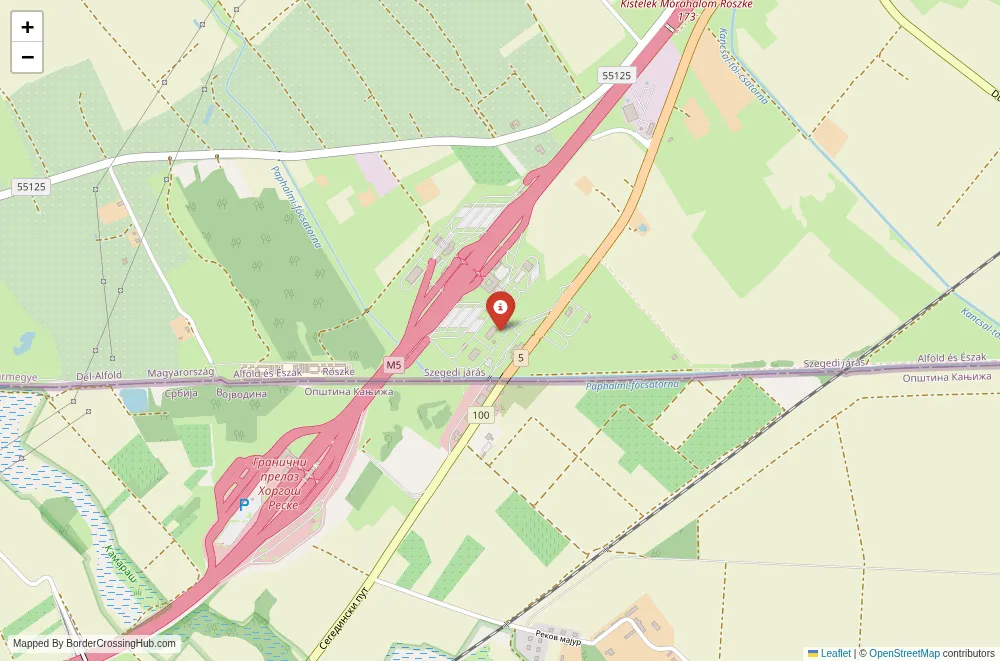
Approximate Border Location
Wait Times
Cars 20-90m; peaks 120-480m holidays
Just crossed? Tap to report:
Operating Hours
Open 24 hrs (12:00 AM-11:59 PM)
Crossing Types
Cars,buses,trucks; motorway controls
Border Type
Land crossing via motorway (M5/E75)
Peak Times
Fri-Sun 08:00 AM-12:00 PM; Jul-Aug
Daily Crossings
20,000-70,000/day
Currency Exchange
HUF; RSD, EUR near Horgoš; ATMs
Safety Information
Severe congestion; avoid unofficial money changers
Languages Spoken
Hungarian/Serbian
Accessibility Features
Accessible lanes; shade limited
About Röszke & Horgoš (Serbia)
Monthly Update (March 2026):
As of 03/2026, the Röszke & Horgoš (Serbia) railway Border Crossing sees steady but quieter movement than the road crossing nearby. Freight trains pass regularly, with passenger services moving through on schedule most days. Activity tends to cluster around train arrivals rather than constant flow. Rail maintenance or freight surges can occasionally shift timing.
No Cell Service at the Border? No Problem.
Don’t get caught scrambling for paperwork when you lose signal. Download the complete Europe Transit Guide directly to your device and access every critical detail, fast-track strategy, and border rule – 100% offline.
The Röszke-Horgoš railway border crossing provides a direct rail connection between Hungary and Serbia, linking Szeged in southern Hungary with Subotica in northern Serbia’s Vojvodina region.
Alternative Names
It shows up as Röszke-Horgoš vasúti határátkelő (Hungarian), Horgoš-Röszke železnička granica (Serbian), or simply the Szeged-Subotica rail border point. The line itself follows the historic Subotica-Szeged route.
Location and Connections
The crossing sits along the railway line that runs from Szeged through Röszke on the Hungarian side, crosses into Serbia at Horgoš, then continues to Subotica (with stops like Palić, Hajdukovo, Bački Vinogradi). From Szeged, trains head north to Budapest or other Hungarian cities. In Serbia, Subotica connects onward to Novi Sad and Belgrade via other lines. Passenger services focus on this short cross-border segment, ideal for regional travel rather than long-haul.
Historical Background
The railway dates to the late 19th century under Austro-Hungarian rule, built in 1869 as part of networks linking Bačka communities. Post-Trianon Treaty in 1920, it became an international border line. Passenger services halted for years (around eight years until late 2023), partly due to low demand, infrastructure needs, and regional factors. Freight continued sporadically, but full passenger reopening came on November 28, 2023, after upgrades including electrification work on parts of the line.
Geopolitical and Economic Role
This rail point supports local cross-border ties in areas with Hungarian and Serbian populations. It eases commuting for work, family visits, or errands between Szeged and Subotica. Freight handles goods, though volumes stay modest compared to road routes. Recent bilateral agreements between Hungary and Serbia (signed around 2025) cover rail controls alongside road and water, aiming for better coordination. Passenger growth since reopening shows demand from commuters and travelers avoiding road queues.
Operating Hours and Current Status
The railway border crossing operates 24 hours for international passenger and goods traffic, though actual train schedules dictate when services run. Checks occur on the Hungarian side at Röszke station for many trains. No major seasonal restrictions apply to the point itself, but timetables adjust slightly. Recent expansions increased services to six daily pairs in early 2026 due to rising ridership. Always confirm current operations via MÁV (Hungarian railways) or Srbijavoz (Serbian) sites, as occasional works or security could affect runs.
Visa Requirements for Foreign Visitors
Hungary follows Schengen rules for entry/exit. Serbia allows visa-free stays for many nationalities (EU, US, Canada, Australia, etc.) up to 90 days. Your passport must meet both countries’ requirements for short visits. Border police handle checks on the train, often jointly or on one side. Third-country nationals might face biometric registration under EU systems. Check embassy advice for your nationality ahead of time.
Crossing Procedures Step by Step
Board the train in Szeged (or Subotica) with your ticket and passport ready. The train stops at Röszke station on the Hungarian side for passport and customs checks—officers board, review documents, and stamp if needed. You remain seated; no need to disembark fully. The process repeats or complements on the Serbian side if not combined. Stops at intermediate stations like Horgoš or Szentmihálytelek handle local aspects. The whole border segment takes minutes to half an hour, depending on passenger numbers.
Wait Times and Peak Periods
Rail crossings move quicker than road ones here—no long vehicle queues. Border checks add 10-30 minutes typically, with minimal extra waits outside rare issues. Peaks align with commuter hours or weekends, but trains rarely face major delays from border processing alone. Demand has grown, so book seats if possible during busy periods like holidays.
Transportation Options After Crossing
From Szeged, connect to Budapest (about 2-3 hours) or regional spots. In Subotica, buses or trains link to Novi Sad (1-2 hours) and Belgrade (further south). Local taxis or walks work near stations. The rail option avoids motorway crowds, making it appealing for those without cars.
Road Conditions and Scenery
Not applicable for rail, but the train route crosses flat Bačka plains: agricultural fields, small villages, sunflowers or corn in season, and open countryside. Tracks run parallel to roads at times, offering views of the rural borderlands without the stress of driving.
Weather and Seasonal Impacts
Flat terrain means fog or winter ice can slow trains occasionally, though lines get priority clearing. Summers bring heat but reliable service; winters might see minor schedule tweaks. No closures tied to seasons reported recently.
Nearby Attractions
Szeged boasts thermal spas, the Tisza River, and paprika heritage. Subotica features striking Art Nouveau architecture, synagogues, and Palić Lake nearby for relaxation. The area mixes cultures with bilingual signs and shared festivals.
Practical Travel Tips
Buy tickets online via MÁV or Srbijavoz for convenience—fares stay low for the short hop. Carry your passport and any needed documents visibly. Arrive early at stations for checks. Pack snacks or water, as onboard options vary. Use rail apps for live timetables. The service suits day trips or regional hops well.
Common Scams and Warnings
Rail crossings see fewer issues than busy road points—no touts or fake helpers on trains. Still, watch belongings during stops and avoid unofficial currency exchanges if offered. Some older reports mention occasional thorough checks, but recent traveler accounts describe straightforward processes. Stick to official trains and report anything odd to staff.
Cultural and Economic Notes
The route revives historic links in a bilingual region, supporting daily life for locals with Hungarian roots in Vojvodina. Passenger numbers rising reflect practical use over tourism, though it opens access to cultural sites on both sides.
Final Planning Advice
This rail crossing beats road alternatives during peak road times, especially with expanded schedules. Verify train times and any updates from official railway sources before your trip. Bring patience for checks, enjoy the easy scenery, and use it to connect these neighboring areas without hassle. Safe journeys.
No reviews yet.