Monthly Update (September 2026):
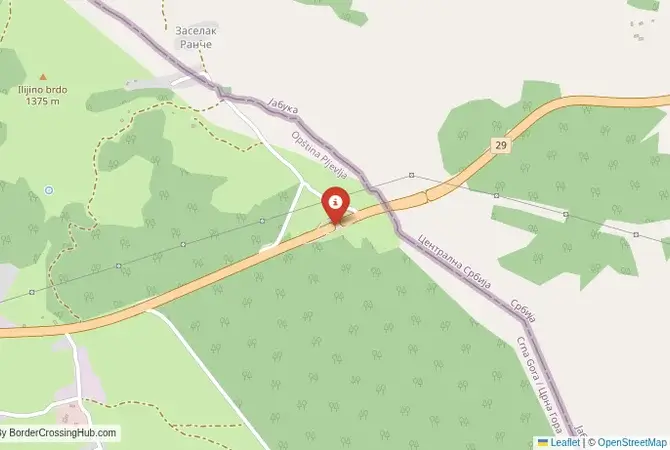
Jabuka & Ranče remains a useful Montenegro-Serbia crossing near Pljevlja and is currently moving freely. Live monitoring on September 4 showed no queue in either direction, with estimated waits of up to five minutes at both checkpoints. This makes Jabuka an attractive alternative when the larger Dobrakovo-Gostun crossing is backed up. The route remains open, with no significant September closure identified.
About this crossing
Operational Details
This checkpoint connects the Pljevlja Municipality of Montenegro with the Prijepolje Municipality of Serbia. It is a major international crossing, open 24/7 to both passenger cars and commercial freight. It is located on the main road that connects northern Montenegro with southwestern Serbia, a key route for regional trade and transit. The facility is located at a high altitude, and it can be subject to harsh winter conditions, with heavy snow sometimes making travel difficult. The crossing is a vital link for the economies of both regions, particularly for the transport of timber and agricultural products.
A History of the Sandžak Region
The history of this region is the history of the Sandžak, a historic geopolitical region that was part of the Ottoman Empire. Today, the Sandžak is divided between Serbia and Montenegro, and it has a large, indigenous Bosniak population alongside Serbian and Montenegrin communities. The area around Pljevlja and Prijepolje has been a multicultural crossroads for centuries. The modern border, established after the breakup of Yugoslavia, divided this historically integrated region. The Ranče-Jabuka crossing is a key point for maintaining the family, cultural, and economic ties that span this border.
Nearby Border Crossings
Border Crossing Procedure
The border crossing procedure is a standard two-part process. You will first complete exit formalities at one country's checkpoint and then proceed to the other country's checkpoint for entry inspection. You will need a valid passport or, for citizens of many European countries, a national ID card. Vehicle registration and international insurance (Green Card) are also necessary. The process is generally straightforward, and the checkpoint is equipped to handle a steady flow of traffic. However, queues can form, especially with freight traffic, so it is wise to allow for some extra time in your travel schedule.
The Surrounding Region: Montenegro Side
On the Montenegrin side, the crossing is in the Pljevlja municipality, the heart of the country's coal and power industry. The city of Pljevlja has a rich history, with the beautiful Husein-paša's Mosque being one of the most important Islamic monuments in the country. The Holy Trinity Monastery is another major spiritual and cultural center. The region is also a gateway to the magnificent Durmitor National Park, a UNESCO World Heritage site, and the Tara River Canyon, the deepest canyon in Europe, which is a world-famous destination for white-water rafting.
The Surrounding Region: Serbia Side
On the Serbian side, the crossing is near the village of Jabuka, which has a monument to a famous battle from World War II. The road follows the Lim River valley towards the town of Prijepolje. The main attraction of the region is the magnificent Mileševa Monastery, located near Prijepolje. Founded in the 13th century, it is one of the most important monasteries in Serbia and is home to the famous "White Angel" fresco, a masterpiece of Serbian medieval art that was one of the first images transmitted in the first satellite broadcast signal from Europe to North America. The region is also a gateway to the popular Zlatibor and Zlatar mountain resorts.
Practical Travel Information
Practical planning is essential for this route. You must have a suitable vehicle and be prepared for mountain driving. Check the weather and road conditions before you set out, especially in winter. The official currencies are the Euro (EUR) in Montenegro and the Serbian Dinar (RSD) in Serbia. Services at the border are limited. It is essential to plan for fuel and any currency exchange in the larger towns of Pljevlja or Prijepolje. Ensure your vehicle's Green Card insurance is valid for both countries. The road is a major regional artery and is kept open, but caution is always advised in adverse weather.
Final Considerations
The Ranče–Jabuka border crossing is a vital artery for the northern, mountainous regions of Montenegro and Serbia. It is a journey through a landscape of stunning natural beauty and a region with a deep and complex multicultural history. It is not the most traveled route for international tourists, but for those exploring the Sandžak region and the national parks of the Dinaric Alps, it is an essential and fascinating passage. It is a border that connects two nations through a shared landscape of high plateaus and deep river valleys, a beautiful and rewarding route for the well-prepared traveler.
View all border crossings between Montenegro and SerbiaPractical information
Fuel
Montenegro: <1 km - Serbia: <1 km
Currency
Nearby exchange; EUR, RSD
Safety information
Calm area; low congestion
Connectivity
Basic mobile data
Have you crossed here?
Help other travelers by sharing your experience, wait times, and any updates.