Monthly Update (September 2026):
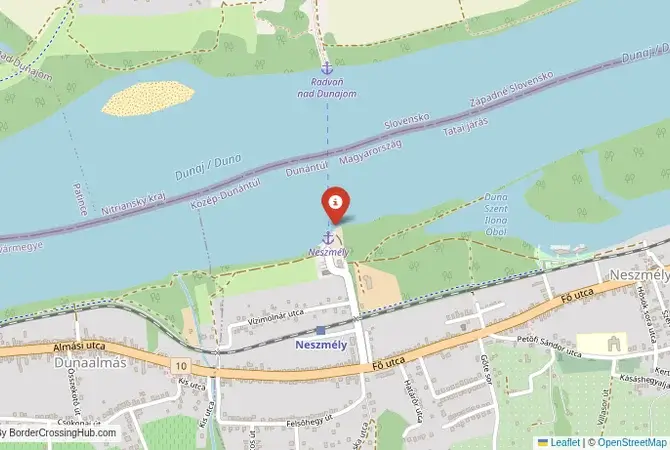
Neszmély & Radvaň nad Dunajom remains a ferry-based Danube connection rather than a conventional road border crossing. No significant September border restriction has been identified. Because the crossing depends on river transport, its usability can change with the ferry timetable and local operating conditions rather than road traffic. Travelers should verify the current ferry schedule before making a detour specifically to cross here.
About this crossing
Operational Details
This ferry crossing connects Slovakia's Nitra Region with Hungary's Komárom-Esztergom County. Its operation is entirely dependent on the ferry schedule and the weather and river conditions. This is not a 24/7 facility. The ferry typically makes regular trips during daylight hours, especially in the summer tourist season. It is absolutely essential to check the latest official ferry schedule and its operational status before you travel, as services can be suspended due to high or low water levels, ice in winter, or technical issues. The ferry is small, carrying only a handful of cars per trip, which adds to its intimate, local character.
A History of a River Frontier
The history of this crossing is the history of the Danube as a great European river. It has been a frontier of the Roman Empire, a highway for migrating peoples, a trade route, and a military barrier. The towns and cities along its banks have been centers of commerce and culture for centuries. The modern border, established after World War I, formalized the Danube as the frontier between Czechoslovakia and Hungary. During the Cold War, this was a controlled and guarded border. The accession of both countries to the Schengen Area in 2007 has restored the river's role as a connector rather than a divider, allowing for the revival of small, local connections like this historic ferry route.
Nearby Border Crossings


The Seamless Border Procedure
Today, there is no border procedure for travelers. You simply buy your ferry ticket and enjoy the short, scenic ride across the river. There are no passport checks and no customs inspections. This is the reality of the Schengen Area. The journey itself is the experience. The slow pace of the ferry allows you to appreciate the beauty of the vineyard-covered hills on the Hungarian side and the flat plains on the Slovak side. It is a peaceful and relaxing way to cross the border, a world away from the stress of a busy highway.
The Surrounding Region: Slovakia Side
On the Slovak side, the crossing is in a fertile agricultural region known for its wine and vegetable production. The village of Radvaň nad Dunajom is a quiet, rural settlement. The area is part of the Podunajsko region, the heartland of the Hungarian minority in Slovakia. The nearby city of Komárno, with its massive fortress system, is a major cultural and historical center. The region is popular for cycling, with well-marked trails that follow the Danube.
The Surrounding Region: Hungary Side
On the Hungarian side, the crossing is in the heart of the Neszmély wine region, one of Hungary's most famous wine-producing areas, known particularly for its crisp, aromatic white wines. The village of Neszmély and its neighbors are dotted with wineries and cellars that are open for tastings. The area is part of the beautiful Danube Bend, a scenic and historic region where the river turns south towards Budapest. The historic cities of Esztergom, with its massive basilica, and Tata, with its beautiful castle on a lake, are a short drive away.
Practical Travel Information
Practical planning for this route requires checking the ferry schedule in advance. The cost of the ferry is usually priced per vehicle and per passenger. Payment is typically required in the local currency (EUR in Slovakia, HUF in Hungary). The most important thing is to have the required motorway vignettes if your journey involves motorways in either country. Both Slovakia and Hungary use an electronic vignette system, which must be purchased online in advance. Services are available in the towns on both sides of the river.
Final Considerations
The Radvaň nad Dunajom–Neszmély ferry crossing is a unique and charming way to cross the Danube. It offers a peaceful and scenic alternative to the busy motorway bridges. It is a journey that connects two parts of a celebrated wine region. It is a border crossing that is not about speed, but about savoring the journey and experiencing the natural beauty of the Danube Bend, a river that has been profoundly shaped by both nature and human culture.
View all border crossings between Slovakia and HungaryPractical information
Fuel
Slovakia: 1 km - Hungary: 1 km
Currency
Limited nearby (EUR, HUF)
Safety information
River-related risks
Connectivity
4G/5G coverage
Have you crossed here?
Help other travelers by sharing your experience, wait times, and any updates.