
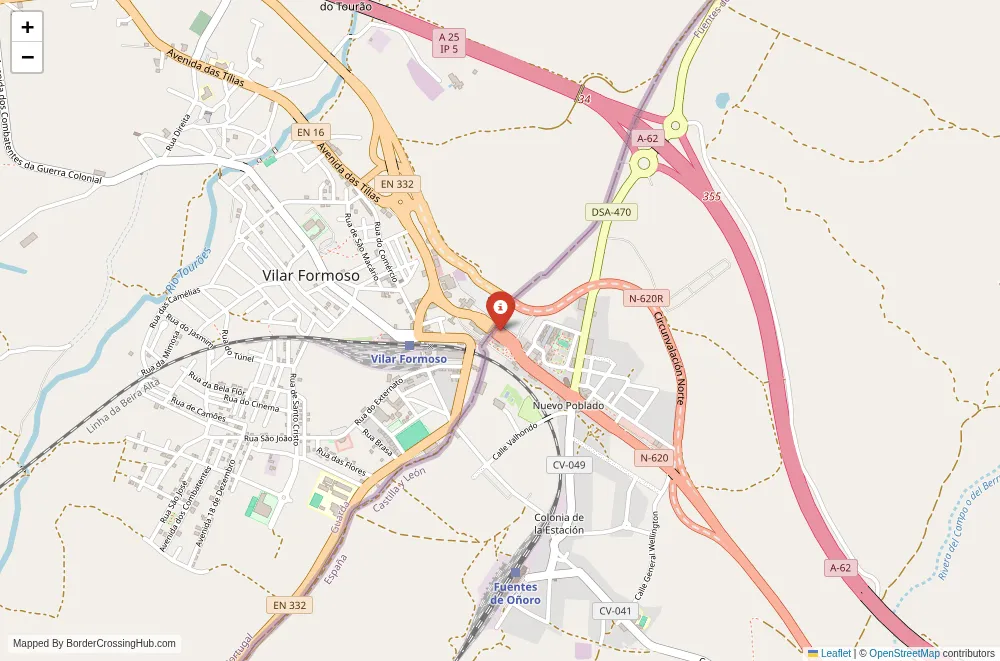
Approximate Border Location
Wait Times
Cars 0-20m; peaks 30-120m holiday waves
Just crossed? Tap to report:
Operating Hours
Open 24 hrs (12:00 AM-11:59 PM)
Crossing Types
Cars,buses,trucks; motorway/AP crossings
Border Type
Land crossing via motorway (A25/A62)
Peak Times
Mon-Fri 02:00-07:00 PM; Aug returns
Daily Crossings
15,000-55,000/day
Currency Exchange
EUR only; ATMs at services/towns
Safety Information
High-speed corridor; enforcement checks possible
Languages Spoken
Spanish/Portuguese
Accessibility Features
Accessible rest stops; step-free toilets
About Quintanilha & San Vitero / Alcañices
Monthly Update (March 2026):
As of 03/2026, the Quintanilha & San Vitero / Alcañices Border Crossing stays quiet and mostly stable. Cars move freely along the rural road, usually with only a few vehicles at a time. Midday tends to be especially calm. Farm traffic and occasional weekend trips add the small bursts of activity.
No Cell Service at the Border? No Problem.
Don’t get caught scrambling for paperwork when you lose signal. Download the complete Europe Transit Guide directly to your device and access every critical detail, fast-track strategy, and border rule – 100% offline.
The Quintanilha-San Vitero border offers one of the quietest and most rural crossings between Portugal and Spain in the northeastern Trás-os-Montes region, where the small River Maçãs (Rio Maçãs) forms the natural line between the two countries.
Alternative Names
This point is known as the Quintanilha border (Portugal side), San Vitero crossing (Spain side), the Quintanilha-San Vitero frontier, or the Alcañices-Quintanilha border (after the nearby Spanish town of Alcañices). It sometimes appears in lists as Quintanilha (Bragança) – San Vitero (Zamora).
Current Status and Safety Note
Portugal and Spain are Schengen countries, so this crossing remains fully open with no permanent checkpoints, booths, or routine controls. You drive or walk across without any formal stop. Random police or customs checks by the Portuguese GNR or Spanish Guardia Civil can happen (typically focused on commercial vehicles or specific alerts), but they are very rare on this remote road and almost never affect private cars or tourists. The area feels peaceful and safe, with no notable reports of scams or problems for travelers.
Historical Background
The Portugal-Spain border here traces back to the Treaty of Alcañices in 1297, signed in the nearby Spanish town of Alcañices, which fixed much of the modern frontier between the kingdoms of Portugal and Castile. This line has remained remarkably stable for over 700 years. Quintanilha itself is a small, traditional village in the Bragança municipality, shaped by its frontier position. The river Maçãs has long served as both a boundary and a resource for local communities. The area also saw minor activity during periods of smuggling and, in the 20th century, as a quieter alternative to larger crossings during historical migrations or trade.
Geopolitical and Economic Role
This is a minor local crossing with low traffic volumes, mainly used by residents of Quintanilha (Portugal) and nearby Spanish hamlets like San Vitero or Trabazos. It supports everyday cross-border life: farmers, families, and occasional shoppers who move freely between the two sides. Larger freight and tourist flows use nearby motorways or other points like Vilar Formoso-Fuentes de Oñoro. The region benefits from EU-funded cross-border cooperation programs that encourage joint projects in rural development, culture, and nature preservation.
Visa Requirements for Foreign Visitors
Schengen rules cover both Portugal and Spain. If your nationality qualifies for visa-free entry, you cross with only a valid passport or national ID. Most non-EU visitors receive 90 days in any 180-day period across the area. Carry your travel document at all times, though checks are extremely unlikely on this back road.
Crossing Procedures Step by Step
By car, follow the small road out of Quintanilha (often the EN217 or local route) toward the river. The border arrives without warning: a simple marker or sign near the river, and you cross a small bridge or ford into Spain. The road continues toward San Vitero or connects to Alcañices. No buildings, barriers, or officials are present. Pedestrians and cyclists use the same route (the river crossing may involve a narrow bridge or path). No forms or queues exist under normal conditions. The reverse direction is exactly the same.
Typical Wait Times and Peak Periods
Wait times are zero most days. You pass through immediately. Even on weekends or local holidays, traffic remains very light. Any brief pause would come only from an unlikely random patrol.
Operating Hours
The crossing is open 24 hours a day, every day of the year, as a public rural road.
Transportation Options to and From the Border
From Bragança (Portugal), take the IP4 / A24 toward Quintanilha, then local roads to the river. On the Spanish side, approach from Alcañices via provincial roads toward San Vitero or Trabazos. Public buses serve Bragança and Alcañices but do not cross directly here; you would need to walk or take a short taxi between the villages. Cycling or walking works well on the quiet lanes. The nearest train stations are in Bragança (Portugal) or Puebla de Sanabria (Spain), both some distance away.
Road Conditions and Scenery
The approach roads are narrow, paved, and generally in fair condition, though rural and winding. The border zone features the gentle valley of the Rio Maçãs, with farmland, pastures, scattered granite boulders, pine woods, and open heath. The river itself is small and often shallow, with stone bridges or simple crossings. The landscape feels remote, green, and timeless, with few houses or modern intrusions.
Seasonal Variations and Weather Impacts
Winter rain or occasional snow can make unpaved sections slippery or muddy. Summer offers dry, pleasant conditions for walking or cycling. No seasonal closures occur, but heavy rain might affect minor river crossings.
Nearby Attractions
Quintanilha is a quiet village with traditional stone houses and a peaceful riverside setting. Alcañices (Spain, about 15-20 km away) is the historic site of the 1297 treaty and features a small old town, remains of walls, and local festivals. The Montesinho Natural Park (Portugal) lies nearby with trails, wildlife, and mountain scenery. The area suits slow travel, hiking, and discovering rural border traditions.
Common Scams and Warnings
No notable scams or issues are reported at this isolated point. The main practical concerns are limited services (few shops or fuel stations), poor mobile signal in the countryside, and potential winter road conditions. Drive carefully on narrow rural roads and have a full tank of fuel.
Travel Tips and Preparation
Use offline maps or GPS, as signage is minimal and the road can feel unmarked. Carry your passport/ID and vehicle papers. Bring water, snacks, and layers for changeable weather. If walking or cycling, the river valley paths offer a relaxing way to experience the border. Combine the crossing with a drive to Alcañices or a hike in Montesinho for a fuller visit.
Cultural and Economic Significance
This crossing reflects the deep, quiet integration of life along one of Europe’s oldest borders. Local families and farmers cross daily for work, family, or resources, ignoring a line drawn centuries ago. The shared rural heritage, language influences, and traditions (like joint religious festivals) keep the region connected despite the political divide.
Final Planning Advice
Confirm road conditions in winter via local sources. Bring your documents, take the quiet road slowly, and savor the peaceful shift across the Rio Maçãs. This hidden rural crossing gives you a genuine taste of Europe’s oldest and least-changed frontier. Safe travels.
No reviews yet.