
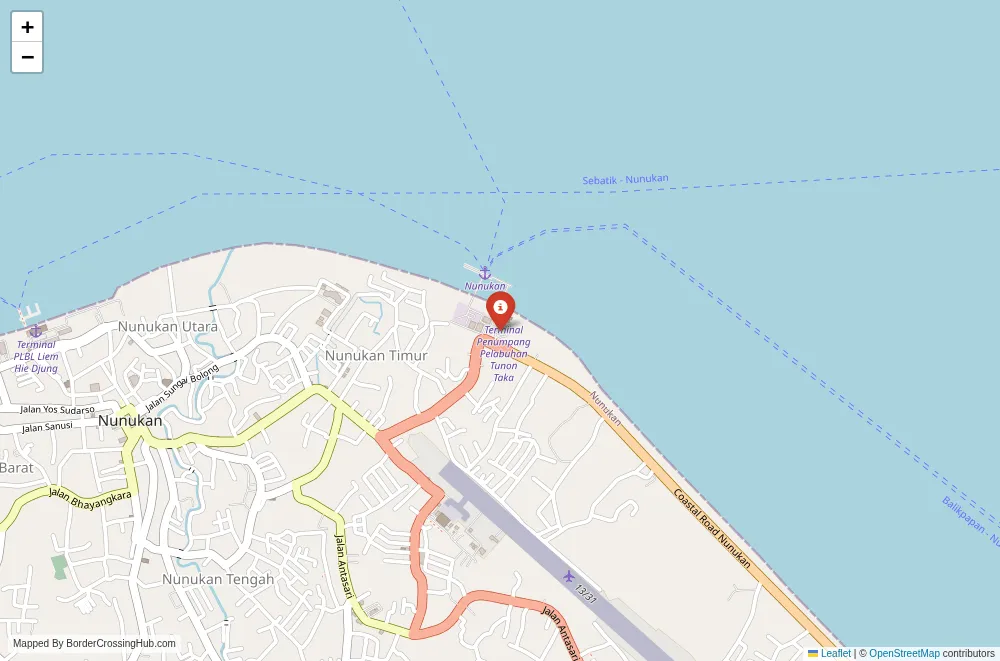
Approximate Border Location
Wait Times
Ferry 30-120m; peaks 120-300m
Just crossed? Tap to report:
Operating Hours
Sailings 06:00 AM-06:00 PM
Crossing Types
Ferry ped only typical; no cars; controls
Border Type
Border crossing via sea ferry
Peak Times
Fri-Mon 08:00-11:00 AM; holidays
Daily Crossings
2,000-12,000/day
Currency Exchange
MYR; IDR at ports; money changers
Safety Information
Port crowds; keep passport secured
Languages Spoken
Indonesian, Malay, English
Accessibility Features
Step-free terminals; accessible toilets
About Puni & Mengkalap
Monthly Update (March 2026):
As of 03/2026, the Puni & Mengkalap Border Crossing ticks along at a calm pace. Cars move steadily through the checkpoint with only short waits most of the day. Late afternoons sometimes see a few extra vehicles returning toward Brunei. Local errands and small trade shape the flow.
No Cell Service at the Border? No Problem.
Don’t get caught scrambling for paperwork when you lose signal. Download the complete Asia Transit Guide directly to your device and access every critical detail, fast-track strategy, and border rule – 100% offline.
The Puni-Mengkalap border crossing (also known as Puni in Brunei Darussalam’s Temburong district and Mengkalap in Malaysia’s Limbang division, Sarawak) connects the isolated Temburong district of Brunei to the Limbang district of Sarawak across a short stretch of open land. You reach this point when traveling between Brunei’s eastern enclave and Sarawak’s northern Limbang area, often as part of routes from Bandar Seri Begawan (via ferry to Bangar) toward Limbang town, Lawas, or Miri. The crossing serves as Temburong’s primary land link with Malaysia, handling passenger vehicles, motorcycles, buses, and local trade in a remote region where Brunei is divided from its main territory by Sarawak’s Limbang district.
Location and Connections
Puni lies in the Temburong district of Brunei, about 10 kilometers from Bangar town (Temburong’s administrative center) and roughly 60 kilometers from Bandar Seri Begawan by road (after crossing from Brunei-Muara by ferry). Mengkalap sits directly opposite in Limbang division, Sarawak, with onward roads to Limbang town (around 30 kilometers) and farther to Lawas or Miri. The crossing features modern immigration and customs buildings on both sides, with a short neutral zone and a paved road bridge over a small stream. The surrounding landscape includes flat, low-lying plains, oil palm plantations, peat swamp forests, and scattered villages typical of Borneo’s coastal lowlands. No major river or mountain barrier dominates; the border here follows a straight surveyed line through rural terrain. No rail or air links serve directly; the route relies on road transport amid agricultural and forested countryside.
Historical and Geopolitical Background
The Brunei-Malaysia border is complex, with Brunei divided into two parts by Limbang district of Sarawak, a legacy of 19th-century colonial divisions when the Brooke family of Sarawak annexed the area in 1890. Puni-Mengkalap formalized in the late 20th century after Brunei regained full independence in 1984 and relations with Malaysia stabilized. It became Temburong’s main land exit point, supporting trade in consumer goods, food, construction materials, and daily necessities, as Brunei relies heavily on imports from Sarawak. The open-border ethos allows citizens of both countries to cross for short distances, though formal checkpoints enforce customs and security. The crossing has remained stable despite occasional diplomatic sensitivities over Limbang’s status, with no major incidents affecting operations. Fun fact: Temburong’s isolation (only connected to the rest of Brunei by water or air until the Temburong Bridge opened in 2020) makes Puni-Mengkalap a vital lifeline for residents traveling to Limbang for shopping, medical care, or family visits.
Current Status and Operating Hours
As of early 2026, Puni-Mengkalap operates as a fully functional international crossing for pedestrians, motorcycles, cars, and light trucks. It opens daily from 6:00 a.m. to 10:00 p.m. (Brunei time; Malaysia is the same time zone), with some flexibility for locals outside peak hours. The crossing sees moderate traffic, particularly on weekends when Bruneians shop in Limbang or Sarawak residents visit Temburong. Dry season (March to October) offers reliable access; rainy season (November to February) brings occasional flooding or muddy roads, though major disruptions remain rare due to paved surfaces. Security involves Brunei’s Immigration Department and Royal Brunei Police alongside Malaysia’s Immigration and Customs, conducting standard checks. No significant closures reported recently, but verify through Brunei’s Immigration Department, Malaysian Immigration Department, or traveler forums, as weather or minor bilateral issues can affect smaller posts.
Crossing Procedures Step by Step
You process exit and entry on both sides. From Brunei to Malaysia: at the Puni Brunei post, present your passport or Brunei ID card (for citizens) for exit stamp or registration, then clear customs if carrying goods. Walk or drive the short distance to Mengkalap Malaysia immigration for entry stamp (Malaysian citizens cross freely; foreigners use visa-free entry or visa-on-arrival depending on nationality). The reverse from Malaysia follows the same sequence: Malaysia exit stamp followed by Brunei entry (customs check for restricted items like alcohol or pork). Procedures include manual document verification, occasional bag or vehicle scans, and questions on purpose. Wait times typically range from 15 minutes to an hour, longer during weekends or holiday periods. Foreigners report straightforward processing, though expect additional scrutiny for goods or longer stays.
Visa Requirements for Foreign Visitors
Bruneian and Malaysian citizens cross without visas under bilateral arrangements, using ID cards or passports. Foreigners entering Malaysia from Brunei receive visa-free entry for most nationalities (typically 90 days for many Western passports; confirm eligibility). Brunei grants visa-free entry or visa-on-arrival for many nationalities (30 days for most; no fee for short stays). Bring passport copies and photos if required. Passports need at least six months validity. Rules remain stable, but confirm via embassies or official portals, as enforcement can vary at smaller crossings.
Transportation Options and Road Details
From Bandar Seri Begawan, take the water taxi or ferry to Bangar in Temburong (45 minutes), then buses, shared taxis, or private cars reach Puni (30-45 minutes on paved roads). From Mengkalap, buses or shared taxis head to Limbang or Lawas. Private cars cross freely for citizens; foreigners may need vehicle permits or temporary import forms. Roads from Bangar stay paved and good; Malaysian side includes highways with occasional rough patches. Rainy season mud or flooding can delay travel. Full Bandar Seri Begawan-Limbang trip takes 2-3 hours with border time. Daylight travel recommended for safety and visibility.
Scams and Safety Warnings
Minor issues include inflated transport fares near Bangar or poor exchange rates (use banks or official changers). Touts may offer “fast” services. The area remains generally safe for transit, but petty theft occurs in crowds. Monitor news for local flooding or unrest in border regions. Avoid unofficial paths. Register with embassies if staying longer in Malaysia or Brunei.
Nearby Attractions and Practical Tips
Puni offers quiet rural views and proximity to Ulu Temburong National Park (accessible from Bangar). Mengkalap leads to Limbang’s markets, colonial history, and nearby Mulu National Park access. Carry BND/MYR cash, water, snacks, sunscreen, and passport copies. Start early; consider Sungai Tujuh or Tedungan as backups if needed. Translation apps aid local interactions.
Final Notes for Planning
Kuala Lurah-Tedungan provides a convenient, low-hassle crossing between Brunei and Sarawak, benefiting from open-border ease for citizens and simple procedures for foreigners. Confirm status, prepare passports, and time travel for daylight. With basic preparation, it offers reliable passage across this Borneo frontier. Safe travels.
No reviews yet.