
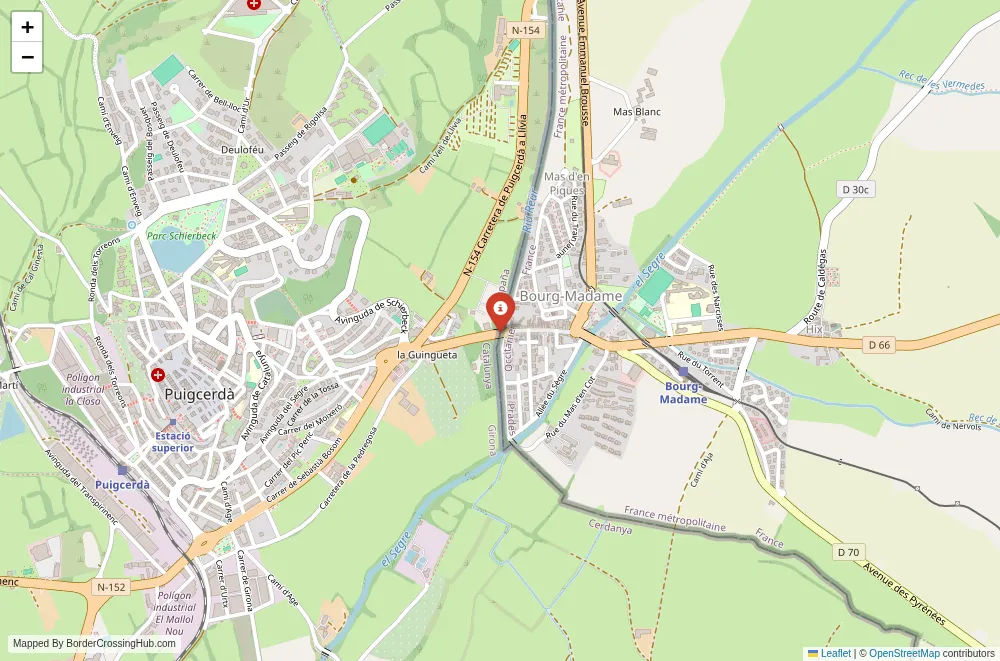
Approximate Border Location
Wait Times
Cars 0-15m; peaks 20-60m ski weekends
Just crossed? Tap to report:
Operating Hours
Open 24 hrs (12:00 AM-11:59 PM)
Crossing Types
Ped,cars,buses; no routine controls
Border Type
Land crossing via urban road
Peak Times
Sat-Sun 08:00 AM-12:00 PM; Dec-Mar
Daily Crossings
6,000-25,000/day
Currency Exchange
EUR only; ATMs on both sides
Safety Information
Winter driving risk; chains may be needed
Languages Spoken
French/Spanish
Accessibility Features
Generally step-free; paved crossings
About Puigcerdà & Bourg‑Madame
The Puigcerdà Bourg-Madame border crossing sits at around 1200 meters in the scenic Cerdanya valley of the eastern Pyrenees, merging the Catalan town of Puigcerdà in Spain’s Girona province seamlessly with the French commune of Bourg-Madame in the Pyrénées-Orientales department across a small bridge over the Raür river.
Location and Basic Connections
You enter this crossing where the main street of Puigcerdà flows straight into Bourg-Madame, divided only by the river and a short bridge. Puigcerdà lies about 100 km northwest of Barcelona via the N-260 road, while Bourg-Madame connects north to Perpignan (around 90 km) along the N-116. The route forms part of the main link through the Cerdanya plateau. Local trains stop at Puigcerdà station on the Spanish side or nearby La Tour de Carol/Bourg-Madame on the French side, with the Yellow Train (Le Train Jaune) offering scenic rides deeper into the French Pyrenees. Buses from Barcelona, Girona, or Perpignan serve both towns, and walking the bridge takes just minutes. The area attracts skiers in winter and hikers in summer, plus day-trippers crossing for shopping or meals.
Alternative Names
This point goes by Puigcerdà Bourg-Madame border, Paso de Puigcerdà, Col de Puigcerdà, or the Cerdanya valley crossing.
Historical Background
The Cerdanya valley split under the 1659 Treaty of the Pyrenees, which awarded much of the area to France while keeping Puigcerdà Spanish. Bourg-Madame developed around the bridge and trade post. The nearby Spanish enclave of Llívia (surrounded by France) adds historical quirk from the treaty’s wording. During the Spanish Civil War’s 1939 Retirada, thousands of refugees crossed here into France. Since Schengen in 1995, the border has become largely invisible, with old customs buildings now unused along the river or bridge.
Geopolitical Significance
Within the Schengen Area, this internal border has no routine checks for most travelers. France maintains temporary internal controls on Schengen frontiers (including Spain) until at least April 30, 2026, due to security concerns like jihadist threats, antisemitic incidents, migration, and smuggling networks. These controls can involve spot ID or vehicle checks, though quiet rural points like Puigcerdà Bourg-Madame see them less often than major highways. The EU’s Entry/Exit System (EES) rollout focuses on external borders, so it has limited direct impact here. The crossing supports regional tourism, skiing, and daily cross-border life without major disruptions reported in early 2026.
Practical Crossing Procedures
You drive, walk, or cycle across without stopping under normal Schengen rules. The border marker sits on the bridge, with signs shifting languages. Spot patrols by police or customs may request ID, check vehicles, or inspect goods. Carry your passport or national ID at all times for any verification. Most nationalities move freely (90 days visa-free short stay in Schengen). Vehicles require standard registration and insurance. Customs rules limit duty-free alcohol, tobacco, or other items when crossing; declare excesses to avoid fines.
Typical Wait Times and Operating Hours
The crossing operates 24/7 with no formal hours or queues on the main roads. Random checks, if they occur, last minutes. The N-116/N-260 through town sees no structured waits beyond local traffic or shoppers. Occasional patrols add brief delays, but flow stays quick compared to external borders.
Transportation Options
Trains connect Barcelona or Perpignan to Puigcerdà or Bourg-Madame/La Tour de Carol. Local buses run frequently between the towns. Driving on the N-116/N-260 offers easy access with mountain scenery. Walking the bridge works for short visits. Taxis or rideshares handle the short distance. The setup fits well for combining Cerdanya exploration with French or Spanish Pyrenees trips.
Road Conditions and Scenery
Paved roads remain reliable year-round, though winter snow may require chains on approaches. The valley provides open vistas of the Segre river, meadows, and surrounding peaks. The bridge gives a quick shift from Catalan to French signage and buildings.
Scams and Warnings
Crowds around Puigcerdà shops attract pickpockets; keep items secure. Border retail may vary prices; compare before purchases. No widespread scams appear here, but random checks mean have ID ready. The area stays safe for visitors, with low reported crime. Winter weather can slow roads.
Nearby Attractions
Puigcerdà centers on its lake (Estany de Puigcerdà) for strolls, the historic bell tower from Santa Maria church, and lively markets. Bourg-Madame offers French village calm and access to the Yellow Train for Pyrenean rides. Nearby Llívia (Spanish enclave) features medieval ruins and shops. The valley excels for skiing (La Molina, Font-Romeu) in winter or hiking in summer.
Seasonal Variations and Delays
Winter increases snow and chain needs, drawing skiers and busier weekends. Summer boosts tourism and shopping. No major closures hit the main crossing.
Cultural and Economic Role
The merged towns thrive on cross-border routines, with locals commuting, shopping, and socializing freely. Catalan culture prevails, mixed with French touches in food, markets, and festivals. Economy draws from tourism, retail, and agriculture.
Final Planning Notes
Carry ID for potential spot checks and note duty-free limits. This suits relaxed valley travel. Enjoy the easy shift between countries in this historic Cerdanya spot.
Crossing This Integrated Valley Border
Puigcerdà Bourg-Madame captures smooth Schengen life in the Pyrenees, where a small bridge unites two towns across a historic divide. With ID on hand and awareness of occasional patrols, you navigate this welcoming frontier effortlessly.
No reviews yet.