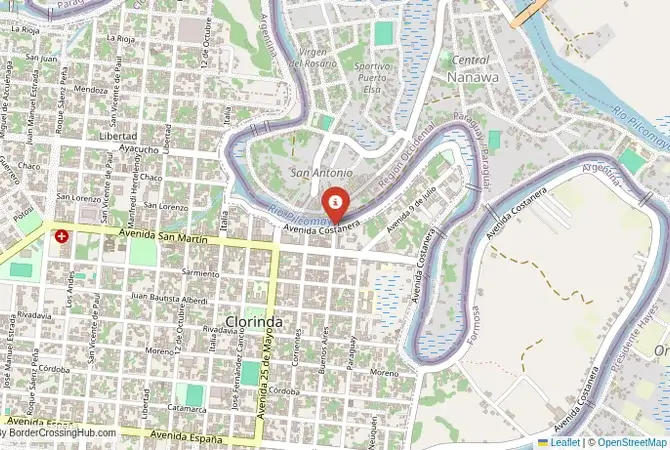
Monthly Update (September 2026):
Clorinda & Puerto José Falcón remains open around the clock, with no new restriction affecting passenger vehicles this month. The latest Argentine border information shows the crossing operating normally, although travelers should be aware that weather conditions around Formosa can change quickly during September storms.
Driving there, or sending a driver? Send them this guide.
For reports and websites
Cite this page
Border Crossing Hub (2026). Clorinda & Puerto José Falcón Border Crossing. Updated September 2026. https://bordercrossinghub.com/puerto-jose-falcon-clorinda-border-crossing/<a href="https://bordercrossinghub.com/puerto-jose-falcon-clorinda-border-crossing/">Clorinda & Puerto José Falcón Border Crossing (Border Crossing Hub)</a>Put this crossing's card on your website
Free. It updates on its own when our information changes.
<iframe data-bch-card src="https://bordercrossinghub.com/puerto-jose-falcon-clorinda-border-crossing/?bch_view=card" width="100%" height="980" scrolling="no" style="border:0;max-width:480px;display:block" loading="lazy" title="Clorinda & Puerto José Falcón border crossing information"></iframe>
<p style="font-size:12px;margin:4px 0 0">Crossing information: <a href="https://bordercrossinghub.com/puerto-jose-falcon-clorinda-border-crossing/">Border Crossing Hub</a></p>
<script src="https://bordercrossinghub.com/?bch_embed_js=1" async></script>Paste it where you want the card. The last line (a script) only adjusts the height and can be left out.
About this crossing
Operational Details
This checkpoint connects Paraguay's Presidente Hayes Department with the Formosa Province of Argentina. It is a full-service international crossing, open to all passenger cars, buses, and commercial freight. The facility is large, but it is often overwhelmed by the sheer volume of traffic, especially freight. It is the primary route for goods moving between the two capitals and for the huge number of tourists and shoppers who travel between the two countries. The queues, for both cars and trucks, can be very long, often lasting for many hours.
A History of a Chaco Frontier
The history of this region is the history of the Gran Chaco, a vast, sparsely populated plain. The Pilcomayo River has long been a natural boundary. The modern border was established after the devastating Paraguayan War in the 19th century and the Chaco War in the 20th century. The towns of Clorinda and the area around Asunción grew as major centers. The construction of the San Ignacio de Loyola bridge in the 1970s was a major step in integrating the two economies. With the establishment of the Mercosur trade bloc in the 1990s, this crossing became one of the most important symbols of the new era of South American cooperation.
Nearby Border Crossings


Border Crossing Procedure
The border crossing procedure is a standard two-part process. You will first complete exit formalities at one country's checkpoint and then proceed across the bridge to the other country's checkpoint for entry inspection. You will need a valid passport or, for citizens of Mercosur countries, a national ID card. Vehicle registration and international insurance (Carta Verde) are also necessary. The process can be slow and bureaucratic, and the high volume of traffic is the main challenge. The facilities can be crowded and chaotic, so patience is essential.
The Surrounding Region: Paraguay Side
On the Paraguayan side, the crossing is just a short drive from the capital city, Asunción. Asunción is one of the oldest cities in South America, with a rich history. It has a charming, if somewhat faded, colonial-era city center, the impressive Palacio de los López (the presidential palace), and a beautiful riverside promenade known as the "Costanera." The city is known for its relaxed atmosphere and its unique Guaraní heritage, which is evident in the language spoken by its people.
The Surrounding Region: Argentina Side
On the Argentine side, the crossing is in the city of Clorinda, a bustling border town that is a major commercial hub. The city is a gateway to the Formosa Province, a subtropical region known for its rich biodiversity and its national parks, such as the Río Pilcomayo National Park. The road from the border leads south towards the city of Formosa, the provincial capital, and further on to the major cities of Santa Fe and Rosario, and the capital, Buenos Aires.
Practical Travel Information
Practical planning is essential for this route. Be prepared for potentially long wait times, especially during peak seasons. The climate is very hot and humid for most of the year. The official currencies are the Paraguayan Guaraní (PYG) in Paraguay and the Argentine Peso (ARS) in Argentina. Services are widely available in the towns on both sides of the border. Ensure your vehicle's Carta Verde insurance is valid for both countries. The road is a major highway and is well-maintained.
Final Considerations
The Puerto Falcón–Clorinda border crossing is the main artery connecting the capitals of Paraguay and Argentina. It is a place of immense economic importance and constant movement. The journey through it can be a test of patience, but it is a direct encounter with the pulse of the Mercosur trade bloc. It is a border that is defined by the slow-moving queues of trucks and buses, a testament to the importance of the connection between the two nations. For the modern traveler, it is the primary gateway to the heart of Paraguay.
View all border crossings between Paraguay and ArgentinaHeading to Clorinda & Puerto José Falcón? Take this with you.
One page with the hours, waits, emergency numbers and coordinates. Works without signal.
Practical information
Fuel
Argentina: 500 m - Paraguay: 500 m
Currency
Available near Puerto José Falcón (ARS, PYG)
Safety information
Generally safe, beware smuggling
Connectivity
Wi-Fi at checkpoints, 4G
Have you crossed here?
Help other travelers by sharing your experience, wait times, and any updates.