
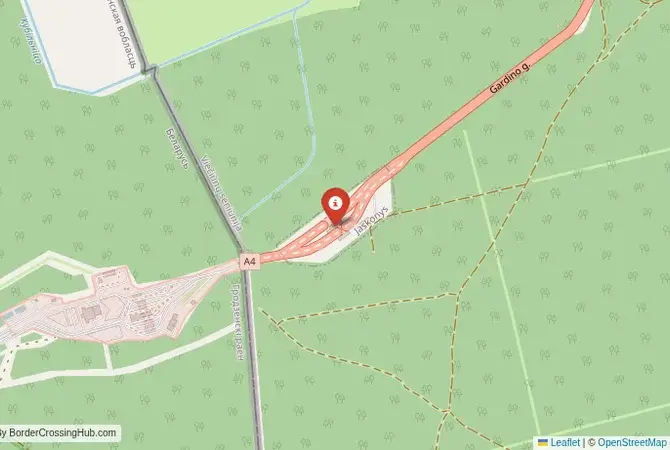
Approximate Border Location
Wait Times
15–60 min; morning peaks
Just crossed? Tap to report:
Operating Hours
6:00 AM–8:00 PM
Crossing Types
Pedestrians, vehicles
Border Type
Land crossing via road
Peak Times
7–10 AM
Daily Crossings
700–1,200 daily
Currency Exchange
Cash exchange nearby; BYN, EUR
Safety Information
Quiet area; sparse services
Languages Spoken
Belarusian/Lithuanian
Accessibility Features
Ramps; limited support
About Privalka & Raigardas
Monthly Update (April 2026):
Traffic builds slowly near the checkpoint, with cars inching forward at busy moments. In April 2026, Privalka & Raigardas Border Crossing is busy and somewhat variable. Vehicles heading into Lithuania tend to move slower. Inspection levels and travel demand can stretch waits.
No Cell Service at the Border? No Problem.
Don’t get caught scrambling for paperwork when you lose signal. Download the complete South America Transit Guide directly to your device and access every critical detail, fast-track strategy, and border rule – 100% offline.
A Closed Gateway to a Spa Resort
Important Note for Travelers: This border crossing has been closed by the Lithuanian authorities since March 1, 2024, and remains closed as of early 2026. It is not operational. This guide is provided for historical and informational purposes only. The border crossing connecting Privalka in Belarus with Raigardas in Lithuania was a significant international checkpoint, serving as the main southern route between the two countries. It is located near the tripoint where Belarus, Lithuania, and Poland meet, making it a strategically important location. The crossing is situated in a landscape of forests and rivers, most notably the Neman (Nemunas) River, which flows nearby. It was a 24/7 facility, a vital link for traffic moving between the Belarusian city of Hrodna and the southern Lithuanian city of Druskininkai, a famous spa resort. Its closure has severed a major artery for tourism and regional trade.
Operational Details
This checkpoint connected the Hrodna Region of Belarus with Lithuania’s Alytus County. It was a full-service international crossing, open to both passenger cars and commercial freight. It was the primary gateway for travelers heading from Belarus to the popular health and wellness resorts of southern Lithuania. The crossing’s importance was underscored by its modern infrastructure, designed to handle a steady flow of traffic.
A History of Health and Heritage
The history of this region is deeply connected to the Neman River and the Grand Duchy of Lithuania. The city of Hrodna, just a short drive from the border, was a royal city with a rich history. The area around Druskininkai has been known for its mineral springs since the 18th century, and it was developed into a fashionable spa town during the era of the Russian Empire. The border drawn in the 20th century divided this region, but the popularity of Druskininkai’s sanatoriums with Belarusians ensured that the crossing remained a busy and important connection. The name Raigardas is associated with a legendary valley in Lithuanian folklore, said to have sunk into the earth.
Former Border Procedure
The border crossing procedure, when it was operational, was a standard two-part process for entering the EU and the Schengen Area. Travelers would first complete exit formalities at the Belarusian checkpoint at Privalka. This involved checks by border guards and customs officials. After this, they would proceed to the Lithuanian checkpoint at Raigardas for a full EU entry inspection by the State Border Guard Service (VSAT) and Lithuanian Customs. A valid passport, a Schengen visa (if required), vehicle registration, and international insurance (Green Card) were required. As a major crossing, it could experience significant queues, especially during summer weekends and holiday periods.
The Surrounding Region
The main attraction on the Lithuanian side is the town of Druskininkai. It is one of the premier spa resorts in the Baltic region, offering numerous sanatoriums, modern wellness centers, a large water park, and the Snow Arena, one of the biggest indoor ski slopes in Europe. The town is set within the beautiful forests of the Dzūkija National Park, offering many opportunities for hiking and cycling. On the Belarusian side, the crossing provides direct access to the city of Hrodna, with its beautiful historic old town, castles, and churches. The Augustów Canal, a 19th-century waterway that connects the Vistula and Neman river systems, also has parts of its route in this region, straddling the border with Poland.
Closure Due to Geopolitical Tensions
The closure of the Raigardas-Privalka crossing in early 2024 was part of a broader move by Lithuania to seal its border with Belarus. Along with the Lavoriškės crossing, it was closed to address national security concerns, combat smuggling, and respond to the political actions of the Belarusian government. This decision has had a significant impact on the tourism industry in Druskininkai, which relied heavily on visitors from Belarus, and it has further isolated the city of Hrodna from its closest EU neighbor, with no reopening as of early 2026.
Final Considerations
The Privalka and Raigardas border crossing was once a bustling gateway to health, wellness, and history. It was a vital link for the tourism-driven economy of southern Lithuania and a convenient route for Belarusians seeking to travel to the EU. Its closure is a stark example of how geopolitical decisions can have profound local economic and social consequences. The once-busy road now leads to a closed gate, another section of the new frontier being drawn in Eastern Europe, severing connections that have been built over centuries.
No reviews yet.