
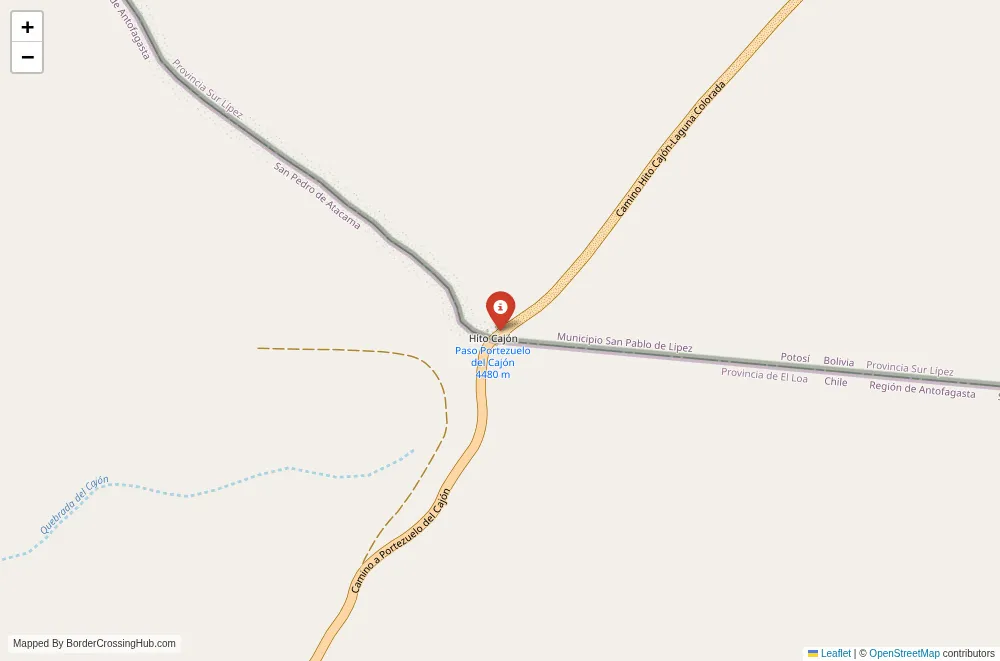
Approximate Border Location
Wait Times
Cars 10-40m; peaks 60-180m tours
Just crossed? Tap to report:
Operating Hours
08:00 AM-08:00 PM
Crossing Types
Cars/minibuses; no buses or trucks typical
Border Type
Land crossing via mountain road pass
Peak Times
08:00-10:00 AM; 03:00-06:00 PM
Daily Crossings
120-600/day
Currency Exchange
Bs; CLP in San Pedro; limited at border
Safety Information
High altitude; strong winds; rapid weather
Languages Spoken
Spanish
Accessibility Features
Minimal access; steps/uneven paths
About Portezuelo del Cajón & San Pedro de Atacama
The Portezuelo del Cajón-San Pedro de Atacama border crossing cuts through the high Andes at an elevation of approximately 4,200 meters, linking the Bolivian altiplano near Uyuni and the Salar de Uyuni with the Chilean town of San Pedro de Atacama in the Antofagasta Region.
Location and Basic Connections
You find this remote highland pass along the international road that connects the Bolivian town of San Pedro de Atacama (sometimes called San Pedro de Quemes or simply the border zone near the Salar de Uyuni) to the well-known Chilean oasis town of San Pedro de Atacama. The Bolivian post sits near the edge of the salt flat area, while the Chilean control point is located a short distance inside Chile, close to the village of San Pedro de Atacama. The route forms part of the classic overland path used by travelers doing the Uyuni Salt Flats tour and continuing into Chile. Most people cross in organized 4×4 tours coming from Uyuni, although private vehicles and occasional public transport also use the route. The road starts from the southern part of the Salar de Uyuni and climbs through desert landscapes toward the Chilean border.
Alternative Names
Travelers usually call it Paso Portezuelo del Cajón, Cajón border crossing, San Pedro de Atacama border, or simply the Uyuni to San Pedro de Atacama pass.
Historical Background
This high-altitude route follows ancient paths used by Aymara and Atacameño peoples long before modern borders existed. The current frontier line was fixed after the War of the Pacific in the late 19th century, when Chile gained control of the Atacama Desert from Bolivia and Peru. The pass itself remained a minor track until tourism began to grow in the 1990s and 2000s. The opening of regular border facilities coincided with the boom in Uyuni salt flat tours that included a three-day or four-day itinerary ending in San Pedro de Atacama. Infrastructure remains basic, with improvements mostly limited to road grading and small border buildings.
Geopolitical Significance
Portezuelo del Cajón serves as one of the most popular overland connections between Bolivia’s southwest altiplano and northern Chile. It carries a steady flow of international tourists rather than heavy commercial freight. The crossing supports tourism economies in both Uyuni and San Pedro de Atacama. Chilean authorities maintain strict customs and agricultural controls here due to the sensitive desert ecosystem. As of early 2026, the crossing operates daily with fixed hours, although seasonal weather and tour schedules heavily influence actual traffic. Check official Chilean and Bolivian border service websites before travel, since temporary closures still happen during extreme weather events.
Practical Crossing Procedures
You exit Bolivia first at the Bolivian control post near the altiplano edge. The process includes passport exit stamping, luggage inspection, and occasional vehicle checks. After clearing, you drive or ride through a short no-man’s-land stretch of dirt road before reaching the Chilean complex. At the Chilean side you complete entry formalities, including a tourist card (Tarjeta de Turismo) for most nationalities, vehicle temporary import permit, and a thorough customs and agricultural inspection. Chile requires all fresh food, plants, and animal products to be declared and often confiscated. Everyone must leave the vehicle for scanning and questioning. Most nationalities receive 90-day visa-free entry to Chile. Bring your passport, tour voucher if traveling with a group, and be ready to open all bags.
Typical Wait Times and Operating Hours
The Bolivian post generally opens from 08:00 to 20:00, while the Chilean side runs from 08:00 to 20:00 as well, with some seasonal adjustments. Most crossings happen in the morning when tour groups arrive. Wait times range from 30 to 90 minutes total, depending on the number of vehicles and passengers ahead. When several 4×4 groups arrive at once, lines form and processing slows. Late arrivals risk being turned back if staff have already closed for the day.
Transportation Options
The vast majority of travelers cross in organized 4×4 tours departing from Uyuni. These multi-day trips include the border crossing as the final leg. Private 4×4 rentals are possible but require complete border paperwork and high-clearance vehicles. Public buses do not operate this route; the road is unpaved and too rough for standard coaches. Shared taxis occasionally run from Calama or San Pedro de Atacama to the border, but they are unreliable. Walking across is not permitted due to the distance and lack of pedestrian facilities.
Road Conditions and Scenery
The Bolivian side consists of dirt tracks across the altiplano, salt flats, and volcanic landscapes. After leaving the Salar de Uyuni area, the road climbs steadily with loose gravel, sand patches, and occasional washouts after rain. On the Chilean side the surface improves quickly to graded dirt and then paved road toward San Pedro de Atacama. The scenery changes dramatically from stark white salt flats to multicolored desert mountains, lagoons, and geysers. You pass through some of the most otherworldly high-desert terrain on the continent.
Scams and Warnings
Most tour companies handle the border correctly, but some budget operators have been known to rush passengers or provide incomplete information about Chilean customs rules. Travelers occasionally lose fresh food or souvenirs because they were not declared properly. Independent drivers sometimes face unexpected fees or delays if paperwork is missing. Altitude sickness remains a real risk at over 4,000 meters; many people feel dizzy or nauseous during the wait. Carry enough water, snacks, and warm clothing even if traveling in summer. Always confirm that your tour includes border assistance and does not leave you stranded.
Nearby Attractions
On the Bolivian side you come from the Salar de Uyuni with its surreal salt landscapes, train cemetery, and colorful lagoons. After crossing into Chile, San Pedro de Atacama becomes your base for the Valley of the Moon, Death Valley, geysers at El Tatio, salt flats of Atacama, and Puritama hot springs. The town itself offers archaeological museums, craft markets, and stargazing tours. The crossing is almost always part of a longer desert itinerary rather than a standalone destination.
Seasonal Variations and Delays
Summer months (December to March) bring the rainy season in Bolivia, which can turn dirt roads into mud and close the pass for days. Winter (June to August) delivers clear skies but very cold nights and occasional snow at the pass. The driest and most reliable period runs from April to November. Tour groups avoid the wettest months, so you see fewer people at the border during rainy season.
Cultural and Economic Role
The crossing ties two very different economies together. On the Bolivian side, tourism around the Salar de Uyuni creates jobs for drivers, cooks, and guides. In Chile, San Pedro de Atacama thrives on international visitors exploring the Atacama Desert. Local Aymara and Atacameño communities live on both sides of the border, maintaining traditional herding and small-scale trade despite the harsh environment.
Final Planning Notes
Book a reputable tour company that clearly explains border procedures. Carry your passport, extra layers, medication for altitude, and enough bottled water. Declare everything at Chilean customs to avoid fines. Arrive at the border early in the day to prevent being stuck overnight in the desert. This crossing demands preparation for altitude, dust, and basic facilities.
Dealing With This High-Desert Pass
Portezuelo del Cajón offers one of the most scenic and remote overland routes between Bolivia and Chile. With careful planning, a reliable tour operator, and awareness of altitude and customs rules, you complete the journey from the salt flats to the Atacama Desert without major problems.
No reviews yet.