Monthly Update (September 2026):
Jurgów & Podspády remains a scenic Slovakia-Poland mountain crossing with no significant September border closure identified. The route is particularly relevant for travelers heading between the High Tatras and southern Poland, where weekend and tourist traffic can be considerably more noticeable than at rural crossings. No new September border restriction has been reported. Travelers should allow extra time on busy summer-to-autumn weekends, when the surrounding mountain roads can become congested.
About this crossing
Operational Details
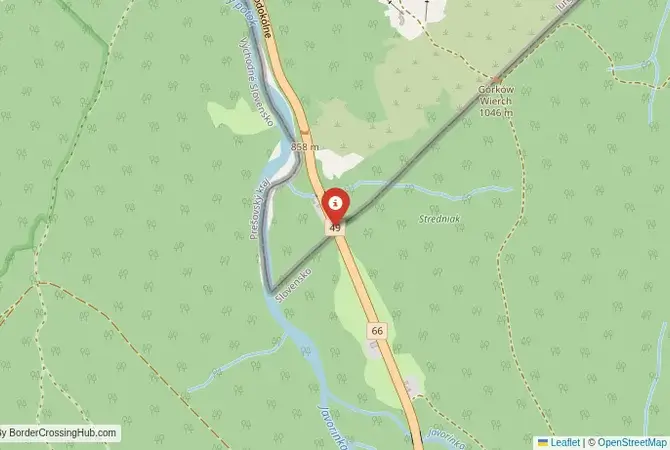
This checkpoint connects Slovakia's Prešov Region with Poland's Lesser Poland Voivodeship. It is a major regional road, open 24/7, and is one of the main gateways to the High Tatras. The former border posts are now abandoned or repurposed. Traffic flows freely, and the only signs of the border are the standard blue EU signs. The route is extremely popular with tourists year-round and can be heavily congested, especially during the winter ski season and the summer hiking season.
A History of a Contested Border
The history of this crossing is the history of the Tatra Mountains and the Goral people who inhabit them. For centuries, this was a remote, high-altitude border between the Kingdom of Hungary and the Kingdom of Poland. After World War I, the new border between Czechoslovakia and Poland was the subject of a bitter dispute, with both countries laying claim to parts of the Tatra region. The final border, arbitrated by the international community, divided the region, leaving the highest peaks on the Slovak side and the major resort town of Zakopane on the Polish side. The Schengen agreement has effectively erased this once-contested line for travelers, allowing the Tatra region to function as a single, integrated tourist destination.
Nearby Border Crossings
The Seamless Border Procedure
Today, there is no border procedure for travelers. You simply drive through the mountain pass. There are no passport checks and no customs inspections. This is the reality of the Schengen Area. However, it is important to remember that both Polish and Slovak police and customs authorities can and do perform random checks on vehicles anywhere in their territory, including near the former border. You are still required to carry a valid passport or national ID card with you at all times.
The Surrounding Region: Slovakia Side
On the Slovak side, the crossing is in the Spiš region. The nearby village of Tatranská Javorina has a beautiful wooden church and a hunting lodge that once belonged to a German prince. The crossing is a gateway to the Slovak High Tatras, with famous resorts like Tatranská Lomnica and Štrbské Pleso offering world-class hiking, climbing, and skiing. The beautiful Belianska Cave is also nearby. The historic town of Kežmarok, with its unique wooden articular church (a UNESCO site), is a short drive away.
The Surrounding Region: Poland Side
On the Polish side, the crossing is in the Podhale region, the heart of Polish Goral culture. The village of Jurgów has a beautiful historic wooden church. The crossing is very close to the major ski resort of Białka Tatrzańska and the popular thermal baths at Bukowina Tatrzańska. The main destination for most tourists is the town of Zakopane, the "winter capital of Poland," famous for its unique wooden "Zakopane style" architecture, its bustling Krupówki street, and its access to the Polish Tatra National Park.
Practical Travel Information
Practical planning for this route is very simple. The most important thing is to have the required motorway vignettes if your journey involves motorways in either country. Both Slovakia and Poland use an electronic vignette system, which must be purchased online in advance. The official currencies are the Euro (EUR) in Slovakia and the Polish Złoty (PLN) in Poland. Services are widely available in the tourist resorts on both sides. The mountain roads are well-maintained but can be extremely challenging in winter, with heavy snow and ice. It is essential to have appropriate winter tires and chains, and to check the weather and road conditions before you travel.
Final Considerations
The Podspády–Jurgów border crossing is a scenic and extremely popular route through the heart of the Tatra Mountains. The abandoned checkpoint buildings are a reminder of a divided past, while the free-flowing traffic is a celebration of the present. It offers a beautiful journey through a region rich in nature, recreation, and the unique Goral culture. It is a border that you might not even notice you have crossed, a testament to the success of the Schengen project in one of Europe's most beautiful and beloved mountain ranges.
View all border crossings between Slovakia and PolandPractical information
Fuel
Slovakia: 1 km - Poland: 1 km
Currency
Limited nearby EUR, PLN
Safety information
Low risk area
Connectivity
4G/5G coverage
Have you crossed here?
Help other travelers by sharing your experience, wait times, and any updates.