
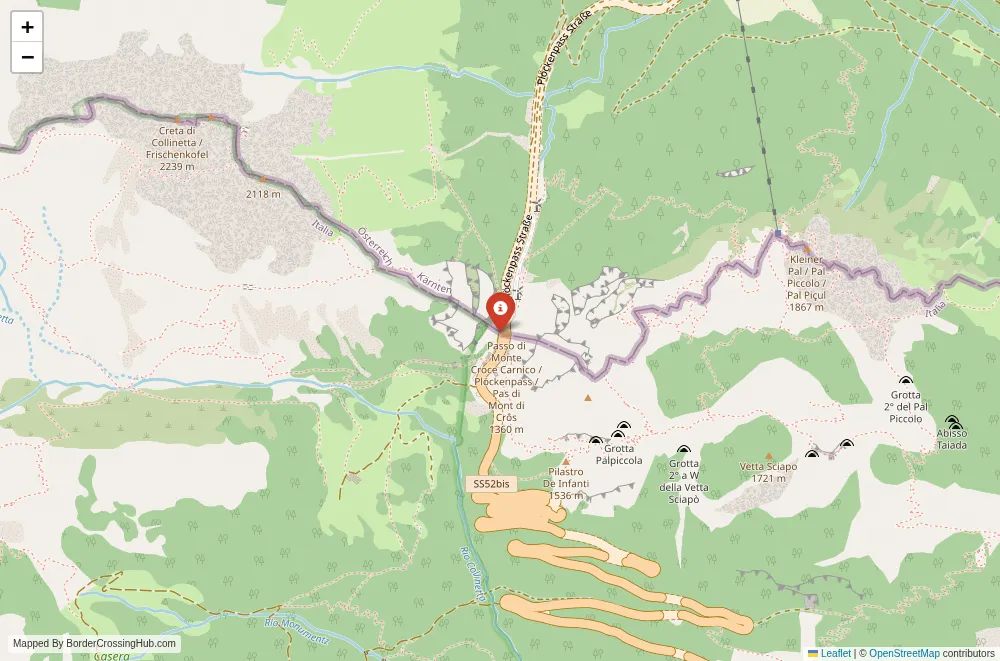
Approximate Border Location
Wait Times
Cars 0-10m; peaks 20-90m summer
Just crossed? Tap to report:
Operating Hours
Seasonal: 06:00 AM-10:00 PM
Crossing Types
Cars,bikes,ped; narrow pass road
Border Type
Land crossing via mountain road pass
Peak Times
09:00 AM-01:00 PM; Jul-Sep
Daily Crossings
500-3,000/day
Currency Exchange
EUR only; ATMs in Kötschach/Paluzza
Safety Information
Rockfall/weather closures possible
Languages Spoken
Italian/German
Accessibility Features
Limited; narrow shoulders
About Plöcken Pass & Timau
The Plöcken Pass (Italian: Passo di Monte Croce Carnico) carries you over one of the most dramatic and historic high Alpine crossings between Austria and Italy, connecting the Gailtal valley in Carinthia directly to the Carnia region of Friuli-Venezia Giulia.
Alternative Names
This point is known as Plöckenpass (German/Austrian), Passo di Monte Croce Carnico (Italian), Plöcken Pass / Monte Croce Carnico Pass, or simply the Plöcken border crossing. It is sometimes referred to as the Kötschach-Mauthen–Timau frontier.
Current Status and Safety Note
Austria and Italy are both in the Schengen Area, so this border has no permanent checkpoints, booths, or routine passport controls. You drive or cycle across without stopping under normal conditions. Austria continues temporary random spot checks at various Italian border points for migration and security reasons; these are selective, intelligence-based, and infrequent on this mountain pass. Italian customs may perform occasional targeted checks, especially on commercial vehicles. The road is a true alpine pass with steep gradients, narrow sections, sharp hairpins, rockfall risk, and significant elevation change. Snow, ice, and avalanches frequently close the road in winter. Always check current road status before attempting it.
Historical Background
The Plöcken Pass has served as an important trade and military route since Roman times, when it formed part of the Via Julia Augusta. In the Middle Ages it was a key link between the Duchy of Carinthia and the Patriarchate of Aquileia. During World War I the pass became a major front line between Austro-Hungarian and Italian forces; extensive trenches, fortifications, and open-air museums remain visible on both sides today (the Carnic Front museums are among the best-preserved WWI sites in the Alps). The modern road was substantially improved after 1918 when the border was redrawn following the Treaty of Saint-Germain.
Geopolitical and Economic Role
This is one of the few remaining public high Alpine crossings between Austria and Italy. It mainly serves tourism, winter sports (the Plöcken Pass is a popular ski touring and snowshoeing area), hiking, and local cross-border traffic. The pass connects the Gailtal (Kötschach-Mauthen area) with Timau and the Carnia region, supporting day-trippers, cyclists, and summer visitors. Heavy freight and long-distance transit mostly use the lower routes via Tarvisio/Fusine or the A23/A2 motorways.
Visa Requirements for Foreign Visitors
Schengen rules apply equally to Austria and Italy. If your nationality qualifies for visa-free entry, you cross with just a valid passport or national ID. Most non-EU visitors receive 90 days in any 180-day period across the area. Carry your travel document at all times, as random Austrian spot checks can occur anywhere in the border zone.
Crossing Procedures Step by Step
By car or motorbike, follow the B110 (Austria) from Kötschach-Mauthen up to the Plöcken Pass summit. You pass through the Austrian ski area and parking zones, reach the highest point (marked by a sign, small parking area, and WWI memorials), and continue down the Italian side on the SP 619 toward Timau / Paluzza without any stop, barrier, or booth. The border is unmarked except for a simple stone marker and the change in road signs/language. Pedestrians and cyclists use the same road (no separate path exists). No forms or officials are present routinely. The reverse direction follows the identical seamless pattern.
Typical Wait Times and Peak Periods
Wait times are zero most days. You cross instantly. During winter ski season (December–March) and peak summer weekends, traffic can build up at the summit parking areas and access roads, but there are no queues at the border itself. Random spot checks add only brief pauses if they occur.
Operating Hours
The road is open 24 hours a day when not closed by weather. In practice the pass is usually open from late May / early June to late October / early November (exact dates vary year to year). Winter closure is normal due to heavy snow and avalanche risk; no winter maintenance occurs on the summit section.
Transportation Options to and From the Border
Drive the B110 from Kötschach-Mauthen (Austria) or the SP 619 from Timau/Paluzza (Italy). No public buses cross the pass itself; local buses serve Kötschach-Mauthen and Paluzza but end well before the summit. Cycling is very popular (the climb is extremely demanding from both sides, ~1,000–1,200 m elevation gain). The nearest train stations are in Kötschach-Mauthen (Austria) and Carnia / Paluzza (Italy), both some distance from the pass.
Road Conditions and Scenery
The road is paved on both sides but narrow, steep, and winding with many tight hairpins. Gradients reach 10–12% in places. The Austrian side passes through alpine meadows and the small Nassfeld-like ski area near the summit. The Italian descent is steeper and more dramatic, dropping quickly into the deep Carnia valley. Views are outstanding: jagged Carnic Alps peaks, deep glacial valleys, alpine lakes (including the small Plöcken lakes), open pastures in summer, and vast snowfields in winter.
Seasonal Variations and Weather Impacts
Summer provides the only reliable access for most vehicles (June–October). Winter sees heavy snow and frequent avalanche risk; the road is usually closed from November to May. Even in shoulder seasons, sudden snow, fog, or ice can make the pass dangerous. Always check road status (Austria: verkehrsauskunft.at / anas.it or regione.fvg.it for Italy) and mountain weather forecasts.
Nearby Attractions
The summit area features excellent WWI open-air museums (especially the Carnic Front trails on both sides) with trenches, tunnels, artillery positions, and interpretive panels. The Plöckenhaus / Rifugio Fratelli Grego near the summit is a popular mountain hut. Timau (Italy) is known for its German-speaking community and historic mining heritage. Kötschach-Mauthen (Austria) offers a charming Gailtal town center. The Carnic Alps provide outstanding high-altitude hiking, via ferrata routes, and mountain biking on both sides.
Common Scams and Warnings
No notable scams exist at this remote pass. The main risks are weather-related: sudden storms, fog reducing visibility, rockfall, and winter ice/snow. The road is narrow with limited guardrails in places. Carry warm clothing, water, food, and a full tank. Do not attempt in bad weather or without checking road status.
Travel Tips and Preparation
Check real-time road conditions (Austria: verkehrsauskunft.at; Italy: anas.it or regione.fvg.it) and mountain weather forecasts. Bring passport/ID, warm layers, and offline maps. Fuel up in Kötschach-Mauthen or Paluzza. Cyclists should prepare for a very strenuous climb. The pass is an out-and-back route for most; continuing far into the other country requires planning for the long descent.
Cultural and Economic Significance
This crossing connects the Gailtal region of Carinthia with Carnia in Friuli-Venezia Giulia, supporting tourism (especially winter sports and WWI history) and local cross-border ties in a historically important Alpine transit zone.
Final Planning Advice
Confirm the pass is open and check weather/road conditions right before departure. Bring your documents, take the climb slowly, and savor the dramatic alpine scenery and WWI history. This high mountain crossing offers one of the most beautiful and least crowded ways to move between Austria and Italy. Safe travels.
No reviews yet.