Monthly Update (September 2026):
Pleebo & Tabou remains a smaller Liberia-Côte d'Ivoire crossing with no significant September closure identified. The route is primarily useful for local traffic in southeastern Liberia and western Côte d'Ivoire rather than for long-distance travelers. Rainy-season road conditions remain a practical concern on the approaches, where travel can be slower than the border formalities themselves. There is no major September change to report.
About this crossing
You will not find the scale of traffic seen at larger crossings like Niangoloko–Laléraba. Instead, this route reflects a more local rhythm, shaped by fishing, agriculture, and small-scale trade.
Regional Context and Historical Background
This part of the Liberia–Ivory Coast border has long been tied together by coastal and forest economies. Communities on both sides share cultural links that predate modern borders.
Nearby Border Crossings




During periods of instability in Liberia, crossings like this one played roles in movement and trade under challenging conditions. Today, the region is more stable, though development has been gradual.
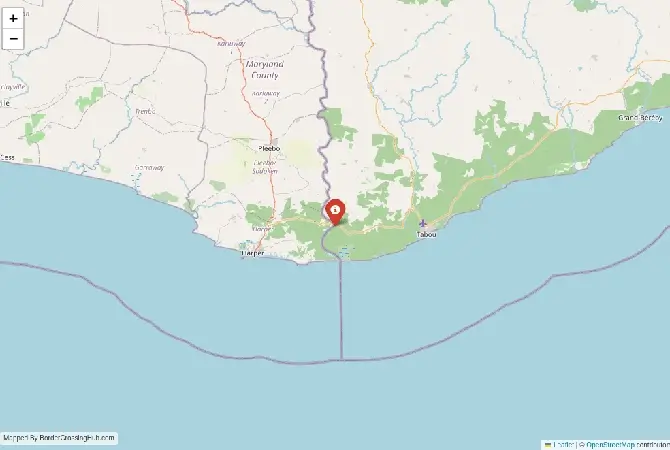
Tabou serves as a coastal town with access to fishing and trade routes, while Pleebo acts as a local hub in southeastern Liberia.
Border Facilities and Infrastructure
Facilities at this crossing are basic but functional. You will find small immigration offices rather than large border complexes.
Processing is mostly manual, with passport checks and record-keeping handled directly by officials. Electricity and communication systems may not always be consistent.
The layout is simple, though not always clearly marked. You may need to ask for directions to complete each step of the process.
Operating Hours and Availability
The border generally operates during daylight hours. Exact opening and closing times are not always clearly defined.
You should aim to arrive early in the day. Late arrivals can lead to delays or the need to wait until the following day.
Staff availability can vary, which affects how quickly the crossing process moves.
Visa Requirements and Documentation
You should prepare all documents before arriving.
For Liberia, most travelers require a visa obtained in advance.
For Ivory Coast, a visa is also typically required before arrival. Ivory Coast’s eVisa system is mainly designed for air travel, so you should confirm its use at land crossings.
A yellow fever vaccination certificate is mandatory for both countries and is often checked.
Carrying printed copies of your documents is strongly recommended.
Crossing Procedure and Wait Times
The process is straightforward: exit formalities on one side, then entry procedures on the other. The distance between checkpoints is short.
Wait times are generally reasonable. On a typical day, you might complete the crossing in 20 to 40 minutes.
Delays can occur if multiple travelers arrive at once or if staffing is limited, but overall the pace is manageable.
Road Conditions and Access
Reaching the Pleebo–Tabou crossing can be challenging. Roads in this region vary in quality, with some sections unpaved or poorly maintained.
During the rainy season, these roads can become muddy and difficult to pass. Travel times may increase significantly, and some areas may be temporarily inaccessible.
On the Ivory Coast side, access to Tabou is somewhat better, with connections to coastal routes, though conditions can still vary.
Public transport options exist but are limited. Shared taxis and minibuses may operate between towns, but direct routes to the border are not always available.
Seasonal and Environmental Factors
Weather plays an important role in travel conditions. The rainy season can disrupt access due to poor road quality and flooding in low-lying areas.
In the dry season, heat and humidity are the main challenges. Dust can also affect travel on unpaved roads.
The surrounding environment includes coastal areas, forests, and agricultural land, which adds to the region’s isolation.
Scams & Warnings
Although this is a quieter crossing, you should still remain cautious. Requests for unofficial payments can occur, particularly if officials assume you are unfamiliar with procedures.
You should remain polite but firm. Ask for receipts when fees are requested and avoid paying anything unclear.
Another common issue is unclear instructions. With limited signage, confirming each step of the process is important.
Local Atmosphere and Cross-Border Movement
The Pleebo–Tabou crossing reflects the daily life of nearby communities. You will likely see fishermen, traders, and families moving between the two countries.
Movement is often informal and tied to local needs rather than international travel. This creates a relaxed but unstructured atmosphere.
Language can vary. English is widely spoken in Liberia, while French is used in Ivory Coast, along with local languages.
Practical Tips for Travelers
You should carry enough water, food, and fuel, as services near the border are limited.
Mobile network coverage may be inconsistent, especially in rural areas. Having offline maps or written directions is useful.
Keeping your documents organized and accessible will help speed up the process.
Flexibility is essential, as delays and unexpected changes are always possible.
Final Thoughts
The Pleebo–Tabou crossing is a quiet but functional route between Liberia and Ivory Coast, shaped by coastal geography and local trade.
Closing Note
You should approach this crossing with preparation and patience. It is less busy than major border points, but the limited infrastructure means you need to stay attentive and adaptable throughout your journey.
View all border crossings between Liberia and Ivory CoastPractical information
Fuel
Liberia: 2 km - Ivory Coast: 2 km
Currency
LRD,XOF informal
Safety information
Coastal route, calm
Connectivity
2G/3G mobile network
Have you crossed here?
Help other travelers by sharing your experience, wait times, and any updates.