
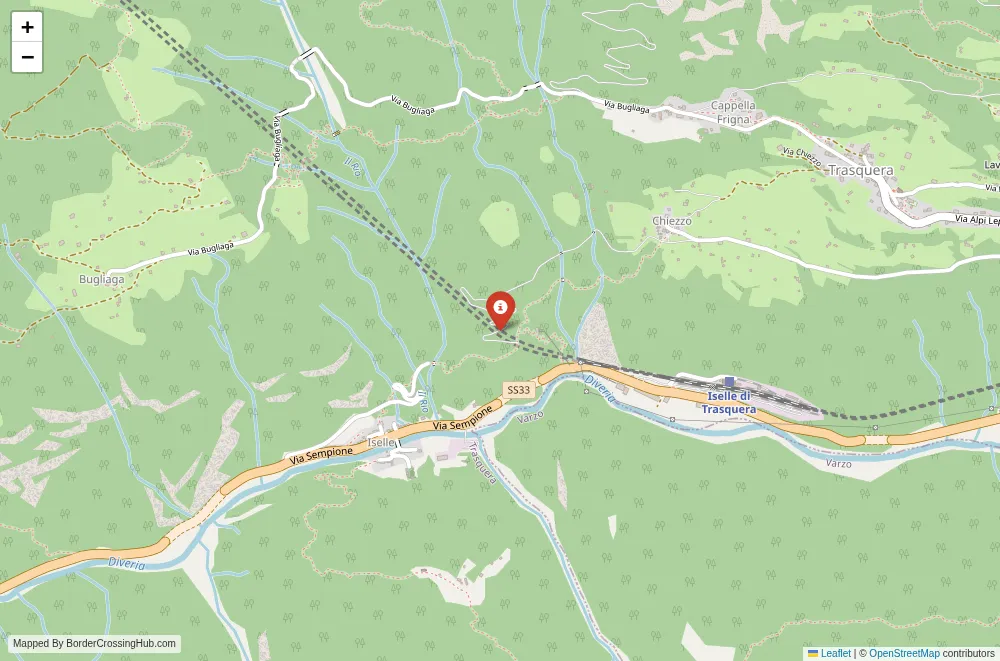
Approximate Border Location
Border Countries
- 🇮🇹Italy
- 🇨🇭Switzerland
Border Cities
- 🇮🇹Domodossola
- 🇨🇭Iselle di Trasquera
Wait Times
Cars 0-15m; peaks 20-120m tunnel traffic
Just crossed? Tap to report:
Operating Hours
Open 24 hrs (12:00 AM-11:59 PM)
Crossing Types
Cars,buses,trucks; Simplon corridor
Border Type
Land crossing via road (Simplon route)
Peak Times
Fri-Sun 09:00 AM-01:00 PM; summer
Daily Crossings
8,000-30,000/day
Currency Exchange
EUR; CHF in Domodossola/Brig; ATMs
Safety Information
Tunnel/bridge traffic; occasional checks
Languages Spoken
Italian/German
Accessibility Features
Accessible services at portals vary
About Piaggio Valmara & Brusimpiano
Monthly Update (March 2026):
As of 03/2026, the Piaggio Valmara & Brusimpiano Border Crossing remains calm with a steady trickle of local traffic. Cars pass easily along the lakeside road, though afternoons sometimes see a few more commuters heading into Switzerland. Pedestrians and cyclists appear regularly during warmer parts of the day. Tourism around Lake Lugano can add small bursts of movement.
No Cell Service at the Border? No Problem.
Don’t get caught scrambling for paperwork when you lose signal. Download the complete Europe Transit Guide directly to your device and access every critical detail, fast-track strategy, and border rule – 100% offline.
The Piaggio Valmara crossing places you at a small, lake-focused border point between Italy and Switzerland on the western shore of Lake Maggiore, where the road and a dedicated customs area connect the Italian side (near Cannobio) to the Swiss side (near Brissago).
Alternative Names
This point is known as the Valico di Piaggio Valmara, Confine di Stato di Piaggio Valmara, Piaggio Valmara customs crossing, or the Piaggio Valmara-Brissago border. It is sometimes referred to in nautical contexts as the dogana flottante (floating customs) for Lake Maggiore boats.
Current Status and Safety Note
Switzerland and Italy are both in the Schengen Area, so this border has no permanent fixed passport controls or routine checks for most travelers. You drive or boat across without stopping under normal conditions. Switzerland keeps temporary random spot checks at various Italian border points for migration and security reasons; these are selective, intelligence-based, and infrequent here. Italian customs may perform occasional inspections, especially on goods, boats, or commercial traffic. The crossing is generally safe, quiet, and used mainly by locals and lake users, with no notable reports of scams or issues for ordinary visitors. The road is narrow in places, so drive with care.
Historical Background
The border line along Lake Maggiore follows 19th-century agreements between the Kingdom of Italy and the Swiss Confederation. Piaggio Valmara has long functioned as a customs and control point for both road and lake traffic, especially before Schengen removed routine checks. The area was historically important for trade and, in earlier periods, smuggling across the lake. The customs infrastructure (including a floating dock for boats) reflects its dual role serving land and water crossings.
Geopolitical and Economic Role
This is a secondary crossing between the Piedmont region (Verbano-Cusio-Ossola province) and the Swiss canton of Ticino. It handles local road traffic and significant boat traffic on Lake Maggiore. Residents cross for shopping (cheaper fuel/groceries on one side, higher-quality or duty-free goods on the other), work, or leisure. The point supports tourism and lake navigation, with many private boats required to clear Italian customs here before entering Swiss waters.
Visa Requirements for Foreign Visitors
Schengen rules apply equally to Switzerland and Italy. If your nationality qualifies for visa-free entry, you cross with just a valid passport or national ID card. Most non-EU visitors receive 90 days in any 180-day period across the area. Carry your travel document at all times, as random Swiss spot checks can occur anywhere in the border zone.
Crossing Procedures Step by Step
**By car or motorbike:** Follow the Via Nazionale / SP 34 from Cannobio (Italy) toward Piaggio Valmara. You pass the Italian customs buildings (usually empty), cross the border line with no booth or stop, and continue into the Brissago area (Switzerland). No immigration or customs formalities are required for private vehicles. **By boat:** Private pleasure craft heading into Swiss waters must first stop at the Italian customs floating dock at Piaggio Valmara for clearance before proceeding. **Pedestrians and cyclists:** Use the road or paths; the crossing is short and unmarked beyond signs or markers. No forms or officials are present routinely for land crossings. The reverse direction follows the same seamless pattern.
Typical Wait Times and Peak Periods
Wait times are zero for road crossings most days. You pass through immediately. Boat clearance can take a few minutes when customs is staffed. Summer weekends and holidays bring more lake traffic and tourists, but road queues remain rare. Random spot checks add only brief pauses if they occur.
Operating Hours
The road crossing stays open 24 hours a day. Customs formalities for boats or goods are generally available during posted hours (often 7:00–24:00 daily, though exact times can vary). The public road remains accessible around the clock.
Transportation Options to and From the Border
Drive the Via Nazionale from Cannobio or Verbania (Italy) or from Brissago/Locarno (Switzerland). Local buses serve Cannobio and Brissago but rarely cross directly; a short walk or taxi may be needed. Boats are common on Lake Maggiore (private or charter); public ferries connect nearby towns but do not always stop exactly at Piaggio Valmara. Cycling works well along the lakefront roads.
Road Conditions and Scenery
The approach roads are narrow, paved lakefront streets with good surfaces but some tight sections. The crossing itself is low-key, with views of Lake Maggiore’s western shore, mountains, wooded slopes, and the open water. The landscape feels scenic and relaxed, with the lake dominating the horizon.
Seasonal Variations and Weather Impacts
Summer brings the heaviest boat and tourist traffic, with pleasant conditions. Winter rain, fog, or occasional snow can slow narrow roads, but the route stays open year-round. No major seasonal closures occur.
Nearby Attractions
Piaggio Valmara itself is a small customs and lake access point. Nearby Cannobio (Italy) offers a charming old town, lakeside promenade, and markets. Brissago (Switzerland) features the famous Isole di Brissago botanical islands (accessible by boat), a lakefront path, and quiet village atmosphere. The area suits lake boat trips, short walks, and cross-border relaxation.
Common Scams and Warnings
Serious scams are very rare here. Occasional overcharging can happen at roadside shops or fuel stations near the border. Random spot checks focus on vehicles/boats and rarely affect tourists. Normal lake and mountain driving precautions apply (watch for narrow roads and boat traffic).
Travel Tips and Preparation
Use navigation apps to follow the lakefront road. Carry your passport/ID and vehicle papers. Bring euros or Swiss francs (both accepted, though francs preferred on the Swiss side) and a card for purchases. If boating, check clearance procedures in advance. Combine the crossing with a boat trip to the Brissago islands or a drive along the lake shore.
Cultural and Economic Significance
This crossing sustains close ties between the western Lake Maggiore communities in Italy and Switzerland. Daily shopping, leisure boating, and family connections cross the line without notice, reflecting the practical unity of the lake region.
Final Planning Advice
Check for any temporary spot-check updates via official Swiss or Italian border sources if driving or boating. Bring your documents, cross the short lakefront road, and enjoy the smooth shift between Italian Piedmont and Swiss Ticino. This peaceful, scenic point offers a simple way to experience the Italy-Switzerland border along Lake Maggiore. Safe travels.
No reviews yet.