Monthly Update (October 2026):
Badovinci & Pavlovića Most is currently carrying more traffic than it was during quieter summer readings, but remains usable as an alternative to Rača. On October 6, monitoring showed about 57 minutes for passenger cars, compared with roughly 25 minutes at Rača after that crossing reopened from its truck-fire closure. The difference means Pavlovića Most was useful as a diversion during the incident, but is no longer the quickest option.
About this crossing
Operational Details
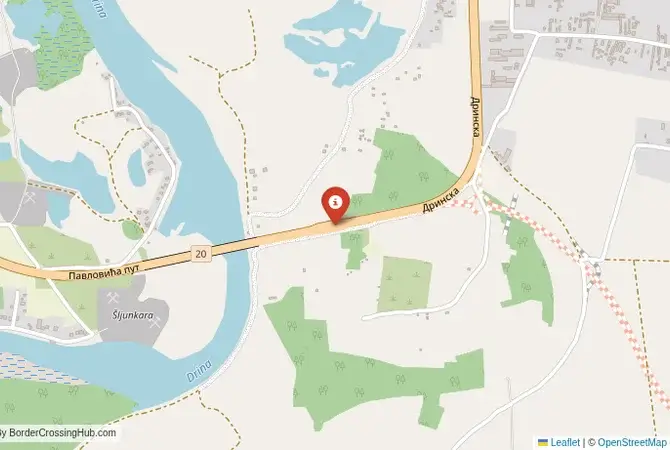
This checkpoint connects the Bijeljina Municipality of Bosnia and Herzegovina (within the Republika Srpska entity) with the Mačva District of Serbia. It is a major international crossing, open 24/7 to all passenger cars, buses, and commercial freight. The bridge, opened in the 1990s, and the modern checkpoint facilities provide a crucial alternative to the crossing at Rača, helping to alleviate congestion on the main Belgrade-Bijeljina route. The crossing is a vital link for the economies of the Semberija region in Bosnia and the Mačva region in Serbia; related expressway works toward Badovinci border (Slepčević-Badovinci section) ongoing with completion targeted by end-2025, per recent Serbian ministry updates, though no direct impact on current operations noted.
A History of a River Frontier and a Private Bridge
The history of this region is the history of the Drina River, which has been a border for centuries and was immortalized in the Nobel Prize-winning novel "The Bridge on the Drina" by Ivo Andrić. It has often been a turbulent frontier. During the Yugoslav era, it was an internal boundary. The breakup of Yugoslavia turned it into an international border. In the midst of the Bosnian War, Slobodan Pavlović, who had made his fortune in the United States, decided to build a bridge to connect the divided communities of his homeland. The "Pavlovića ćuprija" (Pavlović's Bridge) was a powerful symbol of connection in a time of intense division. It has since been integrated into the state road network and has become a key piece of regional infrastructure.
Nearby Border Crossings


Border Crossing Procedure
The border crossing procedure is a standard two-part process. You will first complete exit formalities at one country's checkpoint and then proceed across the bridge to the other country's checkpoint for entry inspection. You will need a valid passport or, for citizens of many European countries, a national ID card. Vehicle registration and international insurance (Green Card) are also necessary. The process is generally straightforward, and the modern facilities are designed to handle a steady flow of traffic. It is often a faster alternative to the busier Rača crossing; recent patterns from similar crossings show short waits in 2025-2026.
The Surrounding Region: Bosnia and Herzegovina Side
On the Bosnian side, the crossing is in the Semberija region, the breadbasket of Bosnia and Herzegovina. The nearby city of Bijeljina is the main commercial and agricultural center of the region. It is known for the beautiful St. Pantaleon's Monastery and the Etno Selo Stanišići, a large and popular ethno-village complex that showcases the traditional architecture and way of life of the region. The crossing is the main entry point for traffic heading from western Serbia towards the cities of Bijeljina and Tuzla.
The Surrounding Region: Serbia Side
On the Serbian side, the crossing is in the historic region of Mačva, a fertile plain between the Drina and Sava rivers. The road connects to the major industrial city of Šabac and provides a direct route to the capital, Belgrade. The region is known for the historic site of the Battle of Cer, the first Allied victory of World War I. The nearby town of Bogatić is known for its geothermal spa.
Practical Travel Information
Practical planning for this route is straightforward. The main road is well-maintained. The official currencies are the Bosnian Convertible Mark (BAM) in Bosnia and Herzegovina and the Serbian Dinar (RSD) in Serbia. Currency exchange facilities are available at the border. Services are widely available in the towns on both sides of the border. Ensure your vehicle's Green Card insurance is valid for both countries. This crossing is an excellent alternative to Rača, and it is always worth checking live traffic data for both to see which one is less congested; BorderAlarm or ams-rs.com cams offer real-time views.
Final Considerations
The Pavlovića Most–Badovinci border crossing is a vital economic artery with a unique origin story. It is a busy, functional checkpoint that serves as a gateway to the rich agricultural lands of both northeastern Bosnia and western Serbia. It is a testament to the power of an individual's vision to create a lasting piece of public infrastructure. For the modern traveler, it is a convenient and efficient passage across the historic Drina River, a bridge that was built on a dream of connection and has become an essential part of the region's reality.
View all border crossings between Bosnia and Herzegovina and SerbiaPractical information
Fuel
Bosnia and Herzegovina: <1 km - Serbia: <1 km
Currency
Limited kiosks; BAM, RSD
Safety information
Quiet rural crossing
Connectivity
3G mobile
Have you crossed here?
Help other travelers by sharing your experience, wait times, and any updates.