
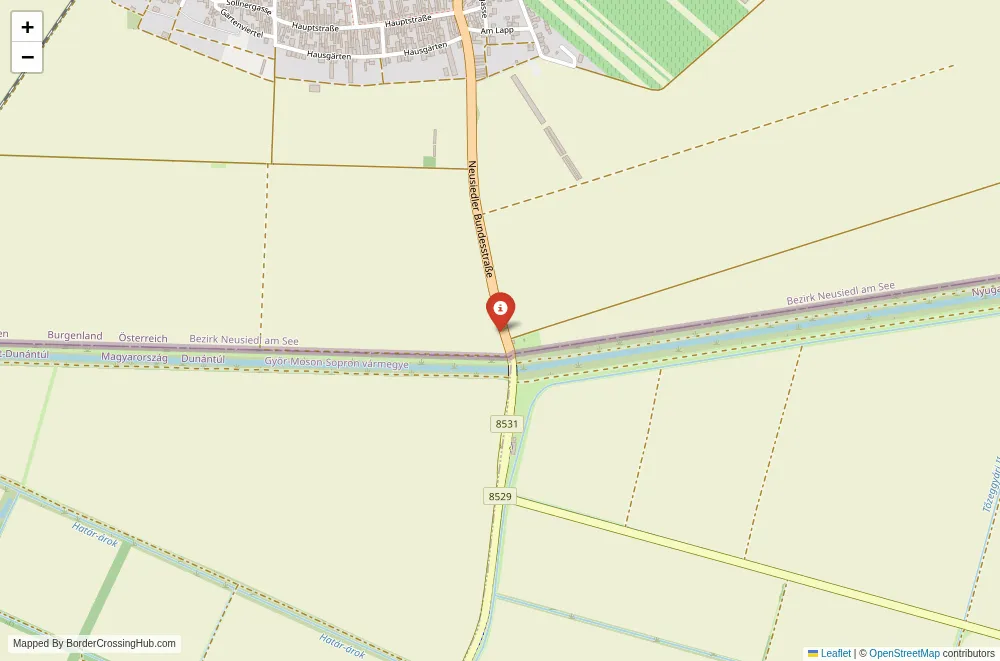
Approximate Border Location
Wait Times
Cars 0-10m; peaks 15-60m weekends
Just crossed? Tap to report:
Operating Hours
Open 24 hrs (12:00 AM-11:59 PM)
Crossing Types
Ped,cars,bikes,buses; no routine checks
Border Type
Land crossing via road (regional)
Peak Times
Sat-Sun 10:00 AM-04:00 PM; summer
Daily Crossings
3,000-12,000/day
Currency Exchange
EUR; HUF near Fertőd/Sopron; ATMs
Safety Information
Rural traffic; occasional police checks
Languages Spoken
German/Hungarian
Accessibility Features
Paved roads; curb cuts limited
About Pamhagen & Fertőd
The Pamhagen-Fertőd border gives you one of the most convenient and frequently used crossings between Austria and Hungary, connecting the small Austrian village of Pamhagen on the eastern shore of Lake Neusiedler See directly to the historic Hungarian town of Fertőd.
Alternative Names
This crossing is commonly known as the Pamhagen border, Fertőd határátkelő, the Pamhagen-Fertőd frontier, the B50 / 85-ös főút crossing, or simply the Neusiedler See / Fertő north border point.
Current Status and Safety Note
Austria and Hungary are both in the Schengen Area, so this border has no permanent checkpoints, booths, or routine passport controls. You drive, walk, or cycle across without stopping under normal conditions. Both countries occasionally carry out temporary random spot checks at various border points (Austria for security, Hungary for migration/smuggling), but these are infrequent and selective on this local road. The crossing is calm, well-maintained, and considered very safe, with locals crossing constantly for work, shopping, or lake activities. No widespread scams or notable safety issues are reported for ordinary travelers.
Historical Background
The border line here was established after World War I under the Treaty of Trianon (1920), which redrew Hungary’s western frontier and left the area around Lake Fertő/Neusiedler See divided between Austria and Hungary. Pamhagen became the Austrian border village, while Fertőd (famous for the Esterházy Palace) remained Hungarian. Before Schengen, this was a busy local customs point; today the old border infrastructure stands empty, and the frontier is practically invisible in everyday life.
Geopolitical and Economic Role
This crossing forms part of the highly integrated Austro-Hungarian frontier zone around Lake Neusiedler See / Fertő tó (a UNESCO World Heritage cultural landscape). It supports daily commuter flows, cross-border shopping (Hungarians often cross to Austria for services and higher wages; Austrians cross to Hungary for lower prices on fuel, groceries, dining, and wine), tourism, and family visits. The road links the Burgenland region (Austria) with the Fertő-Hanság area (Hungary), facilitating easy access to both sides of the lake.
Visa Requirements for Foreign Visitors
Schengen rules apply equally to Austria and Hungary. If your nationality qualifies for visa-free entry, you need only a valid passport or national ID card. Most non-EU visitors receive 90 days in any 180-day period across the area. Carry your travel document at all times, as random spot checks can occur anywhere in the border zone.
Crossing Procedures Step by Step
By car or motorbike, follow the B50 from Neusiedl am See or Pamhagen (Austria) toward Hungary. You pass the disused Austrian customs area, cross the unmarked border line with no booth or barrier, and continue straight onto the 85-ös főút (Road 85) into Fertőd (Hungary). Pedestrians and cyclists use the same road or adjacent sidewalks/paths; the transition is quick and subtle, usually just a change in road signs and language. No forms, immigration desks, or queues exist routinely. The reverse direction follows the identical seamless pattern.
Typical Wait Times and Peak Periods
Wait times are zero most days. You cross instantly. Morning and evening commuter hours, weekends, and summer holidays bring slightly more traffic (especially lake visitors and shoppers), but congestion remains light. Random spot checks add only brief pauses if they occur.
Operating Hours
The road crossing remains open 24 hours a day, every day of the year, as a public route.
Transportation Options to and From the Border
Drive the B50 from Neusiedl am See or Eisenstadt (Austria) or Road 85 from Fertőd / Sopron (Hungary). Regional buses connect Pamhagen to Neusiedl am See and Fertőd to Sopron, but direct cross-border buses are limited; a short walk across the road may be needed. Trains do not cross here; the nearest stations are Neusiedl am See (Austria) and Fertőszentmiklós (Hungary). Cycling is extremely popular along the lake’s excellent cycle paths.
Road Conditions and Scenery
The B50 / Road 85 is a good two-lane road with smooth surfaces. The border zone is flat and open, surrounded by farmland, vineyards, reed beds, and views toward Lake Fertő/Neusiedler See. The scenery is classic Pannonian plain: wide horizons, shallow saline lake wetlands, and a peaceful rural atmosphere.
Seasonal Variations and Weather Impacts
Summer brings the most leisure traffic (lake visitors, cyclists, birdwatchers) and pleasant conditions. Winter rain, fog, or occasional snow/ice can slow the road, but it remains open year-round. No major seasonal closures occur.
Nearby Attractions
**Austria:** Pamhagen offers lake access, the Neusiedler See cycle path, and the nearby Podersdorf am See beach area. **Hungary:** Fertőd is home to the magnificent Esterházy Palace (“the Hungarian Versailles”), one of the finest Baroque palaces in Central Europe, with beautiful gardens and concerts. The entire Fertő-Hanság region provides outstanding birdwatching (UNESCO site), hiking, and cross-border cycling routes around the lake.
Common Scams and Warnings
Serious scams are very rare at this quiet crossing. Some shoppers note occasional higher prices at border-area fuel stations or small shops. Random spot checks are brief and focus on vehicles. Normal precautions apply when parking or walking (keep valuables secure).
Travel Tips and Preparation
Use navigation apps to follow B50 / Road 85. Carry your passport/ID and vehicle papers. Bring Hungarian forints or euros (both widely accepted on both sides). The crossing is short and simple — many people cycle or walk between Pamhagen and Fertőd. Combine it with a visit to Esterházy Palace and a bike ride around Lake Fertő.
Cultural and Economic Significance
This crossing is a textbook example of deep cross-border integration in the Burgenland–Western Hungary region. Daily commuting, shopping, tourism, and family ties cross the line without notice, showing how Schengen has made the post-Trianon border practically invisible in everyday life around Lake Fertő/Neusiedler See.
Final Planning Advice
Check for any temporary spot-check notices if driving. Bring your documents, cross the short road, and enjoy the easy shift from Austrian Burgenland to Hungarian Fertő region. This peaceful, everyday crossing offers a simple and authentic way to experience the Austria-Hungary border. Safe travels.
No reviews yet.