
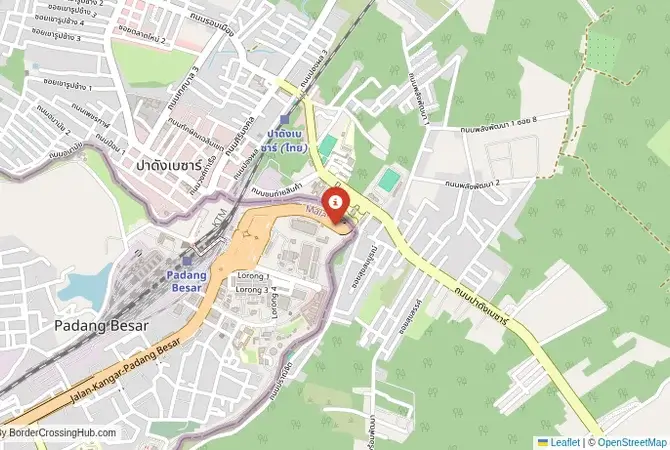
Approximate Border Location
Wait Times
15–30 min typical
Just crossed? Tap to report:
Operating Hours
Open 24 hours
Crossing Types
Pedestrians, vehicles, trains
Border Type
Land crossing via road/rail
Peak Times
7:00–10:00 AM, weekends
Daily Crossings
9,000–11,000 crossings
Currency Exchange
Exchange near Padang Besar (THB, MYR)
Safety Information
Safe, traffic moderate
Languages Spoken
Thai, Malay, English
Accessibility Features
Ramps, elevators
About Padang Besar & Padang Besar
Monthly Update (March 2026):
In recent weeks of 03/2026, the Padang Besar & Padang Besar Border Crossing stays lively with trains, cars, and freight trucks moving between Thailand and Malaysia. Passport checks usually move smoothly, though truck inspections can slow things down. Midday sees the most traffic. Cross-border trade and commuting shape the rhythm.
No Cell Service at the Border? No Problem.
Don’t get caught scrambling for paperwork when you lose signal. Download the complete Asia Transit Guide directly to your device and access every critical detail, fast-track strategy, and border rule – 100% offline.
The Padang Besar Crossing: A Town and a Railway Divided
The border crossing at Padang Besar is a unique and fascinating gateway between Thailand and Malaysia. Like the town of Hili on the India-Bangladesh border, Padang Besar is a single town that is bisected by the international frontier. The Thai part of the town is in Songkhla Province, while the Malaysian part is in the state of Perlis. This is both a road and a major railway crossing. The railway station itself is a unique piece of infrastructure, with the tracks and platforms straddling the border, and both Thai and Malaysian immigration and customs offices located within the same station complex. This crossing is a bustling hub of local commerce and a key transit point for travelers using the international train service that connects the two countries. The atmosphere is a vibrant mix of a classic border market town and a formal, international railway interchange, a place where you can feel the seamless blend of two cultures and the rigid formality of an international line in the very same space. It is a border that is not just a line to be crossed, but a destination in its own right.
A History of a Railway Frontier
The history of Padang Besar is the history of the railway. The town was created and developed in the early 20th century as a key station on the main railway line that the British built to connect their territories in Malaya with the railway network of Siam (now Thailand). The station was deliberately designed as a border interchange point. The 1909 Anglo-Siamese Treaty had already demarcated the border, and the railway was built to cross it here. For over a century, this has been the primary rail link between the two nations, a vital artery for both passengers and freight. The town grew up around the railway, its economy entirely dependent on the cross-border traffic. The road crossing was developed later but has always been secondary in importance to the railway. The unique, integrated nature of the railway station is a testament to the long history of cooperation required to keep this vital link operating smoothly. It stands as a monument to an era when railways were the primary instrument of economic development and geopolitical connection, a role it continues to play in the modern era of high-speed trains.
The Border Crossing Procedure: Two Options, Road or Rail
You can cross the border at Padang Besar by either road or rail. Both are open during daylight hours, with rail formalities integrated into station operations and road crossing handling local traffic efficiently.Crossing by Road: The road crossing is located in the center of the town. The process is straightforward. You will first go to the Thai immigration and customs post to get your passport stamped for exit. You will then walk or drive a very short distance to the Malaysian ICQS (Immigration, Customs, Quarantine and Security) complex. Here, you will go through Malaysian immigration, where your passport will be stamped (visa-free for many nationalities) and your fingerprints scanned. The customs check is usually brief. The road crossing is busy with local traffic and people on foot.Crossing by Rail: This is the more unique and popular option for long-distance travelers. The procedure is conveniently handled within the single, large railway station.
The International Train Services
The Padang Besar crossing is the key interchange for the international railway services. From Thailand, the State Railway of Thailand (SRT) operates a shuttle train service from the major southern city of Hat Yai to Padang Besar. From Malaysia, the modern, high-speed ETS (Electric Train Service) operated by KTMB runs from Padang Besar all the way to Kuala Lumpur and Gemas. This means a traveler can take the shuttle from Hat Yai, go through the border formalities at the station, and then board a comfortable, high-speed train to the heart of Malaysia. There is also the “International Express” which historically ran all the way from Bangkok to Padang Besar, though its schedule and operation should be checked in advance. Recent trials in 2025 of the cross-border “MySawasdee” tourist train (Padang Besar–Surat Thani) have paved the way for expanded services by late 2025/early 2026, including potential extensions and increased frequency. The train journey is a very comfortable and scenic way to travel between the two countries, offering a relaxed alternative to the highways. The seamless transition from the Thai railway system to the Malaysian one within a single station is a remarkable piece of logistical cooperation.
Final Planning Advice for the Railway Gateway
The Padang Besar crossing, particularly by rail, is a highly convenient and unique border experience. The ability to complete all immigration and customs for both countries within a single building is a major advantage. The key to a smooth journey is to know your train schedules and to have all your documents ready. Ensure you know the visa requirements for both countries. The town of Padang Besar itself is a bustling market, especially on the Malaysian side, famous for its large duty-free shopping complexes that attract shoppers from both nations. This crossing offers a fantastic blend of local border town energy and modern, efficient rail travel. It is an excellent choice for any traveler looking for a comfortable and interesting way to journey down the Malay Peninsula, a journey that is as much about the process and the history as it is about the destination.
No reviews yet.