
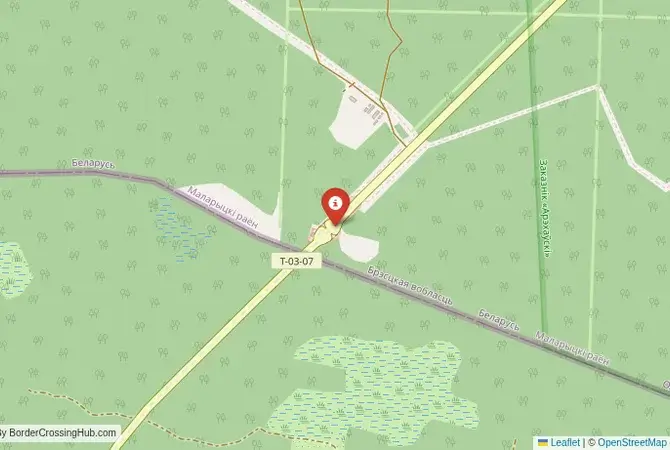
Approximate Border Location
Wait Times
20–60 min typical
Just crossed? Tap to report:
Operating Hours
6:00 AM–8:00 PM
Crossing Types
Pedestrians, vehicles
Border Type
Land crossing via road
Peak Times
7–10 AM
Daily Crossings
700–1,100 daily
Currency Exchange
Local exchange; BYN, UAH
Safety Information
Rural zone; low incident rate
Languages Spoken
Belarusian/Ukrainian
Accessibility Features
Ramps; partial assistance
About Oltuš & Pishcha
Monthly Update (April 2026):
Long quiet periods break up with the occasional vehicle passing through. During April 2026, Oltuš & Pishcha Border Crossing is mostly stable and very low traffic. Checks are present and can take time depending on procedures. Regional conditions influence how often it’s used.
No Cell Service at the Border? No Problem.
Don’t get caught scrambling for paperwork when you lose signal. Download the complete South America Transit Guide directly to your device and access every critical detail, fast-track strategy, and border rule – 100% offline.
A Closed Local Crossing
Important Note for Travelers: Due to the ongoing war in Ukraine and the volatile political situation with Belarus, this border crossing is closed and the entire region is a high-risk security zone. It is not operational as of early 2026. This guide is provided for historical and informational purposes only. The border crossing connecting the Belarusian village of Oltuš with Pishcha in Ukraine was a small, local checkpoint situated in the heart of the historic Polesie region. This was a route far from the main highways, a passage through a quiet landscape of forests, marshes, and small agricultural communities. It was not a crossing for international transit or heavy freight; its purpose was to serve the local populations on either side of the border, allowing for the continuation of family, social, and small-scale economic ties that have existed for centuries. To cross here was to experience the Belarusian-Ukrainian border at its most intimate and local scale.
Operational Details
This checkpoint connected the Brest Region of Belarus with the Volyn Oblast of Ukraine. It was a minor crossing with limited daylight operating hours and was restricted to passenger cars and local traffic. This ensured that the crossing remained a tranquil point of passage, in harmony with its peaceful, rural surroundings. Its existence was a nod to the needs of the local people, a recognition that life does not always follow the major arteries of a nation.
A History of the Polesie Region
The history of this region is the history of Polesie, a vast lowland that has long been a distinct cultural and geographic zone. The people of this area, known as Poleshuks, have their own unique traditions and dialects, shaped by the forested and often waterlogged environment. The region has been part of various larger states over the centuries, but it has always retained a strong local identity. The border established in the 20th century between the Belarusian SSR and the Ukrainian SSR divided this cohesive region. The Oltuš-Pishcha crossing was one of the small links that helped to mitigate this division, allowing people to visit relatives, tend to graves, or trade in local markets just a few kilometers away in another country.
Former Border Procedure
The border crossing procedure, when it was operational, was a simple and personal two-part process. Travelers would first complete exit formalities at the small Belarusian checkpoint at Oltuš. This involved a straightforward check of passports and vehicle documents by the border guards. They would then proceed to the Ukrainian entry checkpoint at Pishcha for inspection by the Ukrainian State Border Guard Service. A valid passport and vehicle documents, including international insurance (Green Card), were required. Given the very low volume of traffic, the process was typically very fast, with none of the queues or impersonal nature of the major international posts. It was a border crossing on a human scale.
The Surrounding Region
The surrounding area is deeply rural and known for its natural beauty. On both the Belarusian and Ukrainian sides, the landscape is a mosaic of pine forests, birch groves, agricultural fields, and wetlands. It is a region that appeals to those seeking to escape the cities and experience traditional village life. The crossing is located south of the main road to the Shatsk Lakes, but it served the communities in the immediate border area. The nearest town of any significance on the Belarusian side is Malaryta, and on the Ukrainian side, the town of Shatsk. The region is popular for foraging for mushrooms and berries, a traditional activity that is a key part of the local culture.
Closure Due to War
The closure of this crossing, like all others on the Belarus-Ukraine border, was an immediate and direct consequence of the full-scale Russian invasion of Ukraine in February 2022. Belarus’s complicity in the invasion turned the entire border into a hostile frontier. All checkpoints were sealed, and the area became a militarized zone. The small, peaceful crossing at Oltuš-Pishcha ceased to exist as a point of passage overnight, with the situation unchanged as of early 2026 due to the continued conflict.
Final Considerations
The Oltuš and Pishcha border crossing was a small but vital link for the local communities of the Polesian borderland. It was a testament to a time when border policy could accommodate the simple, everyday needs of people’s lives. Its closure is a tragic but necessary consequence of the war. The quiet country road that once connected neighbors now leads to a fortified and closed border. It is a poignant symbol of how major geopolitical conflicts have a devastating impact on the small, local connections that form the true fabric of a region, turning a familiar path into an impassable and dangerous frontier.
No reviews yet.