Monthly Update (September 2026):
Olbernhau & Brandov remains a quiet Ore Mountains crossing with no significant September disruption reported. Germany's temporary controls on the Czech frontier continue across the month, with a new notification taking effect September 16 after the current period expires. Travelers using this smaller route should carry valid identification and allow a little extra time in case of a spot check.
About this crossing
Location and Connections
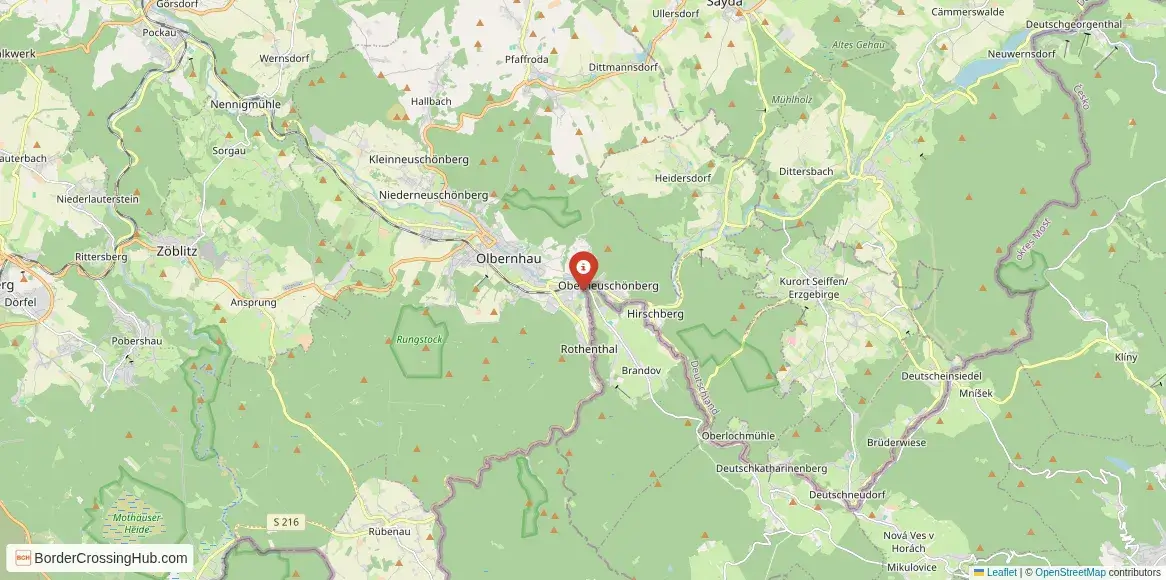
You reach this point along the German state road S207 (from Olbernhau via Satzung) which becomes Czech road 25271 after the border. Olbernhau lies about 15–20 minutes drive from the line, roughly 40–50 minutes from Chemnitz. On the Czech side, Brandov is 5–10 minutes from the summit, with onward access to Hora Svatého Šebestiána, Chomutov (about 45 minutes), or Most and the North Bohemian lignite basin. The road carries mostly cars, motorcycles, local vans, and occasional timber trucks; heavy lorries avoid the steep, winding climb. Cyclists and hikers frequently use the route as part of Ore Mountains cross-border trails. The pass reaches approximately 780–800 m above sea level, offering views over thick coniferous forest, rocky ridges, and distant valleys.
Alternative Names
It is commonly called the Olbernhau-Brandov border crossing, Brandov-Olbernhau Grenzübergang, or the S207 / 25271 crossing. In older maps or local usage you may still see references to the Zinnwald-Georgenfeld – Cínovec route farther east, but this is a distinctly separate point.
Nearby Border Crossings


Historical Background
The route has carried traffic since at least the 18th century, when it served as a smuggling and trade path for salt, timber, glass, and later coal between Saxony and Bohemia. After 1945 the border was heavily fortified as part of the Iron Curtain; the road remained closed to ordinary traffic until the early 1990s. Passenger and goods traffic restarted gradually after German reunification and Czech independence, with full Schengen openness in 2007. The nearby mining history is very visible: Olbernhau was once a centre of tin and silver mining, while Brandov and the surrounding area were linked to lignite and uranium extraction in the North Bohemian basin. Several abandoned customs buildings and watchtowers still stand near the line, now mostly overgrown or repurposed as sheds.
Geopolitical Context
Schengen membership since December 2007 normally means no routine passport or customs controls for EU citizens and visa-exempt travellers. Germany continues temporary border controls on all land borders with the Czech Republic due to migration, smuggling, and security concerns. As of February 10, 2026 these controls remain in force at least until March 15, 2026 (with frequent short-term extensions in previous years). Random Bundespolizei checks are possible, though this secondary mountain crossing sees far fewer inspections than major motorway points such as Rozvadov or Petrovice. No fixed booths or barriers exist. Always check the German Federal Police or Czech Interior Ministry websites for the latest status before travel, especially if planning a weekend or holiday trip.
Practical Crossing Procedures
You drive straight over the summit road; a simple border marker and sign indicate the transition. Under current temporary measures German police may stop vehicles shortly after entry for passport/ID verification, questions about travel purpose, length of stay, or a quick look at documents. EU citizens present passport or national ID card. Non-EU nationals carry valid passports, visas/residence permits if applicable, and basic supporting documents (accommodation booking, return ticket, sufficient funds). Vehicle insurance is required; no Czech vignette is needed for this non-highway road. Pedestrians and cyclists cross freely, although the road is narrow and traffic can be fast on descents.
Typical Wait Times
In normal conditions you cross in seconds. Random checks add variability: most vehicles are waved through quickly, but a detailed stop can take 10–40 minutes depending on questions and any queue. Because the road carries low volume, even during weekends or holidays delays rarely exceed half an hour. Early mornings or weekdays usually pass with minimal or no interruption.
Operating Hours
The road is open 24 hours a day, every day of the year. Schengen removed fixed closing times long ago. Heavy winter snow or ice can temporarily limit access, but the crossing itself does not close.
Transportation Options and Road Conditions
Your own car or motorcycle offers the best flexibility. No regular public buses cross here; the nearest are in Olbernhau or Hora Svatého Šebestiána. The S207/25271 is a well-surfaced two-lane mountain road with steep gradients (up to 10–12% in places), tight bends, and elevation gain of several hundred metres from Olbernhau. Pavement quality is generally good, but watch for fallen branches, deer, cyclists, and occasional timber lorries. The climb through dense forest feels remote, with frequent views over valleys and ridges.
Scams & Warnings
Scams are very rare at this low-traffic mountain crossing. No reports exist of touts, fake officials, or overpriced “help” services. Some border-area shops in Brandov sell cheaper fuel, tobacco, alcohol, groceries, or Asian goods to Germans; occasional complaints involve pushy vendors or unfavourable informal exchange rates. Keep valuables out of sight in parked cars. The winding mountain road demands careful driving, especially in wet, foggy, or icy conditions.
Nearby Attractions
Brandov offers basic services and a quiet starting point for hikes into the Krušné hory. Olbernhau features the Erzgebirgsmuseum (Ore Mountains museum) with exhibits on mining, wooden toy carving, and traditional crafts. Nearby hiking trails lead to summits such as the 890 m Hirtstein or cross-border paths toward Hora Svatého Šebestiána. The whole region is ideal for nature lovers seeking solitude, cross-country skiing in winter, or quiet exploration rather than major tourist crowds.
Seasonal Variations and Weather Impacts
Winter snow from December to March requires winter tyres and often chains on the steeper sections; fog and ice are common at altitude. Summer brings clear days, hikers, and motorcyclists. Autumn foliage colours the forest vividly while crowds thin out. Heavy rain or sudden storms can reduce visibility and make curves slippery, though full road closures for weather are uncommon.
Travel Tips and Preparation
Always carry passport or national ID due to possible random checks. Buy Czech vignette online only if you plan to continue on motorways (not required here). Fuel and shop on the Czech side for lower prices. Download offline maps for patchy mobile signal in the forest. Bring warm layers and water, as mountain weather changes rapidly. Check police websites or border info apps for real-time control status before departure. Stick to marked trails if hiking to avoid fines in protected areas.
Cultural and Economic Significance
The crossing supports modest cross-border shopping, tourism, and occasional local commuting. Germans buy cheaper Czech fuel, groceries, tobacco, and alcohol; Czech visitors head to German markets or the Ore Mountains trails. The route maintains ties between Saxony and northern Bohemia through shared mining heritage, joint trail maintenance, and environmental projects in the Krušné hory/Erzgebirge. Small local businesses on both sides rely on this quiet flow.
Before You Cross
Check the latest temporary control status on official German and Czech police websites shortly before departure. With preparation for possible random stops and awareness of mountain driving conditions, you handle this peaceful forested crossing and continue exploring the Ore Mountains on either side. Safe travels.
View all border crossings between Germany and Czech RepublicPractical information
Fuel
Germany: 2 km - Czech Republic: 2 km
Currency
EUR; CZK in Most/Olbernhau; ATMs
Safety information
Narrow streets; occasional checks
Connectivity
Wi-Fi points; 4G
Have you crossed here?
Help other travelers by sharing your experience, wait times, and any updates.