
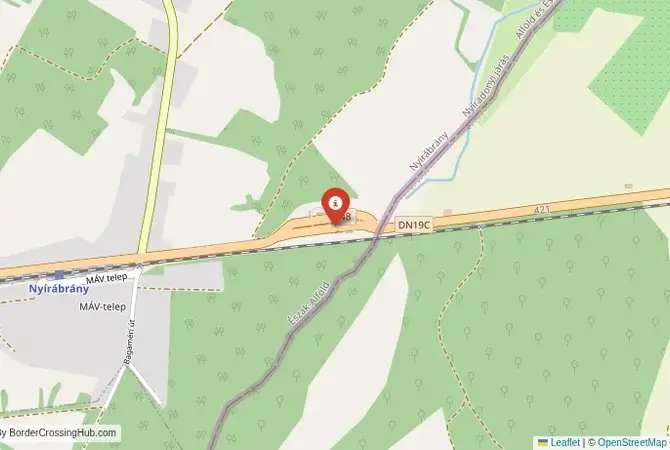
Approximate Border Location
Wait Times
10-50 min pedestrians/vehicles
Just crossed? Tap to report:
Operating Hours
6:00 AM-10:00 PM
Crossing Types
Pedestrians, vehicles
Border Type
Land crossing via road
Peak Times
7-10 AM
Daily Crossings
1500-2500 travelers/vehicles
Currency Exchange
Near Nyírábrány (HUF, RON)
Safety Information
Rural, low crime
Languages Spoken
Hungarian/Romanian
Accessibility Features
Ramps, assistance
About Nyírábrány & Valea lui Mihai
Monthly Update (April 2026):
Cars move through steadily, with short pauses at the checkpoint. During April 2026, Nyírábrány & Valea lui Mihai Border Crossing is mostly stable with mild variation. Traffic into Romania can take slightly longer. Weekends and local movement can bring small spikes.
No Cell Service at the Border? No Problem.
Don’t get caught scrambling for paperwork when you lose signal. Download the complete South America Transit Guide directly to your device and access every critical detail, fast-track strategy, and border rule – 100% offline.
General Overview
Positioned on the edge of the great Nyírség region of Hungary and the Crișana plain of Romania, the border crossing between Nyírábrány and Valea lui Mihai (known as Érmihályfalva in Hungarian) is a key local and regional link. It connects the area east of Debrecen, Hungary’s second-largest city, with the northern part of Romania’s Bihor county. Unlike the massive motorway crossings designed for trans-European freight, this checkpoint has a more practical, workaday character. It is a conduit for local commerce, cross-border commuters, and travelers exploring the specific cultural landscapes of the Partium region. Your journey through Nyírábrány is a passage through a landscape of sandy soils, forests, and agricultural lands, leading into a historically rich area of Romania defined by its thermal spas, vineyards, and enduring Hungarian cultural heritage. It represents a more textured and deliberate choice for travel between the two nations.
Historical and Geopolitical Context
The history of this region is inseparable from the city of Debrecen’s role as a historic center of Hungarian Protestantism and commerce, and the Partium region’s complex identity. For centuries, this entire area was an integrated economic and cultural zone within the Kingdom of Hungary. Valea lui Mihai and its surroundings were part of a vibrant agricultural and trade network centered on larger cities like Oradea (Nagyvárad) and Debrecen. The drawing of the border after the 1920 Treaty of Trianon was a profound disruption. It sliced through established railway lines and roads, turning neighboring towns into international frontiers. The railway line passing through here, once a vital local link, suddenly became an international route subject to complex regulations. During the Cold War, the border was sealed, a stark line of demarcation between Warsaw Pact allies with differing internal policies. The reopening and development of this crossing in the post-communist era were crucial for revitalizing local economies and reconnecting communities. Although both countries are now EU members, the persistence of land border checks (as Romania is not a full Schengen member for land travel) means that a formal procedure is still in place, a constant echo of the 20th century’s transformative impact.
Crossing Procedures and Wait Times
The Nyírábrány-Valea lui Mihai border crossing is a significant point of entry, operating 24 hours a day, 7 days a week for both passenger cars and international freight up to a certain weight limit. The process is systematic. Approaching from Hungary, you will first be processed by Hungarian Police for your exit from the Schengen Area. You will then proceed a short distance to the Romanian Border Police (Poliția de Frontieră) and customs checkpoint for entry procedures. For EU/EEA/Swiss nationals, a passport or a national ID card is required. For travelers from other countries, a passport is mandatory and will be stamped upon entry and exit. The officials here manage a consistent flow of local and regional traffic. Wait times can be longer here than at smaller local crossings, particularly during peak periods. Expect potential delays of 30-45 minutes during summer weekends (especially in August), major holidays like Easter and Christmas, and on weekday mornings and evenings when local commuters and freight trucks are most active. You can check real-time wait times on the Hungarian Police or Romanian Border Police websites before you travel.
Scam Awareness
While this is a professionally managed border crossing, you should remain aware of common issues that can affect travelers in the region. The most critical is the mandatory road vignette. Both countries require them for travel on motorways and most national roads. Purchase your vignette (‘e-vinjeta’ in Hungary, ‘rovinietă’ in Romania) only from official vendors, such as major petrol stations or designated offices at the border. Ignore anyone attempting to sell you one from the roadside, as you risk buying an invalid document or paying an inflated price. Secondly, be wary of currency exchange. While you may see informal money changers, their rates are typically unfavorable. For the best rates for Hungarian Forint (HUF) or Romanian Leu (RON), use a bank ATM in a nearby city like Debrecen or Valea lui Mihai. Lastly, some taxi drivers on either side may not use a meter for cross-border trips; always agree on a fare before you begin your journey to avoid being overcharged upon arrival.
Transportation Options
Traveling by car is the most practical way to use this crossing. In Hungary, Létavértes is accessible via Route 4814, which connects to the national road network leading to Debrecen (approximately 25 kilometers away). On the Romanian side, Săcuieni is situated on road DN19B, which provides a direct link to the city of Marghita and connects to the main DN19 road leading to Oradea and Satu Mare. The roads are paved two-lane highways that traverse a predominantly flat, agricultural landscape. There are no direct cross-border public bus or train services. While both Létavértes and Săcuieni are part of their respective national transportation networks, these services do not connect at the border. Therefore, relying on public transport would require complex and likely unreliable arrangements involving taxis on both sides of the frontier. The drive itself is pleasant, offering a view of rural life in this part of the Great Plain.
Nearby Attractions and Tips
The proximity to Debrecen makes this crossing a starting point for exploring Hungary’s “Calvinist Rome.” Debrecen boasts the iconic Great Reformed Church, the Déri Museum with its monumental Munkácsy paintings, and a lively city center. Just east of the city, the Erdőspuszta (Forest Steppe) offers a network of trails and recreational activities. On the Romanian side, Valea lui Mihai is known for its thermal waters and is part of a region dotted with spas. The nearby town of Săcueni has a historic castle, while a drive south towards Oradea (about an hour away) is highly recommended. Oradea is one of Romania’s most beautiful cities, famous for its stunning collection of Art Nouveau architecture, a vibrant riverside promenade, and a historic fortress. A useful tip for this region: Hungarian is widely spoken on the Romanian side of the border in towns like Valea lui Mihai, a reflection of the area’s history and demographics.
Seasonal and Weather Considerations
The region experiences a continental climate with hot summers and cold winters. From June to August, temperatures frequently rise above 30°C (86°F), and summer thunderstorms are common. Winter months, from December to February, are cold, with temperatures often falling below 0°C (32°F), along with frost and occasional snowfall. While the crossing remains open, be prepared for potentially icy conditions on local roads. The most pleasant times to travel are spring (April-May), when the landscape is green and blooming, and autumn (September-October), during the grape harvest season. Fog can be an issue in the mornings, especially in autumn, so exercise caution and allow for extra travel time if you are driving early in the day.
Planning Your Crossing
Given its 24/7 operation and freight traffic, it’s wise to check online for current wait times before you depart, especially if traveling during peak holiday seasons. Ensure you have your passport or ID card, vehicle registration, and insurance documents. Remember to budget for and purchase the required road vignettes for both countries. This crossing is an excellent, logical choice for anyone traveling from northeastern Hungary to northwestern Romania, particularly for those whose journeys originate or terminate in the major cities of Debrecen and Oradea. It balances good infrastructure with a direct route into the culturally distinct Partium region of Romania.
No reviews yet.