Monthly Update (August 2026):
Ngwenya–Oshoek remains one of the busier South Africa–Eswatini crossings, with August travel adding to the regular commuter and commercial flow. There has been no major new restriction at the border, while South Africa's heightened attention to border security continues to be noticeable around its major ports. For travelers, Oshoek remains the main and generally straightforward gateway into Eswatini from the N17 corridor.
About this crossing
A History on a Main Artery
The history of this crossing is the history of the modern state of Eswatini and its deep and indispensable relationship with South Africa. The border is a colonial legacy, a line drawn by the British between their protectorate of Swaziland and the Boer republic of the Transvaal. The route through Oshoek and Ngwenya has always been the most direct path from the major population and industrial centers of South Africa to the Swazi capital. As such, it grew into the most important checkpoint. The crossing's importance was magnified by the development of the Ngwenya iron ore mine in Eswatini, which was one of the first major industrial projects in the country. A railway line was built from the mine to the port of Maputo, but the road to South Africa remained the key link for all other goods and for people. In the post-apartheid era, the crossing has become a major symbol of the deep economic integration between the two countries, who are both members of the Southern African Customs Union (SACU). The border facilities have been extensively modernized to handle the huge volume of traffic that is the lifeblood of the Swazi economy. It is a border that has evolved from a simple colonial outpost to a major, modern piece of regional infrastructure.
The Border Crossing Procedure: A Modern and Busy Process
The border is open 24 hours a day. The process is known for being very smooth, professional, and efficient, but the high volume of traffic, especially trucks, can lead to queues and delays, particularly on weekends and public holidays. Exiting South Africa (Oshoek): You will arrive at the large and modern South African border post. You will go to the immigration hall and get your passport stamped for exit. The customs process for vehicles involves checking your registration papers. The officials are professional and the process is generally quick. The No-Man's-Land: After clearing the South African side, you will drive a short distance through the hilly no-man's-land to the Eswatini side. Entering Eswatini (Ngwenya): You will arrive at the large and modern Eswatini border post. You will go to the immigration office. For most nationalities, Eswatini offers visa-free entry. The officer will check your passport and provide an entry stamp. After immigration, you will proceed to the customs and road authority offices. If you are in a vehicle, you will need to pay a road tax. You will also need to have third-party insurance for Eswatini, which can be purchased at the border if your existing policy is not valid. The officials are known for being friendly and welcoming, and the process is generally hassle-free.
Nearby Border Crossings


Route, Onward Travel, and The Ezulwini Valley
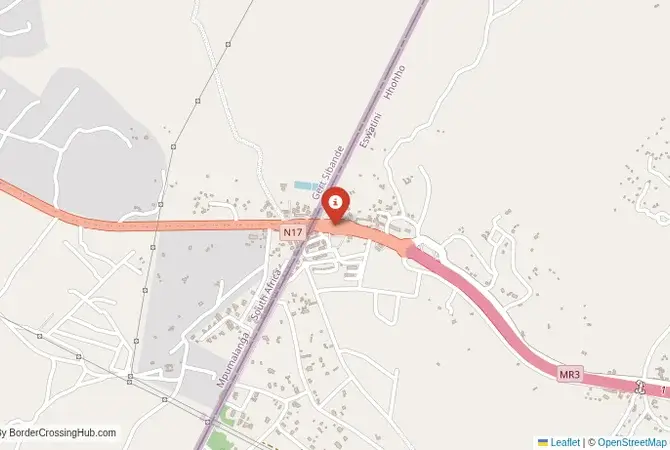
This crossing is on the main MR3 highway. On the South African side, the road connects to the N17 highway from Johannesburg. On the Eswatini side, the road from the border is a world-class, multi-lane highway that descends dramatically into the beautiful Ezulwini Valley, the cultural and tourism heartland of the kingdom. The capital city, Mbabane, is just a few minutes' drive from the border. The Ezulwini Valley, located between Mbabane and the main city of Manzini, is home to most of the country's major hotels, craft markets, and tourist attractions, including the Mlilwane Wildlife Sanctuary. For those without a car, there are numerous direct, high-quality international bus services that run from Johannesburg and Pretoria to Mbabane and Manzini. This is a very comfortable, convenient, and highly recommended option. The crossing is the main gateway for all trade and travel between the two countries' main economic centers. The Ngwenya Glass factory, a famous tourist attraction known for its beautiful, recycled glassware, is located right at the border on the Eswatini side and is well worth a visit.
Final Planning Advice for the Main Gateway
The Oshoek-Ngwenya crossing is a modern, efficient, and very busy border. It is the main and best gateway for overland travel from the economic heart of South Africa into the Kingdom of Eswatini. The key to a successful crossing is to have all your documents in order, especially your vehicle registration and cross-border authorization letters if you are driving. Taking one of the direct international bus services is an excellent, hassle-free alternative. The 24-hour operation of the border provides great flexibility for travelers. This crossing is a smooth and easy passage into the beautiful highlands of Eswatini. It is a border that works, a testament to the excellent infrastructure and professional relationship between the two countries, and a perfect, stress-free gateway for any overland journey into the unique and beautiful Kingdom of Eswatini. It is the grand entrance to a land of rich culture and stunning scenery.
View all border crossings between South Africa and EswatiniPractical information
Fuel
South Africa: <1 km - Eswatini: <1 km
Currency
Available near Oshoek (ZAR, SZL)
Safety information
Generally safe, traffic moderate
Connectivity
Wi-Fi at checkpoints, 4G
Have you crossed here?
Help other travelers by sharing your experience, wait times, and any updates.