
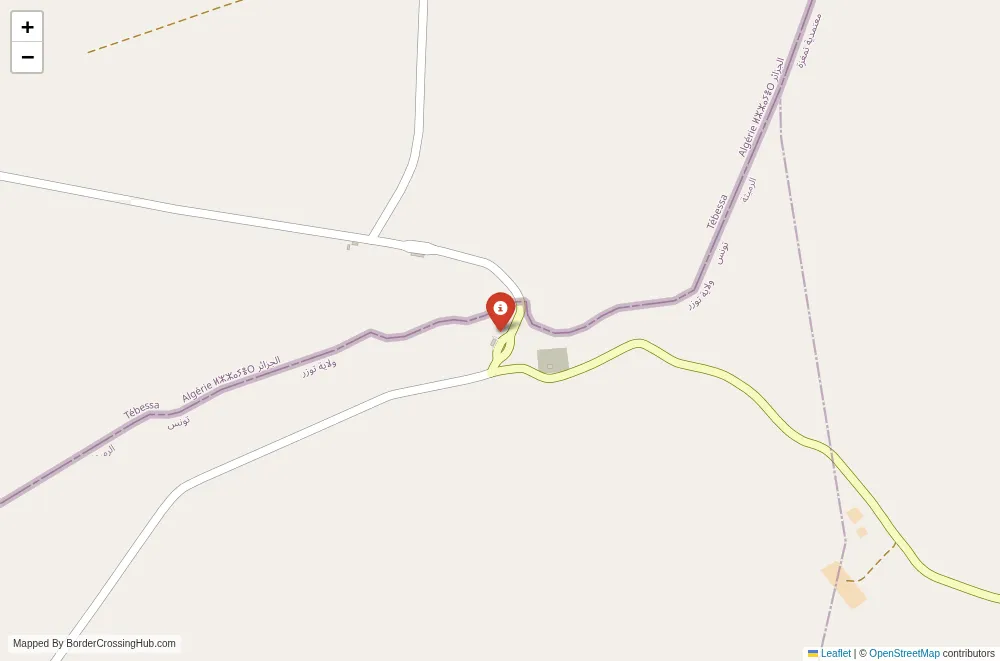
Approximate Border Location
Wait Times
Cars 15-75m; peaks 90-240m
Just crossed? Tap to report:
Operating Hours
07:00 AM-07:00 PM
Crossing Types
Ped,cars; limited buses; controls
Border Type
Land crossing via road (local)
Peak Times
09:00 AM-01:00 PM; summer
Daily Crossings
500-3,000/day
Currency Exchange
TND; DZD; EUR common; cash only
Safety Information
Remote oasis route; checks possible
Languages Spoken
Arabic, French
Accessibility Features
Uneven surfaces; minimal ramps
About Mwenda & Nakonde
Monthly Update (March 2026):
As of 03/2026, the Mwenda & Nakonde Border Crossing sees moderate trade traffic moving between DR Congo and Zambia. Trucks often gather in small queues while inspections work through paperwork. Passenger vehicles typically pass faster. Regional trade and market runs keep the crossing steadily active.
No Cell Service at the Border? No Problem.
Don’t get caught scrambling for paperwork when you lose signal. Download the complete Africa Transit Guide directly to your device and access every critical detail, fast-track strategy, and border rule – 100% offline.
The Mwenda-Nakonde border crossing operates as a minor and often informal land connection between the Democratic Republic of the Congo and Zambia, positioned in the extreme southeast of the DRC’s Haut-Katanga Province and the northern tip of Zambia’s Muchinga Province. You reach this point only if traveling through exceptionally remote and challenging terrain, typically from Pweto or Kilwa in the DRC toward Nakonde or Isoka in Zambia, or as part of rare overland routes linking Lubumbashi in the DRC to northern Zambia. Alternative names include the Mwenda Border Post (DRC side), Nakonde Border Post (Zambia side), or simply the Mwenda-Nakonde crossing (sometimes confused with the nearby official Nakonde-Kasumbalesa post farther west).
Location and Basic Connection
Mwenda lies on the DRC side near the small settlement in the Pweto Territory, close to the eastern shore of Lake Mweru and the Luapula River system that forms part of the boundary. Nakonde sits across in Zambia’s Nakonde District, near the town of Nakonde but distinct from the main Nakonde-Kasumbalesa post. The crossing connects rudimentary dirt tracks and footpaths through dense miombo woodland, seasonal floodplains, and gallery forests along the Luapula/Mweru basin. It handles almost exclusively local foot traffic, bicycles, motorcycles, and very occasional dugout canoes or 4×4 vehicles in an area of low population density and near-total absence of commercial infrastructure.
Historical Background
The border follows the Luapula River and Lake Mweru system as defined by colonial agreements between Belgian Congo and British Northern Rhodesia in the early 20th century. The region remained sparsely administered, used mainly by Lunda, Bemba, and Tabwa communities for fishing, farming, and cross-border kinship. During the Congo Crisis (1960-1965) and later Katangese secessionist movements, the area saw refugee flows and rebel movements across the lake and river. Post-independence conflicts in both countries kept the frontier unstable, with informal crossings persisting despite official posts being farther west at Kasumbalesa-Nakonde. In recent years, the zone has been affected by spill-over from eastern DRC conflicts and occasional LRA remnants, though the immediate Mwenda-Nakonde area has seen relative quiet compared to other frontiers.
Current Operating Status
As of early 2026, the Mwenda-Nakonde crossing operates informally and intermittently, with no fixed hours, permanent structures, or reliable official presence on either side. Access depends entirely on local security conditions, community arrangements, and the absence of active militia activity in the Luapula-Mweru basin. When functional, it operates roughly from dawn to dusk (approximately 06:00 to 18:00 local time, UTC+2). Both the DRC and Zambia require pre-obtained visas for most nationalities (no visa-on-arrival at this post). The crossing sees almost exclusively local fishermen, small traders, and cross-border families; foreign use is virtually nonexistent and strongly discouraged. Numerous governments classify the Haut-Katanga frontier and northern Zambia border zones as high-risk due to armed groups, banditry, and lack of any consular or emergency support. Recent reports from late 2025 and early 2026 note continued low-level insecurity in Pweto Territory and occasional cross-border smuggling. Verify through humanitarian organizations, embassies, or local contacts, but expect that access is effectively impossible for most travelers.
Practical Crossing Procedures
You cross by foot, bicycle, motorcycle, or dugout canoe across the Luapula River or adjacent wetlands. From the DRC at Mwenda, any exit formalities (if officials are present) involve basic passport checks at a temporary or village-based post. Proceed across unmarked bush tracks or river crossings (several kilometers of no-man’s-land) to Nakonde in Zambia for entry. South Sudan requires pre-obtained visa, registration with police within days of arrival, and explanations of purpose. Both sides may involve military, local chiefs, or self-appointed “officials” questioning. Bring multiple passport copies, cash in USD or local currencies (Congolese franc in DRC, Zambian kwacha in Zambia), yellow fever vaccination proof, and malaria prophylaxis documentation. The entire process can take hours or days depending on official presence, local commanders, or spontaneous roadblocks. No facilities exist beyond perhaps a shade tree or mud hut.
Wait Times and Peak Periods
No queues exist; you may wait hours or days for officials or clearance. Movement peaks during dry-season fishing or market days in nearby villages, but even then activity stays minimal. Insecurity can halt everything for weeks or months.
Transportation Options
No public transport reaches either side. From the DRC, 4×4 or motorcycle from Pweto or Kilwa is required. In Zambia, tracks lead from Nakonde or Isoka. You must arrange private transport with local drivers who know the bush paths and current security situation. Fuel, spare parts, and water must be carried for days.
Scams and Safety Warnings
Scams are secondary to the overwhelming security threats. Armed groups, local militias, bandits, and occasional LRA remnants operate in the region. Kidnapping for ransom, ambushes, and forced recruitment remain documented risks. Both countries lack effective control in this tripoint zone; travelers have disappeared or been held for weeks. Humanitarian access is heavily escorted and limited. Virtually every government advises against all travel to Haut-Katanga Prefecture in DRC and northern Zambia border zones, with no consular support available. The isolation means no quick evacuation or medical help exists.
Road Conditions and Scenery
No real roads exist; the route consists of dirt tracks, footpaths, seasonal river crossings, and swampy areas through dense forest, tall grass, and gallery forests. Scenery includes thick woodlands along the Luapula, open savanna patches, small fishing villages with thatched huts, and abundant wildlife (monkeys, antelope, occasional hippos). Rain turns tracks into mud; dry season exposes deep ruts and dust.
Seasonal Variations and Weather Impacts
Dry season (May-October) offers the only realistic window with passable tracks. Wet season (November-April) brings heavy rain, flooding, malaria spikes, and near-impassable conditions. Insecurity overrides seasons, with ambushes more common during dry months when visibility is better.
Nearby Attractions
Bambouti and Ezo offer only the most basic rural life and glimpses of Azande or other local cultures. The surrounding forests and savanna hold potential for wildlife viewing, but insecurity makes exploration impossible for outsiders. The area appeals only to conflict researchers or humanitarian workers with heavy security.
Cultural and Economic Role
Minimal cross-border trade in salt, fish, livestock, and basic goods sustains the crossing for local families. It enables rare family visits and traditional movements across the bush. The post represents one of the most marginal frontiers in Africa, used almost exclusively by those who live in the immediate vicinity.
Final Planning Tips
This crossing is not recommended for any non-essential travel. If unavoidable (humanitarian, research), travel only with experienced local guides, armed escort if possible, satellite communication, and full embassy notification. Carry extensive medical supplies, cash in small denominations, and multiple means of identification. Attempt only during dry season and with real-time security updates. Most experienced overlanders avoid this entire region entirely.
Wrapping Up the Crossing
Bambouti-Ezo remains one of the most isolated and dangerous formal border points in Africa, shaped by persistent insecurity and near-total lack of infrastructure. Approach only with extreme caution, exhaustive preparation, and acceptance of serious risks, or avoid entirely. Safe travels—if you must go.
No reviews yet.